
Comstock Resources' Volatile Surge: Valuation Realism and Operational Risks in the E&P Sector
The recent multi-year price surge in Comstock ResourcesCRK-- (CRK) has captivated investors, but beneath the surface lies a complex interplay of valuation extremes and operational execution risks. As the energy sector grapples with macroeconomic headwinds and shifting demand dynamics, CRK's story demands a closer look at whether its lofty multiples are justified-or if they hint at a precarious disconnect between price and fundamentals.
Valuation Realism: A Tale of Two Multiples
Comstock Resources' valuation metrics stand in stark contrast to industry benchmarks. As of December 2025, the company trades at a , dwarfing the S&P 500 Energy Sector's average of 17.04x and the U.S. according to WorldPeratio data. This disconnect suggests that investors are pricing in aggressive growth expectations, potentially overlooking the sector's historical volatility. Meanwhile, CRK's enterprise value-to-EBITDA (EV/EBITDA) multiple of 14.9x as reported by NYU Stern's data. Such a premium implies that the market views CRKCRK-- as a high-growth outlier, but this optimism must be tempered with scrutiny.
The company's according to multiples.vc analysis appears more aligned with industry norms, yet it still raises questions. per multiples.vc data, the disconnect between revenue and EBITDA multiples hints at a reliance on earnings growth rather than operational scalability. In an E&P sector where cash flow stability is paramount, this could be a red flag.
Operational Execution: Costs, Debt, and Hedging Gambles
Comstock's operational profile offers a mixed bag. Production costs averaged , as reported in Q3 2025 earnings. These figures position CRK as a low-cost producer, a critical advantage in a sector where margin compression is a perennial risk. However, the company's reserve replacement rate remains opaque, with no explicit data in Q3-Q4 2025 filings per investor filings. While 28 wells were turned to sales in 2025 in the Legacy Haynesville area as per Q3 earnings, the absence of formal reserve replacement metrics raises concerns about long-term production sustainability.
On the balance sheet, CRK's according to Yahoo Finance is a marked improvement from past levels, bolstered by the $430 million divestiture of its Shelby Trough assets as reported in Q3 2025 financials. This liquidity boost, per financial release, paints a picture of a leaner, more agile company. Yet the hedging strategy tells a different story. While Q3 2025 saw as reported in Q3 earnings, Q1 2025 reported $8.0 million in losses. This volatility underscores the risks of relying on hedging to smooth cash flows, particularly in a market where price swings are inevitable.
The Haynesville Play: A Double-Edged Sword 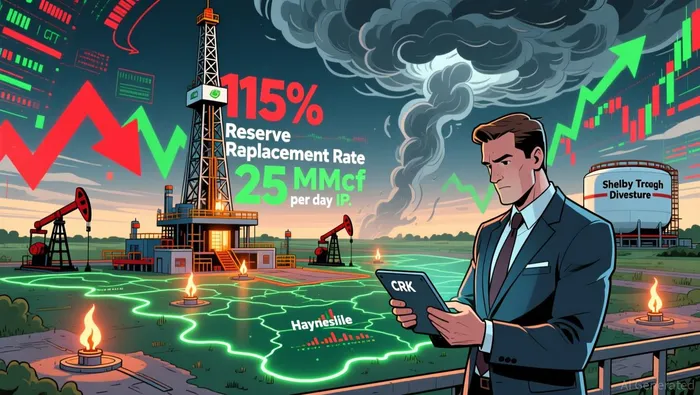
CRK's focus on the Haynesville Shale-a low-cost, high-IP natural gas basin-has been a key driver of its recent success. The region's 25 MMcf per day average initial production rates per Q3 2025 financials and long lateral lengths (11,919 feet) as reported in earnings suggest a robust asset base. However, the company's strategic pivot to divest non-core assets like Shelby Trough as reported in Q3 earnings signals a shift toward capital efficiency over scale. While this aligns with its goal of a according to SWOT analysis, the lack of concrete data on achieved rates leaves room for skepticism.
Risks and the Road Ahead
as per macroeconomic data suggests a market still pricing in recovery, but CRK's multiples are straining the limits of realism. For every $1 of EBITDA, , a premium that demands consistent execution. If production costs rise or reserve replacement falters, the stock's valuation could face a harsh correction. Additionally, while CRK's debt reduction is commendable, its according to Finimize may not insulate it from broader sector downturns.
Conclusion: A High-Stakes Bet
Comstock Resources' Haynesville-focused strategy and cost discipline are undeniably compelling. Yet the current valuation-especially the P/E and EV/EBITDA multiples-reflects a level of optimism that may not be fully supported by operational data. Investors must weigh the company's short-term liquidity and low-cost position against the risks of overvaluation and uncertain reserve replacement. For now, CRK remains a high-conviction play, but one that demands constant vigilance.







Comentarios
Aún no hay comentarios