
Comstock's Acquisition of Haywood Quarry and Its Strategic Implications
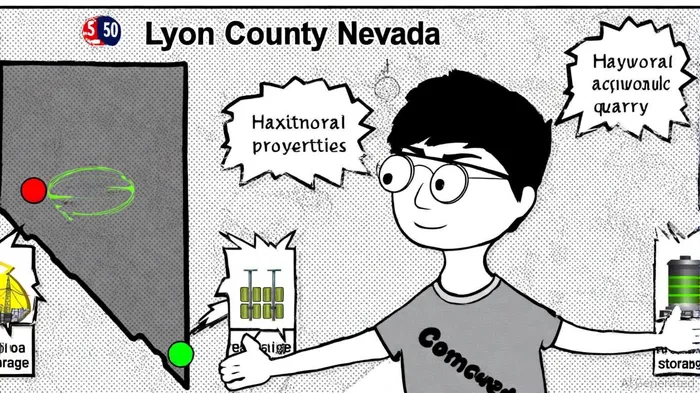
In the evolving landscape of the materials sector, strategic acquisitions are increasingly pivotal in securing long-term shareholder value. ComstockLODE-- Inc.'s recent $2.2 million acquisition of the Haywood Quarry in Lyon County, Nevada, exemplifies this trend. By acquiring a contiguous property with existing infrastructure—power, water, and access to US Highway 50—Comstock is positioning itself to enhance its lithium recycling operations and reduce dependency on volatile global supply chains, according to Comstock's press release. This move aligns with broader industry shifts toward vertical integration, a strategy that has proven critical for firms seeking to control costs, secure raw materials, and capture value across the battery value chain, as noted in a StockTitan article.
Vertical Integration: A Strategic Imperative in the Lithium Sector
Vertical integration has emerged as a defining feature of the lithium-ion battery industry, driven by the need to mitigate risks from raw material price volatility and geopolitical concentration. For instance, Tesla's closed-loop supply chain, which spans battery production, electric vehicles, and charging infrastructure, has enabled the company to achieve economies of scale and reduce costs, according to an MDPI study. Similarly, LG Energy Solution's acquisition of General Motors' Michigan joint-venture plant and Ford's partnership with SK On to build gigafactories underscore the strategic advantages of controlling multiple stages of production, a point highlighted in a HILCO Global perspective.
Comstock's acquisition of Haywood Quarry follows this playbook. By securing a site adjacent to its flagship Dayton gold and silver resource, the company is creating a localized hub for lithium-ion battery storage. This proximity reduces transportation costs and enhances operational efficiency, while the property's existing infrastructure accelerates deployment timelines—details available in Comstock's press release. Such strategic resource control is particularly valuable in the U.S., where government incentives aim to bolster domestic production and reduce reliance on Chinese-dominated supply chains, as noted by HILCO Global.
Comstock's Strategic Positioning and Shareholder Value
The Haywood Quarry acquisition is not merely a tactical move but a foundational step in Comstock's transformation into a renewable energy company. As noted by Executive Chairman Corrado De Gasperis, the property will directly support lithium recycling operations, a critical component of the circular economy (per a StockTitan article). This aligns with industry trends where upstream players like Vulcan Energy Resources and Nouveau Monde Graphite are supplying battery-grade materials directly to automakers, bypassing intermediaries and enhancing profit margins, according to an IDTechEx article.
Moreover, vertical integration offers Comstock tax advantages and procurement leverage. By controlling its supply chain, the company can better navigate material price fluctuations—a persistent challenge in the sector. For example, Arcadium Lithium's recent expansion projects at Fénix and Olaroz have enabled a 25% increase in production volumes, demonstrating how integrated operations can drive scalable growth, as outlined in Arcadium's 2024 Investor Day. Comstock's focus on lithium recycling further differentiates it, as recycling is expected to account for a growing share of global lithium demand in the coming decade, according to a GlobalData analysis.
Challenges and the Path Forward
Despite these advantages, Comstock faces hurdles. The U.S. lithium industry, while experiencing a surge in projects, grapples with high capital costs and lengthy development timelines. As of 2025, 66 lithium projects are in early stages, with many relying on unproven technologies like direct lithium extraction, according to a Dallas Fed analysis. Comstock's success will depend on its ability to optimize the Haywood Quarry's potential while navigating these challenges.
However, the company's strategic alignment with policy-driven domestic production and its focus on circular economy practices position it to capitalize on long-term trends. Governments in the U.S. and Canada are offering substantial financial support to build resilient supply chains, a tailwind that could amplify Comstock's returns, as discussed by HILCO Global.
Conclusion
Comstock's acquisition of Haywood Quarry underscores the growing importance of vertical integration in the materials sector. By securing strategic assets and integrating its operations, the company is not only mitigating supply chain risks but also enhancing its capacity to deliver sustainable shareholder value. As the lithium-ion battery industry matures, firms that prioritize resource control and operational efficiency—like Comstock—are likely to outperform peers reliant on fragmented supply chains. For investors, this acquisition signals a forward-looking strategy that aligns with both market demands and regulatory tailwinds, positioning Comstock as a compelling player in the energy transition.





Comentarios
Aún no hay comentarios