
Computacenter's Dividend Resilience Amid Industry Volatility
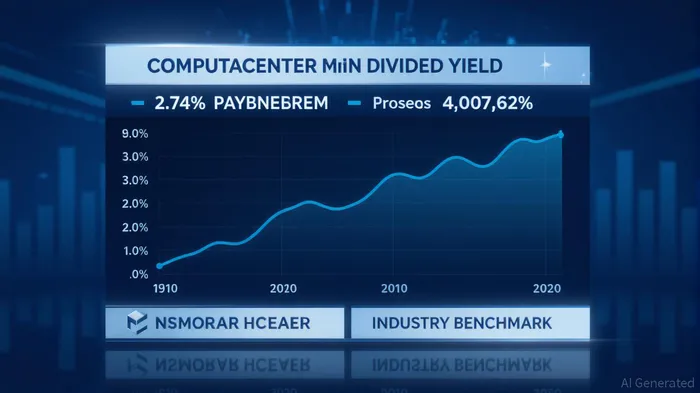
The IT services sector, long a bellwether for global economic shifts, has faced mounting volatility in 2025 due to trade wars, supply chain disruptions, and inflationary pressures. Against this backdrop, Computacenter (CCC) has emerged as a peculiar case study: a company offering a tempting dividend yield of 2.74%[1], yet burdened by a payout ratio of 4,047.62%—a figure that defies conventional metrics for sustainability[1]. This paradox raises critical questions about its defensive appeal and ability to weather sector-specific headwinds.
Dividend Yield vs. Payout Ratio: A Tenuous Balance
Computacenter's dividend yield, while higher than the bottom 25% of dividend-paying stocks[1], is undermined by its astronomical payout ratio. A payout ratio exceeding 75% is typically a red flag, signaling that a company is distributing more in dividends than it earns[1]. In Computacenter's case, the ratio suggests a reliance on non-operational cash flows or aggressive cost-cutting to fund payouts. This creates a fragile equilibrium: while the yield attracts income-focused investors, the underlying financial structure appears precarious.
However, the company's 2025 Half Year results reveal a counterpoint. Despite the high payout ratio, Computacenter reported a 1.3% increase in dividend per share compared to the prior year[1], alongside a trailing EPS of GBX 1.53 and a P/E ratio of 1,483.00[2]. These figures imply robust short-term earnings, though they mask long-term risks. The absence of a consistent dividend growth history[1] further complicates the narrative, as investors accustomed to compounding returns may find the company's track record unconvincing.
Financial Health: Free Cash Flow and Revenue Stability
The key to understanding Computacenter's resilience lies in its free cash flow and revenue dynamics. Recent financial reporting highlights £352.7 million in free cash flow[3], a critical buffer that allows the company to sustain dividends even as its payout ratio spirals. This cash flow, coupled with adjusted net funds of £278.0 million as of H1 2025[1], suggests a degree of liquidity that mitigates immediate concerns about solvency.
Revenue stability also bolsters the case for defensive appeal. Computacenter's H1 2025 revenue surged 28.5% year-on-year, driven by strong performances in North America and the UK[1]. Such growth, if sustained, could theoretically reduce the payout ratio over time by increasing earnings. Yet, the IT services sector's exposure to macroeconomic cycles—such as trade wars—introduces uncertainty. For instance, supply chain shifts in 2025 have already forced companies to reevaluate long-term contracts[2], a risk Computacenter has not explicitly addressed in its disclosures.
Industry Benchmarks and Defensive Appeal
While specific benchmarks for the IT services sector are sparse, Computacenter's financials suggest a hybrid profile: part high-yield speculative play, part cash-flow-driven defensive stock. Its free cash flow and revenue growth outperform many peers in the sector[3], yet its payout ratio remains an outlier. This duality makes it a compelling but risky proposition for investors seeking income in a volatile market.
The company's debt position, though not quantified in the sources, appears cautiously managed. A £200m share buyback in H2 2024[1] indicates confidence in liquidity, but it also raises questions about whether management is prioritizing shareholder returns over long-term debt reduction. In an industry where capital expenditures and R&D investments are critical, such trade-offs could prove costly.
Conclusion: A High-Yield Gamble
Computacenter's dividend resilience hinges on its ability to convert short-term earnings and free cash flow into sustainable long-term value. While its 2.74% yield and revenue growth offer defensive appeal, the 4,047.62% payout ratio remains a glaring vulnerability. Investors must weigh the immediate allure of income against the risks of a payout model that defies conventional wisdom. In a sector marked by volatility, Computacenter's dividends may prove resilient—but only if its financial engineering can keep pace with macroeconomic realities.







Comentarios
Aún no hay comentarios