
CompoSecure's NYSE Migration: Strategic Visibility or Valuation Gamble?
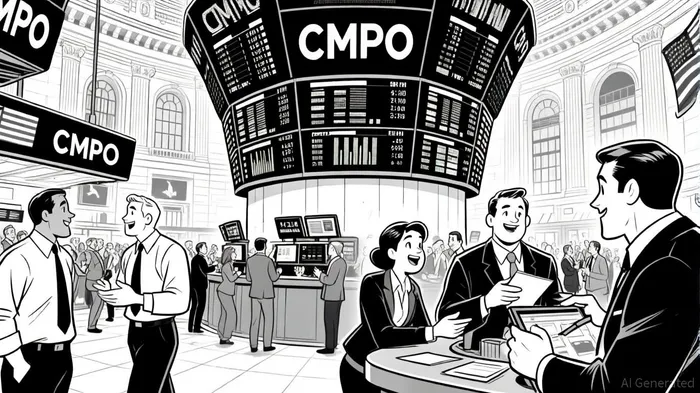
The recent decision by CompoSecureCMPO--, Inc. (CMPO) to migrate its Class A common stock listing from the Nasdaq to the New York Stock Exchange (NYSE) has sparked debate among investors and analysts. Scheduled to begin trading on the NYSE on September 23, 2025, the move is framed as a strategic effort to enhance visibility and attract a broader investor base[1]. Yet, with the company's recent financial performance marked by declining revenues and operational losses[2], the question remains: Will this shift bolster CompoSecure's valuation, or is it a symbolic gesture amid underlying vulnerabilities?
Historical Context: The NYSE as a Prestige Play
Companies switching from the Nasdaq to the NYSE often cite access to institutional investors, historical prestige, and improved liquidity as key motivators[3]. Since 2010, 265 firms have made this transition, including Oracle and Spirit Airlines, driven by the NYSE's ability to amplify market visibility[4]. Empirical studies suggest that such moves can facilitate capital-raising activities, with firms often issuing more debt and engaging in acquisitions post-migration[3]. Conversely, companies moving to the Nasdaq—such as PepsiCo—typically highlight cost savings and technological advantages[5]. However, mixed evidence exists: Firms shifting to the Nasdaq often experience short-term liquidity declines, while long-term trading volumes eventually rise[6].
CompoSecure's rationale aligns with the NYSE's traditional appeal. The company emphasized “increased visibility for investors” as its primary motivation[1], a claim echoed by firms like LiveRamp and Campbell's in past transitions[4]. Yet, as one analyst notes, “Prestige alone rarely justifies a listing change unless paired with tangible capital-raising needs”[7].
Market Reaction and Valuation Metrics
The market initially responded favorably to the announcement, with CMPOCMPO-- shares rising 4.11% to $19.26[1]. However, this optimism contrasts with CompoSecure's recent financials. For the quarter ending March 31, 2025, net sales plummeted 42% year-over-year to $59.824 million, while operating income fell by 81%[2]. Despite a 26% year-on-year increase in net income—driven largely by warrant liability gains—the company reported a $26.13 million net loss in Q2 2025[2].
Valuation metrics paint a mixed picture. CompoSecure trades at a forward P/E of 18.33 and a P/S of 6.32[2], suggesting growth expectations outpace current earnings. However, its Altman Z-Score of 1.3—a threshold for elevated bankruptcy risk[2]—and weak liquidity ratios (current ratio: 0.11; quick ratio: 0.09) underscore financial fragility[2]. Analysts remain divided: A “Strong Buy” consensus rating coexists with a price target of $17.67, slightly below the current $19.00 level[5].
Strategic Risks and Opportunities
The NYSE migration could amplify CompoSecure's access to institutional capital, particularly if it seeks to fund its expansion into premium payment card and digital security markets[1]. The exchange's reputation for liquidity may also attract long-term investors, as seen in historical cases like Oracle's 2013 move[4]. However, the company's recent operational challenges—such as a 51% drop in gross profit and a negative net margin of -28.15%[2]—raise questions about its ability to sustain growth.
Critics argue that the move risks overhyping a company with shaky fundamentals. “Switching exchanges is a branding exercise,” says one Wall Street strategist, “but without addressing declining sales and liquidity issues, the NYSE listing may not deliver the promised benefits”[7]. Conversely, proponents highlight CompoSecure's strong EBITDA margin (20.27%) and $62.32 million in trailing free cash flow as evidence of its resilience[2].
Conclusion: A Calculated Bet
CompoSecure's NYSE transition reflects a calculated bet on market perception. While the move may enhance visibility and investor confidence in the short term, its long-term success hinges on the company's ability to reverse its financial trajectory. For investors, the key will be monitoring whether the NYSE's institutional gravitas translates into tangible capital-raising advantages or merely serves as a temporary distraction from operational headwinds.
In the broader context, CompoSecure's case underscores a recurring theme in capital markets: The interplay between symbolic gestures and substantive value creation. As the company rings the NYSE's opening bell on September 23, the market will be watching to see if this strategic shift is a prelude to growth—or a desperate attempt to mask deeper vulnerabilities.





Comentarios
Aún no hay comentarios