
The Competitive Landscape of Oral GLP-1s: Novo Nordisk vs. Eli Lilly
Efficacy: A Slight Edge for NovoNVO--, but Trade-offs for Eli Lilly
Clinical trials reveal a nuanced picture of efficacy. Novo Nordisk's 25-milligram oral semaglutide demonstrated a 13.6% weight loss in the OASIS4 trial, outperforming Eli Lilly's orforglipron, which achieved 12.4% weight loss in the ATTAIN-1 trial. However, Eli Lilly's drug showed a lower discontinuation rate (21.9% in the low-dose group vs. 24.4% in the high-dose group), suggesting better tolerability for some patients. Analysts note that while Novo's pill may offer marginally superior efficacy, Eli Lilly's small-molecule formulation could mitigate gastrointestinal side effects, a critical factor for patient adherence.
Market Timing: Novo's First-Mover Advantage vs. Eli Lilly's Scalability
Novo Nordisk is on track to launch its oral semaglutide by late 2025, positioning itself as the first needle-free GLP-1RA in the weight loss space. This first-mover status could capture early adopters, particularly needle-averse patients. However, Eli Lilly's orforglipron, while projected for a 2026 global launch, may leverage its small-molecule design for faster manufacturing scalability. Goldman Sachs forecasts that Eli Lilly's pill could dominate 60% of the oral GLP-1 market by 2030, compared to Novo's 21%, underscoring the importance of production efficiency in sustaining long-term market share.
Delivery Convenience: Absorption, Diet, and Patient Experience 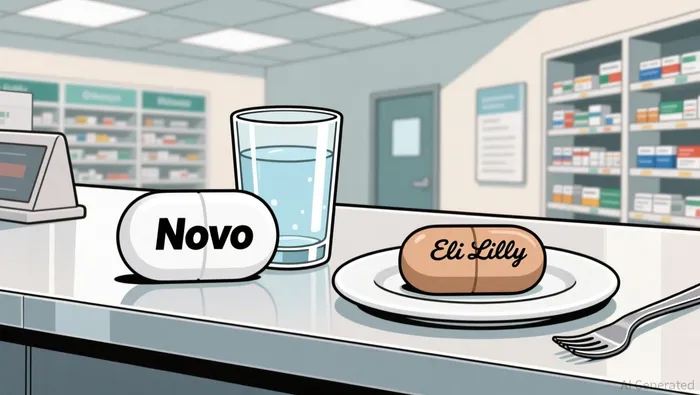
Delivery mechanisms remain a pivotal differentiator. Eli Lilly's orforglipron is a small-molecule drug, which may offer superior absorption and eliminate dietary restrictions that often complicate peptide-based therapies like Novo's semaglutide. For instance, Novo's pill requires administration on an empty stomach, a barrier for some patients. Eli Lilly's formulation, by contrast, could simplify dosing regimens and improve adherence, potentially translating into higher retention rates-a critical metric for long-term revenue stability.
Insurance Coverage and Pricing Strategies: A Cost-of-Therapy Arms Race
The insurance landscape for GLP-1RAs remains fragmented, but both companies are adapting aggressively. Novo Nordisk has slashed cash prices for Wegovy and Ozempic to $349 per month, with introductory offers as low as $199. These moves aim to counter the impending launch of TrumpRx, a government-run discount pharmacy expected to offer GLP-1 drugs at reduced prices starting in 2026. Eli Lilly, meanwhile, has introduced LillyDirect, a direct-to-consumer pricing model that bypasses traditional insurance systems. While these strategies enhance accessibility, they also compress profit margins, particularly as oral GLP-1s enter a crowded market.
Investment Implications: Balancing Innovation and Execution
For investors, the key question is whether Novo's first-mover advantage and marginally higher efficacy can offset Eli Lilly's scalability and patient-friendly formulation. Novo's early launch could secure a foothold in the oral GLP-1 market, but Eli Lilly's projected 60% share by 2030 suggests its small-molecule approach resonates more with commercial realities. Additionally, Eli Lilly's pricing agility and focus on reducing out-of-pocket costs may position it to outperform in a market increasingly influenced by affordability.
However, Novo's established dominance in injectable GLP-1s (e.g., Wegovy and Ozempic) provides a buffer against short-term oral market volatility. Its ability to cross-sell oral semaglutide to existing patients could mitigate some of Eli Lilly's scalability advantages. Conversely, Eli Lilly's lack of a strong injectable portfolio may limit its ability to capture patients who prioritize efficacy over convenience.
Conclusion: A Tug-of-War Between Efficacy and Execution
The oral GLP-1 market represents a $22 billion opportunity by 2030, but success will hinge on balancing clinical performance with commercial execution. Novo Nordisk's edge in efficacy and brand recognition offers a defensive moat, while Eli Lilly's scalable manufacturing and patient-centric design present a compelling offensive strategy. Investors should monitor Novo's Q4 2025 FDA approval timeline and Eli Lilly's 2026 launch readiness, as these milestones will determine which company gains the upper hand in this high-stakes rivalry.







Comentarios
Aún no hay comentarios