
Community Resilience Investing: Lessons from Fairport's Power Outage Crisis
The December 5, 2025, power outage in Fairport, New York, serves as a stark reminder of the fragility of aging grid infrastructure in the face of escalating climate risks and surging energy demand. While the specific cause of the outage remains under investigation, the incident-leaving the entire community without power and forcing the cancellation of school activities-highlights systemic vulnerabilities that extend far beyond a single locality. As extreme weather events intensify and energy consumption patterns shift, the case of Fairport underscores the urgent need for rethinking infrastructure resilience and the growing investment potential in decentralized energy solutions.
The Fragility of Centralized Grids
Fairport's power outage, though localized, reflects broader challenges facing the U.S. electricity grid. According to the New York Independent System Operator's (NYISO) 2025 Short-Term Assessment of Reliability (STAR) report,
the region faces a projected 446-megawatt shortfall during peak summer demand, driven by the retirement of peaker plants and the closure of the Indian Point nuclear facility. Compounding this, delays in critical projects like Empire Wind and Champlain Hudson Power Express (CHPE) have left the grid exposed to supply shocks. Meanwhile,
the Department of Energy warns that without adequate replacement of retiring power sources, the U.S. could see a 100-fold increase in outages by 2030.
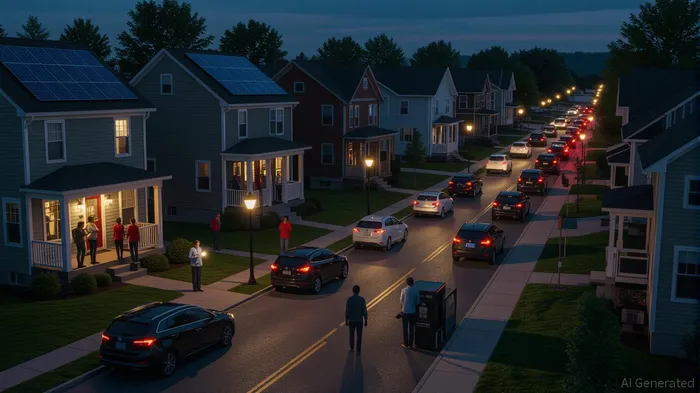
Fairport's historical reliability-averaging just 20 minutes of outages in 2024-belied its susceptibility to cascading failures. The December 5 event, coupled with earlier regional outages caused by severe weather, illustrates how even well-maintained systems can falter under compounding stressors. As the DOE notes,
the growing demand from data centers and AI operations further strains an already strained grid.
The Case for Decentralized Solutions
The crisis in Fairport has accelerated interest in decentralized energy systems, particularly microgrids and energy storage. PowerBank Corporation's recent announcement of 15 distributed solar and energy storage projects across New York-including 67 MW DC of solar and 11 MWh of storage-exemplifies this shift. These projects, eligible for federal tax credits under the One Big Beautiful Bill Act of 2025,
aim to bolster resilience while aligning with New York's 2030 clean energy targets.
Microgrids, which combine on-site generation, storage, and load management, offer a compelling alternative to centralized systems. They enable communities to operate independently during outages and reduce reliance on vulnerable transmission networks. For instance,
the U.S. Army Corps of Engineers' Black Start exercises-testing military installations' ability to function during prolonged outages-have spurred investments in microgrids and resilience projects. Such initiatives are increasingly relevant for municipalities like Fairport, where localized solutions could mitigate the impact of future disruptions.
Investment Opportunities in Resilience
The growing market for decentralized energy solutions presents significant opportunities for investors. New York State Energy Research and Development Authority (NYSERDA) has already signaled its commitment to this transition, with programs like the Clean Energy Fund and the 2025 Land-Based Renewable Energy Solicitation offering incentives for solar, wind, and storage projects
according to NYSERDA's official announcements. These programs align with federal initiatives, such as the DOE's methodology for identifying at-risk regions, which
prioritize "energy addition" through diverse, reliable sources.
Energy storage, in particular, is emerging as a cornerstone of grid resilience.
The PowerBank projects, capable of powering 7,500 homes, demonstrate how storage can stabilize supply during peak demand and weather-related outages. Similarly,
NYSERDA's Bulk Energy Storage Request for Proposals (RFP) in 2025 highlights the state's focus on enhancing grid reliability through innovative storage technologies. For investors, these developments signal a shift from reactive grid maintenance to proactive, technology-driven resilience.
Conclusion: Future-Proofing Infrastructure
The Fairport outage is not an isolated incident but a harbinger of systemic risks facing aging infrastructure.
As the average U.S. outage duration rises from 8.1 hours in 2022 to 12.8 hours by mid-2025, the economic and social costs of grid failures will only escalate. However, the crisis also reveals a path forward: investing in decentralized, smart-grid solutions that prioritize resilience over mere efficiency.
For investors, the message is clear. Microgrids, energy storage, and distributed generation are no longer niche technologies but essential components of future-proof infrastructure. The lessons from Fairport underscore the urgency of aligning capital with systems that can withstand-and adapt to-the challenges of a rapidly changing world.







Comentarios
Aún no hay comentarios