
Community Healthcare Trust's Q3 Earnings and Strategic Positioning: Navigating Growth and Resilience in a Shifting Healthcare Real Estate Landscape
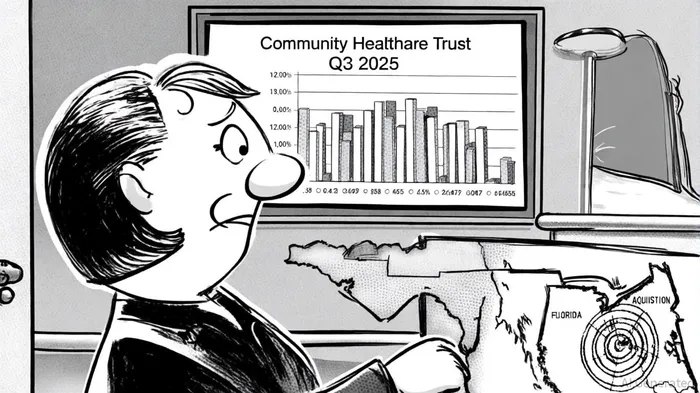
Community Healthcare Trust (CHCT) has navigated a challenging Q3 2025 with a mix of strategic acquisitions, operational adjustments, and a resilient dividend policy, even as it grapples with a significant net loss. The company's performance reflects broader trends in the post-pandemic healthcare real estate sector, where demand for outpatient care and behavioral health facilities is surging, while capital availability and regulatory shifts create both opportunities and risks.
Q3 Earnings: A Tale of Two Metrics
CHCT reported a net loss of $12.6 million, or $0.50 per diluted share, in Q3 2025, driven by a $1.7 million reserve on interest receivable and a $5.9 million charge from the termination of its Executive Vice President, according to the third-quarter results. However, the company's funds from operations (FFO) and adjusted FFO (AFFO) stood at $0.23 and $0.50 per share, respectively, per the report. These divergent metrics highlight the tension between short-term operational pressures and long-term strategic investments.
The net loss was partially offset by a $1.5 million gain from property sales and lease amendments, including the $0.6 million divestiture of an Ohio property. Meanwhile, CHCTCHCT-- acquired a behavioral specialty facility for $9.7 million and a $26.5 million inpatient rehabilitation facility in Florida. These moves align with the sector's shift toward specialized care settings, as noted in CBRE's 2025 outlook, which emphasizes the growing demand for outpatient and behavioral health facilities.
Strategic Positioning in a Dynamic Sector
The post-pandemic healthcare real estate landscape is defined by three key trends: demographic-driven demand, technological disruption, and regulatory uncertainty. CHCT's portfolio-comprising 200 properties across 36 states, with a 36.3% focus on medical office buildings (MOBs) and 19.4% on inpatient rehabilitation facilities-positions it to capitalize on these shifts, according to its Q2 2025 slides.
Aging Population and Outpatient Care: The aging baby boomer cohort is driving increased healthcare spending, particularly for outpatient services. MOBs, which CHCT owns in significant volume, are well-suited to meet this demand. The company's acquisition of a Florida inpatient rehabilitation facility further taps into the need for post-acute care, a sector projected to grow as hospitals seek to reduce readmission rates, according to a Healthcare Business Today analysis.
Adaptive Reuse and Capital Efficiency: With limited availability of purpose-built MOBs, healthcare systems are repurposing commercial properties. CHCT's strategy of acquiring smaller, off-market properties-such as its recent behavioral specialty facility-avoids competitive bidding and aligns with the sector's trend of adaptive reuse. This approach also supports its geographic diversification, with key concentrations in Texas, Illinois, and Ohio.
Regulatory and Reimbursement Shifts: The 2025 federal administration transition could reshape Medicaid expansion and ACA marketplaces, potentially altering reimbursement models. CHCT's conservative debt structure-41.6% debt-to-capitalization-provides flexibility to navigate such uncertainties, though the elevated leverage exceeds its stated 40% policy limit.
Financial Resilience and Risks
CHCT's balance sheet reveals a mixed picture. While its $400 million revolving credit facility and $275 million in term loans offer liquidity, the company has hedged only $350 million of its debt through interest rate swaps, leaving it exposed to rising rates. Additionally, credit loss reserves-such as an $8.7 million charge on a geriatric behavioral hospital tenant-signal tenant-specific risks in a sector where occupancy rates are critical.
Yet CHCT's $146 million acquisition pipeline, with projected returns of 9.1% to 9.75%, underscores its growth ambitions. These deals, expected to close through 2027, could offset near-term losses and diversify revenue streams. The company's commitment to a $0.4725 per share dividend also signals confidence in its ability to generate cash flow despite current challenges.
Conclusion: A High-Risk, High-Reward Proposition
Community Healthcare Trust's Q3 performance illustrates both the vulnerabilities and opportunities inherent in the post-pandemic healthcare real estate sector. While its net loss and elevated leverage raise concerns, its strategic acquisitions, focus on high-growth segments like behavioral health, and conservative capital structure position it to benefit from long-term demographic and technological trends. Investors must weigh the risks of regulatory shifts and tenant concentration against the potential for value creation through its acquisition pipeline and sector tailwinds.
As the healthcare real estate market evolves, CHCT's ability to balance aggressive growth with financial prudence will be critical. With its next earnings report expected on November 4, 2025, the coming months will offer further insight into whether the company can transform its current challenges into sustainable value.





Comentarios
Aún no hay comentarios