
Community Financial System: A Model of Dividend Sustainability and Strategic Capital Allocation for Shareholder Value
Let's talk about a stock that's quietly building a fortress of shareholder value: Community Financial System (CBU). If you're looking for a company that balances consistent returns with disciplined growth, CBUCBU-- is a standout. Here's why.
Dividend Sustainability: A 32-Year Legacy of Trust
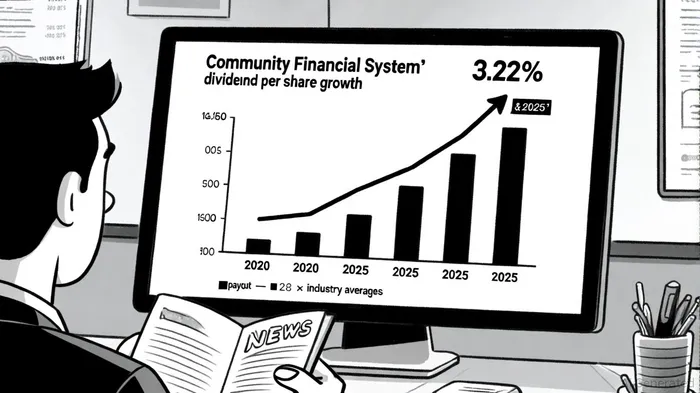
Community Financial System has raised dividends for 32 consecutive years, a testament to its unwavering commitment to shareholders[2]. As of September 2025, the company is paying $1.88 per share annually, translating to a 3.22% yield-a compelling figure in today's market[3]. But what really matters is sustainability.
The payout ratio is key here. CBU's current payout ratio sits at 50.27% of earnings and 47% of operating free cash flow, both well within safe ranges for a regional bank[1]. Compare that to the prior year's 58.1% and 55.6%, and you see a clear trend of improvement[2]. This isn't just about keeping the dividend alive-it's about future-proofing it. With $518 million in cash and cash equivalents as of March 2025[2], CBU has the liquidity to weather economic headwinds while maintaining its payout.
Capital Allocation: Growth Without Dilution
Here's where CBU shines brightest. The company's 2025 strategy is a masterclass in capital-efficient growth. Take the acquisition of seven Santander branches in Pennsylvania-a move that added $600 million in deposits without issuing a single new share[4]. That's a win for shareholders: no dilution, immediate deposit growth, and a platform for future loan expansion.
And let's not forget the $5.9 billion in liquidity on hand[2]. This isn't just a rainy-day fund-it's a weapon. CBU can deploy capital into high-ROE opportunities (like commercial lending or digital infrastructure) without relying on volatile markets. The company's plan to hold acquired deposits in short-term instruments before reinvesting is a smart hedge against interest rate risk[4].
Strategic Growth: Balancing Risk and Reward
CBU isn't just about dividends-it's about smart, scalable growth. The company is targeting mid-single-digit loan growth in 2025 across mortgage, auto, and commercial segments[4], supported by a robust pipeline. Even with a slow start in consumer lending, management expects to hit 4% growth for the year[4].
On the expense side, CBU is tightening its belt. While non-interest expenses rose 8.5% year-over-year, the company expects this to stabilize as it automates back-office processes and invests in digital tools[4]. This focus on efficiency is critical. As a report by Cutter Associates notes, operational agility will define winners in 2025's volatile financial landscape[3]. CBU's plan to reduce its non-interest expense-to-average-assets ratio to 2.35% by year-end[3] shows it's taking this seriously.
The Bigger Picture: Why This Matters for Shareholders
Let's connect the dots. A 50% payout ratio means CBU retains enough earnings to fund growth while still rewarding shareholders. The Santander acquisition adds deposits without dilution, and the $5.9 billion liquidity cushion gives management flexibility to navigate rate hikes or credit cycles[2]. Meanwhile, the 3.22% yield is a magnet for income-focused investors in a low-rate world[3].
Analysts aren't blind to this. A SWOT analysis from Seeking Alpha highlights CBU's "fortress-like deposit base" as a key strength[4], while its focus on M&A and digital transformation addresses weaknesses like regional concentration. This isn't just a bank-it's a strategic engine building long-term value.
Final Take: Buy and Hold?
If you're looking for a stock that checks all the boxes-consistent dividends, disciplined capital use, and growth potential-CBU is a rare gem. The 3.22% yield is attractive, but the real magic lies in its ability to compound value through acquisitions, efficiency gains, and a balanced approach to risk.
As the market grapples with AI-driven disruption and geopolitical uncertainty, companies like CBU that prioritize capital allocation discipline will outperform. This is the kind of company that makes you say, "I'll take the dividend-and I'll take the growth too."





Comentarios
Aún no hay comentarios