
Commerzbank's Strategic Position Amid German Economic Reforms and Cost Optimization
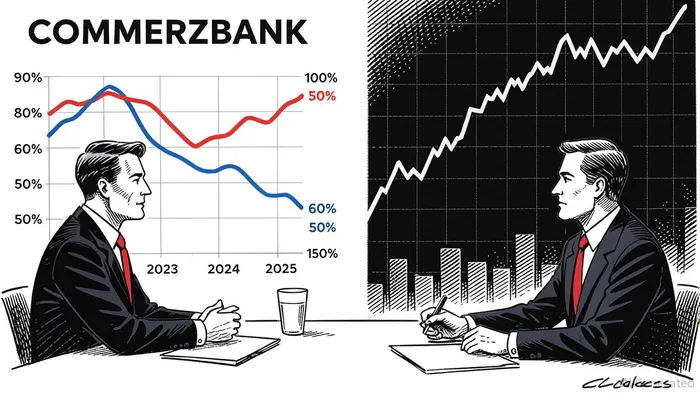
In the evolving landscape of German banking, Commerzbank AG has emerged as a standout performer, leveraging aggressive cost optimization, fee resilience, and strategic alignment with national economic reforms to position itself as a compelling long-term investment. As the German government's “Made for Germany” initiative accelerates structural reforms, Commerzbank's disciplined execution of its “Momentum” strategy—targeting a cost-to-income ratio of 50% by 2028—sets it apart from peers like Deutsche BankDB--, which struggles with domestic inefficiencies and uneven progress.
Cost Optimization: A Pillar of Operational Excellence
Commerzbank's cost discipline is a cornerstone of its competitive edge. In 2023, the bank reduced its cost-to-income ratio to 61% from 69% the prior year, a trend that accelerated in 2025. By Q2 2025, the ratio had dropped to 55%, a 5 percentage point improvement year-over-year despite a 5% cost increase driven by inflation and strategic investments[1]. This achievement underscores the effectiveness of its €450 million cost-reduction initiatives, which include AI-driven automation, international shoring, and digital transformation[2].
In contrast, Deutsche Bank's cost-to-income ratio remains above 65%, with its domestic private banking segment lagging at 78% in 2024[3]. While Deutsche Bank has committed to operational efficiency, its progress is uneven, particularly in retail banking, where Commerzbank's 65% cost-to-revenue ratio in the same segment highlights a stark efficiency gap[3].
Fee Resilience and Revenue Diversification
Commerzbank's fee-based business has proven resilient, contributing to a 10% year-over-year increase in net commission income to €1.004 billion in Q2 2025[4]. This diversification, coupled with stable net interest income of €2.062 billion despite lower benchmark rates, has enabled the bank to raise full-year net interest income guidance to €8 billion[4]. Deutsche Bank, meanwhile, relies more heavily on volatile investment banking revenues, which, while strong in Q2 2025 (€6.2 billion pre-provision profit), mask weaknesses in its domestic operations[5].
Strategic Alignment with German Economic Reforms
The “Made for Germany” initiative, launched in 2025, aims to reduce bureaucracy, boost infrastructure, and attract €631 billion in investments by 2028[6]. Commerzbank, a founding participant, has positioned itself to benefit from these reforms. CEO Bettina Orlopp highlighted the initiative as a “tailwind” for the bank's growth, citing its potential to drive demand for corporate and investment banking services[6]. The bank's focus on digitalization and shareholder returns—through dividends and buybacks—aligns with the government's push for innovation and capital efficiency[7].
Deutsche Bank, also a co-founder of the initiative, faces a more challenging path. While its Q2 2025 profit nearly doubled to €6.2 billion[5], its domestic private banking business remains underperforming, with a return on tangible equity (RoTE) of just 5% in 2024 compared to Commerzbank's 9.2%[3]. This disparity reflects Commerzbank's superior execution in balancing cost discipline with revenue growth.
Valuation Attractiveness: A Compelling Case for Investors
Commerzbank's valuation metrics further strengthen its investment case. As of Q2 2025, the bank trades at a forward P/E of 12.98 and a P/S ratio of 3.12, reflecting strong earnings and revenue growth expectations[8]. Its return on equity (ROE) of 11.1% in H1 2025 outpaces Deutsche Bank's 9.9% in the same period[9], underscoring superior capital allocation. Deutsche Bank, with a forward P/E of 9.39 and a trailing ROE of 8.14%[10], appears undervalued but lags in translating operational improvements into shareholder returns.
Conclusion: A Strategic Outperformer in a Transforming Sector
Commerzbank's combination of cost efficiency, fee resilience, and alignment with Germany's economic reforms positions it as a strategic outperformer in a sector grappling with macroeconomic headwinds. While Deutsche Bank's scale and investment banking prowess remain strengths, its domestic inefficiencies and uneven progress in cost optimization create a widening gap. For investors seeking long-term value, Commerzbank's disciplined execution and ambitious 2028 targets—coupled with its active participation in national reforms—make it a compelling choice in the German banking landscape.





Comentarios
Aún no hay comentarios