
Why Comfort Systems USA is a Safer, More Viable AI-Related Play Than Oklo
The race to power artificial intelligence infrastructure has intensified demand for reliable, scalable energy solutions. Two companies often mentioned in this context-Comfort Systems USAFIX-- and Oklo-represent divergent approaches to the challenge. While Oklo, a developer of advanced nuclear reactors, epitomizes high-risk innovation, Comfort Systems USAFIX--, a construction and engineering services firm, offers a more grounded, revenue-generating path to supporting AI's energy needs. A comparative analysis of their 2025 financial performance, market positioning, and risk profiles reveals why Comfort Systems USA is a safer and more viable investment for those seeking exposure to the AI-energy nexus.
Financial Performance: Proven Growth vs. Speculative Burn
Comfort Systems USA has demonstrated consistent, robust financial results in 2025. For the third quarter, the company reported revenue of $2.45 billion, a 35.2% year-over-year increase, with earnings per share (EPS) doubling to $8.25. Its operating cash flow surged to $553.3 million, and its backlog expanded to $9.38 billion, reflecting strong demand for its services in AI-driven industrial and commercial projects. Strategic acquisitions, such as Feyen Zylstra and Meisner Electric, further bolstered its revenue potential, adding over $200 million in annual revenue.
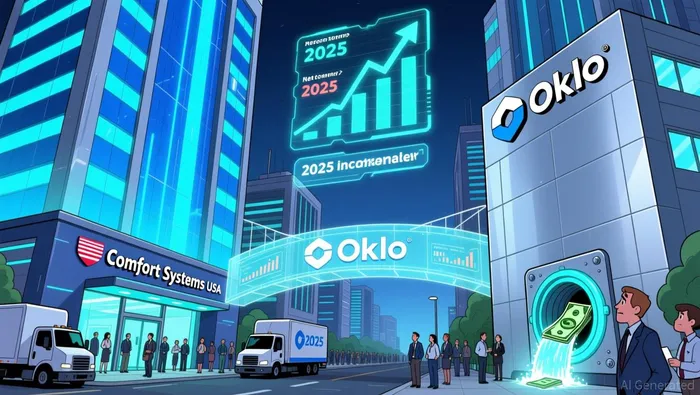 In contrast, Oklo, despite a tripling of its cash reserves to $1.18 billion in Q3 2025, reported a net loss of $64.2 million for the nine months ending September 30, driven by escalating R&D and administrative costs. Its EPS of -$0.20 missed forecasts, triggering a post-earnings stock price decline. As a pre-revenue company, Oklo's financial model relies on speculative future cash flows from its Aurora reactor, which remains subject to regulatory delays beyond 2027.
Market Position: Established Infrastructure vs. Regulatory Uncertainty
Comfort Systems USA's market position is anchored by its role in constructing and maintaining the physical infrastructure that underpins AI operations. Its backlog of $9.38 billion-up from $5.68 billion in September 2024- highlights its entrenched position in sectors such as data centers, which require energy-efficient mechanical and electrical systems. The company's recent foray into AI-enabled software tools for project management further aligns it with technological trends while mitigating reliance on volatile construction cycles.
Oklo, meanwhile, operates in a far more uncertain landscape. Its market value hinges on the successful commercialization of its nuclear reactor technology, a process contingent on Nuclear Regulatory Commission approval-a timeline that remains opaque. Even if approved, Oklo faces competition from other small modular reactor developers and established utilities, which could dilute its market share. Partnerships with Siemens Energy and the U.S. Department of Energy, while valuable, do not accelerate regulatory milestones or generate near-term revenue.
Risk Profiles: Mitigating Known Challenges vs. Navigating Existential Uncertainties
Investors in Comfort Systems USA must contend with industry-wide challenges such as labor shortages, supply chain bottlenecks, and inflationary pressures. These risks, however, are well-documented and partially offset by the company's strong cash flow and diversified client base. Its speculative credit rating (CCC) reflects broader macroeconomic uncertainties rather than operational mismanagement. By comparison, Oklo's risks are existential: a 70% probability of default over the next five years, as calculated by some models, underscores the peril of its capital-intensive, pre-revenue model.
Oklo's reliance on regulatory and technical milestones introduces a binary outcome: success could yield transformative returns, but failure would likely render its current valuation irrelevant. Comfort Systems USA, by contrast, offers more predictable returns. Its recent 20% dividend increase and disciplined acquisition strategy signal confidence in its ability to navigate cyclical headwinds.
Conclusion: Prudent Capital Allocation in an AI-Driven Energy Transition
While both companies aim to address the energy demands of AI, their investment theses diverge sharply. Comfort Systems USA provides immediate, tangible value through its infrastructure expertise and cash-generative business model. Oklo, though aligned with long-term decarbonization goals, remains a high-risk bet on a technology that may not commercialize for years. For investors prioritizing capital preservation and near-term returns, Comfort Systems USA emerges as the more viable play in the AI-energy sector.





Comentarios
Aún no hay comentarios