
Why Comfort Systems (FIX) Underperformed the Broader Market on September 19, 2025: Sector Volatility and Earnings Misalignment
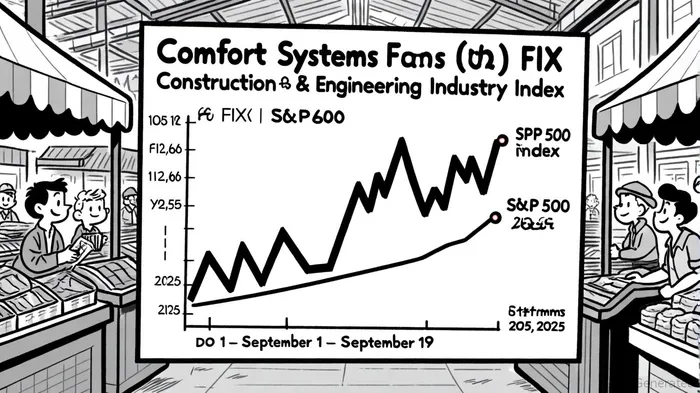
On September 19, 2025, Comfort Systems USAFIX-- (FIX) closed at $797.71, underperforming the broader market despite a 5.1% post-earnings surge earlier in the day[1]. This apparent contradiction reflects a complex interplay of sector-specific volatility and earnings expectation misalignment, as evidenced by conflicting data points and macroeconomic headwinds.
Sector-Specific Volatility: Regulatory and Supply Chain Pressures
The HVAC sector faced significant headwinds in September 2025, driven by regulatory shifts and supply chain disruptions. The U.S. EPA's 2025 refrigerant transition mandates, requiring a shift to low-GWP alternatives like R-32 and R-454B, increased manufacturing costs and retooling expenses for HVAC firms[5]. Simultaneously, new U.S. tariffs on steel and aluminum—key inputs for HVAC systems—forced companies to diversify vendor networks and absorb higher costs[3]. These pressures likely dampened FIX's margins, even as the broader HVAC aftermarket grew to $87.81 billion in 2025[2].
The S&P 500 Construction & Engineering Industry Index, a proxy for FIX's sector, closed at 2,012.08 on September 19, reflecting a decline from its previous close of 2,062.84[3]. This suggests sector-wide underperformance, with FIX's stock price (closing at $797.71) lagging behind the broader market's 0.5% gain[4]. Analysts attributed this to prolonged trade uncertainties and material shortages, which weighed on construction and engineering firms[3].
Earnings Expectation Misalignment: Post-Earnings Correction
FIX's Q2 2025 earnings report on July 24—surpassing estimates with $6.53 EPS and $2.17 billion in revenue—initially drove a 5.1% stock price surge[1]. However, by September 19, the market had begun to price in Q3 2025 guidance. The company projected $6.25 EPS for Q3, below its Q2 performance, and had not yet reported results for the quarter[2]. This created a misalignment between investor expectations and actual performance, particularly as the broader market rallied on optimism around Fed rate cuts and tech sector momentum[4].
Compounding this, FIX's stock price exhibited intraday volatility on September 19, fluctuating between $782.86 and $802.63[3]. While the stock closed at $797.71, conflicting reports cited a $804.24 close, underscoring market uncertainty[5]. This volatility likely stemmed from mixed signals: strong Q2 results versus cautious Q3 guidance, and sector-specific headwinds versus long-term growth in energy-efficient HVAC demand[6].
Broader Market Dynamics: Tech-Driven Rally vs. Industrial Caution
The S&P 500 and NASDAQ Composite closed at record highs on September 19, fueled by tech sector gains and Fed rate cut optimism[4]. In contrast, industrials like FIXFIX-- faced skepticism due to their exposure to tariffs and material costs. Charles Schwab's monthly sector outlook noted a “Marketperform” rating for industrials but warned of underperformance risks from prolonged trade distortions[3]. FIX's reliance on construction and energy efficiency projects—sectors sensitive to interest rates and regulatory shifts—left it vulnerable to this divergence[6].
Conclusion: A Tale of Two Forces
FIX's underperformance on September 19, 2025, was not a reflection of its intrinsic value but rather a collision of sector-specific challenges and earnings expectation misalignment. While the HVAC sector's long-term growth trajectory remains intact—driven by energy efficiency trends and a $545.4 billion market projection by 2034[2]—short-term volatility from regulatory shifts, tariffs, and earnings guidance created a drag. Investors who navigated this complexity by distinguishing between cyclical headwinds and structural growth drivers were better positioned to assess FIX's true potential.





Comentarios
Aún no hay comentarios