
Comcast's Network Expansion in Litchfield County and Its Implications for Broadband Infrastructure Investment
The global shift toward digital infrastructure has positioned broadband connectivity as a cornerstone of economic development. In underserved markets, where access to high-speed internet remains limited, companies like ComcastCMCSA-- are leveraging fiber-based networks to bridge the digital divide while unlocking long-term investment value. A case in point is Comcast's recent expansion in Litchfield County, Connecticut, which offers a compelling model for evaluating the strategic and economic returns of converged network deployments in rural and suburban areas.
Project Scope and Technological Innovation
Comcast's Litchfield County initiative represents a significant escalation of its broadband ambitions. By 2025, the company has completed a $400 million investment in the region, connecting nearly 22,000 homes and businesses to its advanced fiber-based Xfinity network. This follows a 2024 phase that added 8,700 additional connections, with construction underway in towns like Litchfield, Morris, and Torrington. The network delivers symmetrical gigabit speeds, ultra-low latency, and enhanced WiFi capabilities, enabling robust connectivity for streaming, remote work, and business operations.
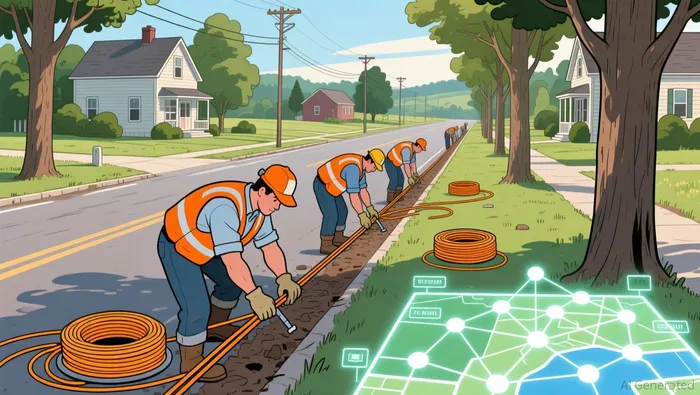 Crucially, the deployment leverages fiber optics-a technology that outperforms alternatives like DOCSIS in scalability and future-proofing. As stated by Comcast, the infrastructure supports "multi-gigabit speeds" and is designed to meet the growing demand for bandwidth-intensive applications. This aligns with broader industry trends, as fiber-connected Broadband Serviceable Locations (BSLs) in the U.S. grew by 35.7% since 2022, underscoring its role as the preferred medium for next-generation networks.
Economic Impact: Local and National Perspectives
The economic benefits of Comcast's expansion extend beyond connectivity. Locally, the project is projected to stimulate job creation and property value appreciation. A 2025 study by Frontier Communications estimates that fiber deployment in unserved areas could generate $3.24 trillion in net present value over 30 years, driven by a 1.64 trillion-dollar increase in housing values and 380,000 new jobs. In Litchfield County, the initiative is expected to enhance digital access for small businesses, enabling them to compete in a digital-first economy.
Nationally, the economic returns of broadband expansion are well-documented. Research from the Federal Reserve Bank of Richmond highlights that increased broadband access in rural areas correlates with lower unemployment rates and higher property values, particularly when paired with digital literacy programs. Comcast's complementary initiatives-such as its Internet Essentials program and WiFi-connected Lift Zones-further amplify these effects by addressing barriers to adoption.
Long-Term Investment Value and Strategic Considerations
For investors, the Litchfield County project exemplifies the long-term value of fiber-based infrastructure. Unlike traditional broadband technologies, fiber optics offer a scalable platform that can support emerging applications like 5G backhaul, smart city initiatives, and AI-driven services. This adaptability is critical in an era where data demand is projected to grow exponentially.
Moreover, federal policy is increasingly favoring fiber deployments. The Infrastructure Investment and Jobs Act has allocated $65 billion over ten years for broadband expansion, with 12% of recent fiber gains attributed to public funding. Comcast's $6 million investment in Hartford's fiber network-offering business customers speeds up to 10 Gbps-demonstrates how private and public capital can synergize to create resilient infrastructure.
From a financial perspective, Comcast's five-year price guarantee for Xfinity Internet-locking in rates at $55 per month-signals confidence in its cost structure and customer retention strategies. This stability, combined with the company's $400 million investment in Connecticut, suggests a disciplined approach to capital allocation in markets with untapped potential.
Conclusion: A Blueprint for Future Investments
Comcast's Litchfield County expansion underscores the transformative potential of fiber-based broadband in underserved markets. By combining cutting-edge technology, strategic public-private partnerships, and community-focused programs, the project not only addresses immediate connectivity gaps but also lays the groundwork for sustained economic growth. For investors, the initiative highlights the importance of prioritizing infrastructure that aligns with long-term digital trends. As the U.S. continues to close its broadband gap, companies that invest in scalable, future-ready networks will likely see disproportionate returns-both in financial terms and societal impact.







Comentarios
Aún no hay comentarios