
Comcast's (CMCSA) Dividend Sustainability and Growth Potential in a High-Yield Market
In an era where income-focused investors are increasingly drawn to high-yield equities, Comcast CorporationCMCSA-- (CMCSA) stands out as a compelling candidate in the telecommunications sector. With a 4.04% dividend yield as of September 2025, a payout ratio of just 21.21% for the trailing twelve months, and a 196% year-over-year earnings surge, the company's financial fundamentals suggest a rare combination of sustainability and growth potential. This analysis evaluates why CMCSACMCSA-- is positioned to outperform peers like Verizon (VZ) and AT&T (T) as a telecom dividend champion in 2025.
Financial Fundamentals: A Model of Prudence and Growth
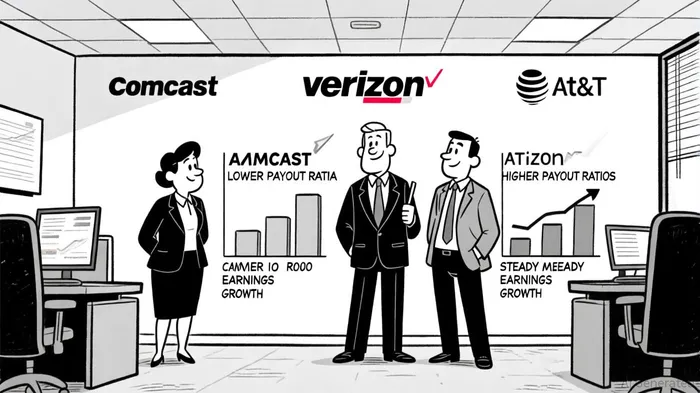
Comcast's dividend policy is underpinned by a disciplined approach to capital allocation. Its payout ratio of 21.21%—significantly lower than the industry average of 50–60% for mature telecom firms, according to the Deloitte telecom outlook—provides ample room for future increases without straining cash flow. This is critical in a sector where capital expenditures for infrastructure upgrades (e.g., DOCSIS 4.0, fiber expansion) are rising. For context, Verizon's payout ratio of 55.76%, noted in a Dividend comparison, and AT&T's 63.07%, shown in its AT&T dividend history, leave less flexibility to navigate economic downturns or unexpected expenses.
Moreover, Comcast's earnings growth has been nothing short of extraordinary. The company reported a 196% YoY jump in earnings per share (EPS) for Q2 2025, driven by the $11.12 billion net income from its Hulu stake sale (per the StockInvest dividend page). This windfall, combined with a 24.92% return on equity (ROE) and a debt-to-equity ratio of 1.04 (per financial-ratios data), underscores its ability to generate robust profits. Such performance is rare in a sector typically characterized by stagnant revenue growth. ComcastCMCSA-- also maintains a healthier balance sheet than its peers, who face higher leverage and slower free cash flow growth, as discussed in the Comcast strategic outlook.
Strategic Positioning: Innovation and Diversification
Comcast's competitive edge lies in its dual focus on infrastructure and content. The company is aggressively expanding its broadband footprint, targeting 8 million additional homes for fiber connectivity by year-end, according to strategic coverage, which addresses a key pain point for consumers seeking faster internet speeds and positions Comcast to capture market share from fiber-first providers like Lumen Technologies. Simultaneously, its investment in Peacock—now boasting 36 million subscribers—creates a recurring revenue stream in the streaming wars, reducing reliance on traditional cable subscriptions.
In contrast, peers like Verizon and AT&T are grappling with stagnation. Verizon's acquisition of Frontier Communications, while promising, has yet to translate into meaningful dividend growth, with its 6.13% yield supported by a 55.76% payout ratio that leaves little room for expansion. AT&T, meanwhile, has frozen its dividend since 2020, despite a 3.79% yield, as it focuses on deleveraging post the WarnerMedia spinoff. Comcast's ability to balance infrastructure investment with content innovation gives it a unique advantage in a sector increasingly defined by convergence.
Peer Comparison: Why CMCSA Outshines VZ and T
A direct comparison of key metrics reveals Comcast's superiority. While Verizon offers a higher yield (6.13% vs. CMCSA's 4.04%), its 0% dividend growth over the past year and elevated payout ratio make it a riskier bet for long-term investors. AT&T's 3.79% yield is further undermined by a -11.79% five-year dividend CAGR, reflecting its post-spinoff struggles. Comcast, by contrast, has raised its dividend for 21 consecutive years (per the StockInvest dividend page), with a 6.5% increase in 2025 and a 6.45% one-year growth rate.
The company's strategic use of share repurchases—$15 billion authorized in 2025, as noted on the dividend page—further enhances shareholder value. This contrasts with AT&T's reliance on debt-funded dividends and Verizon's cautious approach to buybacks. For income investors, Comcast's combination of a low payout ratio, strong earnings momentum, and disciplined capital returns creates a more sustainable and scalable model.
Risks and Mitigants
Critics may point to cord-cutting trends and rising content costs as headwinds. However, Comcast's bundling strategy—combining broadband, mobile, and streaming services—has proven effective in retaining customers, as highlighted in strategic coverage. Its AI-driven automation initiatives, which reduce outages and improve customer service, also bolster operational efficiency. Meanwhile, the Hulu sale and Peacock's cost-competitive model mitigate content spending pressures.
Conclusion: A Dividend Champion for the Long Term
In a high-yield market, Comcast's financial discipline, strategic innovation, and superior peer positioning make it a standout choice for dividend-focused investors. With a payout ratio that allows for future increases, earnings growth that defies sector norms, and a diversified business model, CMCSA is not just a telecom dividend champion—it is a blueprint for sustainable shareholder returns in an evolving industry.





Comentarios
Aún no hay comentarios