
Colombia's Inflation Dilemma: Monetary Policy at a Crossroads
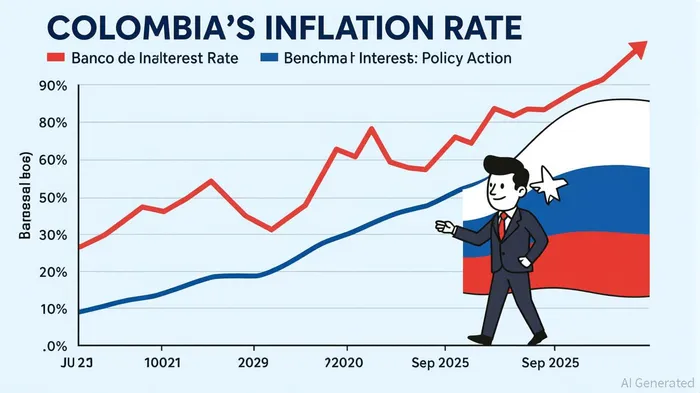
Colombia’s inflation dilemma has reached a critical juncture. After years of stubborn price pressures, the nation’s annual inflation rate hit 5.1% in August 2025—a four-month high and a stark reminder of the challenges facing the Banco de la República (Colombia’s central bank) [2]. While this figure represents a slight moderation from July’s 5.1% (previously 5.3% in May 2025), the trajectory remains troubling. Food, health, and service sectors continue to drive inflation, with restaurant and hotel prices surging 7.78% year-on-year [3]. Meanwhile, the central bank has held its benchmark interest rate at 9.25% since July 2025, resisting calls for rate cuts to stimulate growth [5]. This standoff between inflationary pressures and policy restraint has created a unique investment environment, particularly for fixed-income markets.
Central Bank Resilience Amid Political Pressure
The Banco de la República’s decision to maintain a restrictive policy stance has drawn sharp criticism from President Gustavo Petro’s administration, which advocates for lower rates to spur economic activity. In a recent Bloomberg interview, Finance Minister José Antonio Ocampo argued that “monetary tightening is stifling recovery,” urging the central bank to “align with fiscal stimulus” [2]. However, Governor Leonardo Villar has firmly rejected such appeals, emphasizing that the 9.25% rate is “compatible with inflation converging to 3% by 2026” [6]. This defiance underscores a broader trend: emerging-market central bankers increasingly prioritizing inflation control over political demands.
The bank’s resolve is rooted in data. Core inflation (excluding volatile food and energy) remains at 4.85% in August 2025, signaling persistent underlying pressures [2]. While headline inflation dipped to 4.8% in June, the rebound to 5.1% in August has reinforced the central bank’s caution. Analysts at BBVA Research note that “the board’s split decision to hold rates in July—four votes for stability, two for a 50-basis-point cut—reflects internal tensions but ultimately reaffirms the anti-inflation mandate” [5]. This institutional independence, though politically contentious, has bolstered investor confidence in the bank’s credibility.
Fixed-Income Positioning: Yields, Risks, and Opportunities
Colombia’s 10-year government bond yield currently stands at 12.35%, a premium reflecting both inflation risks and fiscal uncertainty [1]. With a projected 2025 fiscal deficit of 7.1% of GDP and recent downgrades from S&P and Moody’sMCO--, the government’s debt sustainability remains a concern [2]. Yet, for fixed-income investors, this volatility presents a paradox: high yields offer attractive returns, but inflation-linked risks and political interference could erode real gains.
The key to strategic positioning lies in balancing duration and hedging. Short-to-medium-term bonds (2–5 years) may offer safer exposure, given the central bank’s likely rate cuts in 2026 if inflation trends downward as projected [3]. However, investors must also consider inflation-linked instruments or currency hedges to mitigate risks from rising consumer prices. For instance, the recent 6.13% annual increase in food prices [3] highlights the vulnerability of real returns in a peso-denominated portfolio.
Political dynamics further complicate the outlook. Petro’s push for expansionary fiscal policy—coupled with a weakened tax base—risks reigniting inflationary pressures. MorningstarMORN-- DBRS warns that “fiscal slippage could force the central bank to delay rate cuts, extending the period of high bond yields” [4]. This uncertainty makes active management critical: investors should monitor policy decisions and fiscal updates closely, adjusting allocations based on inflation data and central bank communication.
Conclusion: Navigating the Crossroads
Colombia’s inflation dilemma encapsulates a broader tension between short-term political goals and long-term economic stability. While the Banco de la República’s resilience has anchored inflation expectations, the risk of fiscal overreach remains. For fixed-income investors, the path forward requires a nuanced approach: leveraging high yields while hedging against inflationary shocks and political volatility. As Villar aptly stated, “The road to 3% inflation is neither quick nor easy—but it is necessary” [6]. In this environment, patience and agility will be the twin pillars of successful investing.
Source:
[1] Colombia 10-Year Government Bond Yield - Quote - Chart, [https://tradingeconomics.com/colombia/government-bond-yield]
[2] Colombia Annual Inflation Accelerates to Four-Month High, [https://www.bloomberg.com/news/articles/2025-09-05/colombia-annual-inflation-accelerates-to-four-month-high-of-5-1]
[3] Colombia’s Inflation Tops Estimates For Another Month, [https://finimize.com/content/colombias-inflation-tops-estimates-for-another-month]
[4] Morningstar DBRS Changes Trend on Republic of, [https://dbrs.morningstar.com/research/454205]
[5] Policy Rate Held Steady at 9.25% in July, in a Split Decision, [https://www.bbvaresearch.com/en/publicaciones/colombia-policy-rate-held-steady-at-925-in-july-in-a-split-decision/]
[6] Monetary Policy Report – January 2025, [https://www.banrep.gov.co/en/news/monetary-policy-report-january-2025]







Comentarios
Aún no hay comentarios