
Colombia's Central Bank Policy in 2025: Navigating Inflation, Equities, and Currency Volatility
Colombia's central bank, Banco de la República, has navigated a delicate balancing act in 2025, maintaining its benchmark interest rate at 9.25% through June and July amid moderating inflation and global uncertainties. This cautious approach has had profound implications for emerging market equities and currency pairs, particularly the Colombian peso (COP) against the U.S. dollar (USD).
Interest Rate Decisions: A Cautious Path
In April 2025, Banco de la República cut rates by 25 basis points to 9.25%, the first reduction of the year, as inflation eased to 5.1% from 5.3% in February, according to a FocusEconomics report. However, by June and July, the central bank paused further cuts, with four directors voting to maintain the rate in June and a divided board doing the same in July, as noted in a ColombiaOne article. The decision reflected concerns over fiscal imbalances, global trade tensions, and the U.S. dollar's strength. Annual inflation stood at 4.8% in June, still above the 3% target, while core inflation stabilized at 4.8%, according to Trading Economics data.
The central bank's technical team noted that Q1 GDP growth hit 2.7%, driven by domestic demand, but emphasized that future policy would depend on inflation convergence and external risks. This data-dependent stance has created a mixed environment for investors, with rate cuts providing short-term stimulus but uncertainty limiting long-term optimism.
Impact on Emerging Market Equities: The COLCAP Rally
Colombia's COLCAP equity index has surged 26.5% year-to-date as of July 17, 2025, outperforming regional peers like Brazil and Mexico, according to a RioTimes article. This rally, despite a widening fiscal deficit, is attributed to ultra-low valuations (5.6× forward earnings), high dividend yields, and event-driven buying from corporate takeovers. For instance, the index closed at 1,745.28 on July 17, its highest level in five years, the RioTimes article noted.
The April rate cut and subsequent stability in June/July provided a tailwind for equities. Lower borrowing costs improved credit access for businesses, while the peso's depreciation (discussed below) boosted export competitiveness. However, analysts caution that the central bank's fiscal concerns—such as the suspension of the fiscal rule and rising public debt—could constrain future rate cuts, a point highlighted in the FocusEconomics report.
Currency Volatility: USD/COP and the Peso's Decline
The Colombian peso has weakened significantly against the U.S. dollar in 2025, with the USD/COP exchange rate falling from 4,458.58 on April 9 to 3,840.56 on September 23—a 12.09% decline, according to ValutaFX historical data. This trend accelerated after the April rate cut, as lower returns on Colombian assets reduced foreign capital inflows. By September, forecasts suggested the peso could reach 3,791 COP per USD by year-end (ValutaFX's forecast).
The central bank's decision to hold rates in June and July further pressured the peso, as markets priced in delayed normalization of U.S. monetary policy. Meanwhile, global trade tensions and U.S. policy shifts (e.g., tariffs) added to the peso's volatility.
Broader Implications for Emerging Markets
Colombia's experience highlights broader challenges for emerging markets in 2025. Elevated debt levels and tight global financial conditions have made rate cuts a double-edged sword: they stimulate growth but risk capital outflows and currency depreciation. For example, an IMF policy paper notes that debt service burdens in emerging markets have constrained development spending, and Colombia's policy trajectory could either stabilize or exacerbate these pressures.
Investors in emerging market equities must weigh the COLCAP's strong fundamentals against macroeconomic risks. While low valuations and resilient sectors like utilities and energy offer upside, fiscal imbalances and external shocks remain critical headwinds.
Conclusion
Colombia's central bank has adopted a measured approach to rate policy in 2025, prioritizing inflation control and fiscal stability over aggressive easing. This strategy has supported equities in the short term but introduced currency volatility that complicates long-term planning. For investors, the key takeaway is that Colombia's market offers compelling opportunities but requires close monitoring of both domestic fiscal developments and global trade dynamics.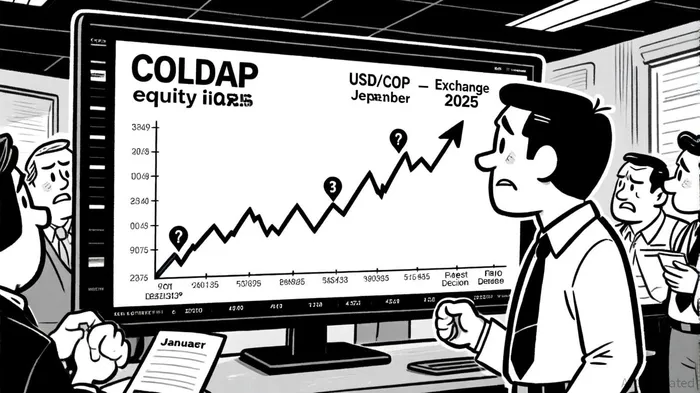







Comentarios
Aún no hay comentarios