
Collegiate Sports as a Catalyst for Institutional Value: Miami's Strategic Resurgence and the Future of Sports-Related Equities
The intersection of collegiate athletics and institutional brand value has never been more dynamic. As media rights deals balloon and fan engagement metrics soar, universities are increasingly leveraging athletic success to amplify their global profiles and secure long-term financial gains. Miami University, a mid-major institution with a storied football program, offers a compelling case study in how strategic athletic innovation-particularly in defensive schemes-can serve as a proxy for broader institutional momentum. By dissecting Miami's 2024-2025 season and its ancillary investments, we uncover a blueprint for how emerging market opportunities in sports-related equities and collegiate intellectual property (IP) can be harnessed.
Institutional Strength and Brand Value: A Symbiotic Relationship
Miami's institutional brand value has surged in recent years, buoyed by accolades such as being named one of the Best Employers for Women in the U.S. and earning LinkedIn's recognition for educational excellence. These achievements are not isolated; they align with a broader trend where universities are repositioning themselves as hubs of innovation and sustainability. Miami's third STARS Gold rating for environmental initiatives and its $7 million partnership with the Cleveland Clinic to develop a quantum computing workforce underscore its commitment to forward-thinking education. Such initiatives enhance academic prestige while attracting a new generation of students and donors who prioritize institutional ethos.
Crucially, athletic programs act as amplifiers of these strengths. As data from CNBC's 2025 college sports valuations reveals, athletic department revenues have skyrocketed due to media rights deals, with the Big 12 and College Football Playoff agreements projected to drive further growth. Miami's 2024 football season, under head coach Mario Cristobal, exemplifies this dynamic. Building on a 7-6 record in 2023, the Hurricanes aim to solidify their ACC Championship aspirations, a trajectory that directly correlates with increased media visibility and sponsorship appeal.
Defensive Innovation as a Strategic Differentiator
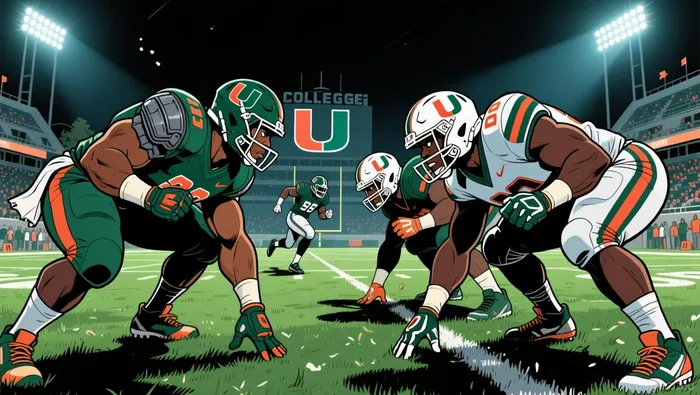
Miami's defensive strategies under coordinator Lance Guidry have emerged as a key differentiator. In 2023, the team ranked 11th nationally in run defense, allowing just 105.6 rushing yards per game. This success is not accidental but rooted in a deliberate focus on adaptability and talent development. Returning stars like linebackers Kiko Mauigoa and Wesley Bissainthe, coupled with transfers such as C.J. Clark and Elijah Alston, form a formidable defensive line. Such innovations not only elevate on-field performance but also attract elite recruits who seek competitive environments-a critical factor in sustaining institutional momentum.
Moreover, Miami's partnership with Kitman Labs to implement a Performance Medicine Solution highlights its commitment to leveraging technology for athlete care and performance optimization. By unifying medical data and reducing injury risks, the university enhances its ability to maintain high-level athletic output, which in turn strengthens its brand as a leader in collegiate sports.
Media Rights, Sponsorships, and the Financialization of Collegiate Sports
The financial implications of athletic success are profound. Miami's multimedia rights partnership with Legends generated record revenue in 2024-2025, a trend mirrored by the ACC's 56% revenue growth over five years. This surge is directly tied to on-field achievements: Miami's 10-win season in 2023 and quarterback Cam Ward's first-round NFL Draft selection amplified media demand, driving higher valuation for its athletic programs. According to analysis, this on-field success directly translates to increased financial performance.
Sponsorship deals further illustrate this synergy. A $2 million gift from alumni Brian and Jennifer Niccol to support men's basketball underscores how athletic success can catalyze donor engagement. Similarly, the Miami Promise Scholarship Campaign, with a $100 million target, ties athletic and academic excellence to institutional accessibility, creating a feedback loop of value creation. These initiatives not only fund programs but also enhance the university's IP portfolio, as alumni and sponsors become stakeholders in its brand.
Investment Implications: Beyond the Sidelines
For investors, Miami's trajectory highlights three key opportunities:1. Sports-Related Equities: As media rights deals expand, companies facilitating athlete performance (e.g., Kitman Labs) and media distribution (e.g., Legends) stand to benefit.2. Collegiate IP: Universities with strong athletic brands can monetize their IP through merchandise, licensing, and alumni networks, creating diversified revenue streams.3. Fan Engagement Platforms: The rise of digital fandom-driven by social media and streaming-offers avenues for investment in platforms that connect institutions with global audiences.
Miami's strategic resurgence demonstrates that collegiate sports are no longer ancillary to institutional value but central to it. By aligning athletic innovation with academic and financial goals, universities like Miami are redefining what it means to be a "brand" in the 21st century. For investors, the lesson is clear: the next frontier of institutional growth lies at the intersection of performance, technology, and brand equity.







Comentarios
Aún no hay comentarios