
The Collapse of Coinbase's $2 Billion BVNK Acquisition and What It Reveals About Crypto Infrastructure Investment Risks
Strategic M&A in a Volatile Sector
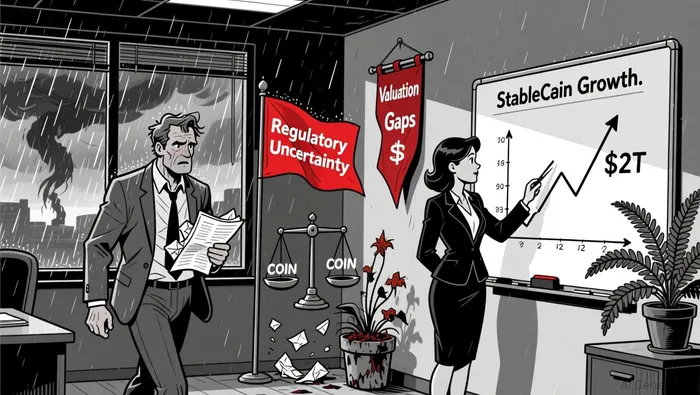
Coinbase's pivot toward stablecoin infrastructure aligns with a broader industry trend. Stablecoins, which underpin cross-border payments and institutional trading, are increasingly seen as a bridge between traditional finance and crypto. However, the BVNK collapse highlights the inherent volatility in this space. Despite entering an exclusivity agreement, CoinbaseCOIN-- and BVNK failed to finalize terms, leaving investors to speculate about regulatory hurdles, valuation mismatches, or operational complexities.
The market reacted swiftly: Coinbase's stock dropped 4.38% to $304.01 following the announcement, according to a Parameter report. This decline underscores investor skepticism about the company's ability to scale its stablecoin offerings-a segment that contributed $246 million in revenue during Q3 2025, according to a CoinoTag report. For context, stablecoin infrastructure is a high-stakes game. Unlike speculative crypto assets, it requires robust compliance frameworks, liquidity management, and regulatory alignment-factors that can derail even the most well-intentioned deals.
Regulatory and Technological Risks
The collapse of the BVNK deal coincides with a pivotal moment in stablecoin regulation. The Bank of England (BOE) is set to implement a temporary ownership cap for stablecoins in 2025, limiting individual holdings to £10,000–£20,000 and business holdings to £10 million, according to a Bitcoinist report. These measures aim to mitigate systemic risks, such as those seen during the 2023 collapses of Silicon Valley Bank and Circle's USD Coin (USDC). Meanwhile, the U.S. is advancing the GENIUS Act, which could provide a clearer legal framework for stablecoin issuers, according to a CoinoTag report.
Regulatory divergence between jurisdictions adds complexity. The BOE's joint oversight with the Financial Conduct Authority (FCA) for systemic stablecoins contrasts with the U.S. approach, creating a patchwork of compliance requirements. For companies like Coinbase, navigating these fragmented rules could delay or derail deals. Technological risks also loom large. Stablecoin infrastructure requires seamless integration with legacy banking systems, real-time settlement capabilities, and resistance to fraud-challenges that may have contributed to the BVNK acquisition's failure.
The Bigger Picture: Competition and Innovation
Despite the setback, Coinbase remains committed to the stablecoin space. The company's $2.9 billion acquisition of Deribit in August 2025 demonstrates its willingness to bet big on infrastructure, according to a Parameter report. Meanwhile, competitors like Exodus are doubling down. Exodus recently acquired Uruguay-based Grateful, a stablecoin payments startup, to expand its reach in Latin America, according to a Yahoo Finance report. Grateful's tools-wallet-to-wallet payments, QR point-of-sale systems, and onchain invoicing-highlight the sector's potential to disrupt traditional commerce.
The key takeaway is that stablecoin infrastructure is not a monolith. While Coinbase's BVNK deal faltered, other players are finding success by targeting niche markets or leveraging regulatory-friendly regions. This fragmentation suggests that M&A in the sector will remain a high-risk, high-reward proposition.
What's Next?
The collapse of the BVNK acquisition serves as a cautionary tale for investors. It underscores the importance of due diligence in a sector where regulatory, technological, and market risks are intertwined. For Coinbase, the challenge will be to pivot quickly-whether through smaller, more targeted acquisitions or partnerships with established players.
As the stablecoin market matures, the winners will be those who can balance innovation with compliance. For now, the BVNK sagaSAGA-- is a reminder that even the most ambitious crypto bets can unravel in an environment of rapid change.





Comentarios
Aún no hay comentarios