
Coke FEMSA's Strategic Reinvention: Fueling Long-Term Growth Through Expansion, Digital Innovation, and Diversification
Capacity Expansion: A Foundation for Operational Momentum
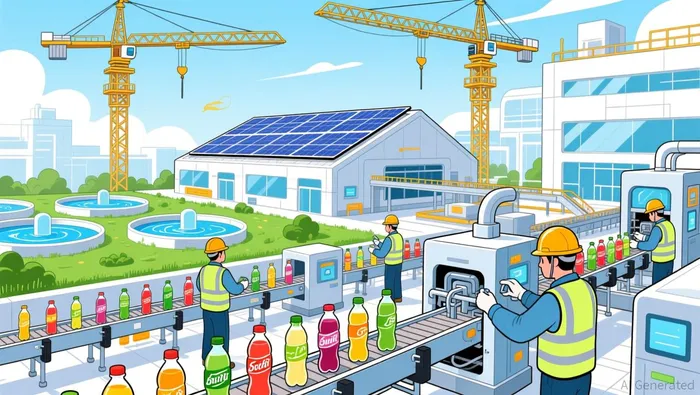
Coke FEMSA's recent investments in production capacity underscore its commitment to scaling operations while enhancing efficiency. A prime example is the company's BRL 600 million ($110 million) investment in its Mogi das Cruzes, São Paulo, Brazil, facility. This project, set to conclude by late 2025, will add two new production lines for soft drinks, with operations commencing in January 2026 according to a report. Beyond raw capacity, the expansion emphasizes sustainability, with energy and water efficiency improvements and reduced gas emissions. The company's Water Neutrality initiative, which returns water used in production to natural ecosystems, further aligns with global ESG trends. Such projects not only bolster operational resilience but also position Coke FEMSAKOF-- to meet rising demand in key markets like Brazil, where it holds a dominant market share.
Digital Transformation: Building a Value-Added Ecosystem
Digital innovation remains a cornerstone of Coke FEMSA's strategy. The FEMSA Forward Strategy explicitly highlights the role of Digital@FEMSA, a division tasked with creating an integrated digital and financial ecosystem. According to a report by NASDAQ, the company is leveraging an omni-channel approach to enhance customer engagement, with Coca-Cola FEMSA leading digital initiatives and the Proximity division (owner of OXXO stores) driving in-store technology adoption. For instance, OXXO's expansion into South America and the U.S. is being supported by digital tools that optimize inventory management and personalize consumer experiences. These efforts are not merely incremental; they aim to transform FEMSA into a platform business, where data-driven insights and financial services (such as OXXO's payment solutions) create additional revenue streams.
Diversification: Expanding the Beverage Portfolio
While Coke FEMSA's core business remains carbonated soft drinks, its foray into new beverage categories reflects a proactive response to shifting consumer preferences. The company already distributes a broad portfolio, including juices, teas, plant-based drinks, and even alcoholic beverages like Topo Chico Hard Seltzer, alongside third-party brands such as Monster Energy according to official company sources. However, the most intriguing developments lie in its exploration of coffee drive-throughs via a joint venture and its alignment with industry trends toward smaller, healthier formats. For example, Coca-Cola's planned 7.5-oz mini cans and Gatorade's low-sugar variants-set to launch in 2026-highlight a sector-wide pivot toward portion control and wellness according to beverage industry analysis. While Coke FEMSA has not yet announced specific product launches, its existing distribution network and agility in adopting new formats suggest it is well-positioned to capitalize on these trends.
Strategic Synergies and Market Positioning
The interplay between these initiatives creates a compounding effect. Enhanced production capacity ensures the company can scale new beverage offerings efficiently, while digital tools enable precise market segmentation and customer retention. Meanwhile, diversification into non-traditional categories reduces reliance on commoditized products and taps into premiumization trends. This holistic approach is critical in a market where competition from private-label brands and health-conscious alternatives is intensifying.
For investors, Coke FEMSA's strategic reinvention offers a compelling narrative. The company's ability to balance capital expenditures with innovation-while maintaining its leadership in Latin America-demonstrates a disciplined, forward-looking management team. As the global beverage industry evolves, Coke FEMSA's focus on sustainability, digital integration, and product diversification positions it not just to compete, but to redefine its sector.







Comentarios
Aún no hay comentarios