
How Coinbase's USDC APY Is Reshaping Crypto Custody and DeFi in 2025
In 2025, the crypto landscape is witnessing a seismic shift as institutional demand and stablecoin yield strategies converge to redefine custody models and DeFi adoption. At the forefront of this transformation is Coinbase's 4.1% APY on USDCUSDC--, a rate that not only outpaces traditional savings accounts but also serves as a bridge between retail investors and institutional-grade financial infrastructure. This development marks a pivotal moment in the evolution of onchain finance, where stability and yield coexist in ways previously unimaginable.
Institutional Demand: A Catalyst for Stability
The surge in institutional adoption of USDC is a critical driver of this shift. Platforms like Nodal Clear, a CFTC-regulated derivatives clearing organization, now accept USDC as collateral for futures trading, signaling a growing acceptance of stablecoins in traditional markets. This institutional validation has been bolstered by regulatory clarity from the GENIUS and CLARITY Acts, which have clarified self-custody rights and peer-to-peer transaction frameworks. As a result, institutions are increasingly treating USDC as a cash-equivalent asset, embedding it into clearing systems and risk management protocols.
Coinbase's Q1 2025 financial results underscore this trend: USDC balances on the platform grew by 39% quarter-over-quarter to $41.9 billion, contributing to a record $698 million in Subscription and Services revenue. This growth is not merely a function of yield-seeking retail users but reflects a broader institutional appetite for programmable, low-volatility assets. For investors, this signals a maturing market where stablecoins are no longer confined to speculative trading but are becoming foundational to financial infrastructure.
Stablecoin Yield Strategies: From Passive to Aggressive
While Coinbase's 4.1% APY on USDC is a compelling offering in its own right, savvy investors are layering strategies to maximize returns. The rise of “yield stacking” has enabled users to combine Coinbase's APY with DeFi protocols like AaveAAVE-- and Compound, generating additional returns. For example, a $10,000 USDC deposit can earn 4.1% from CoinbaseCOIN-- and an incremental 2-3% from Aave, compounding into a total APY of 6-7%.
More aggressive strategies involve liquid staking derivatives (LSDs). By converting USDC into stETH via LIDO, investors can access governance token rewards (e.g., ARB, UNI) and stake those tokens on platforms like UniswapUNI--. These layered approaches can push total APYs to 12.2%, far outpacing traditional savings accounts. However, such strategies require a nuanced understanding of smart contract risks and market volatility, making them better suited for advanced investors.
The Role of Regulatory Tailwinds
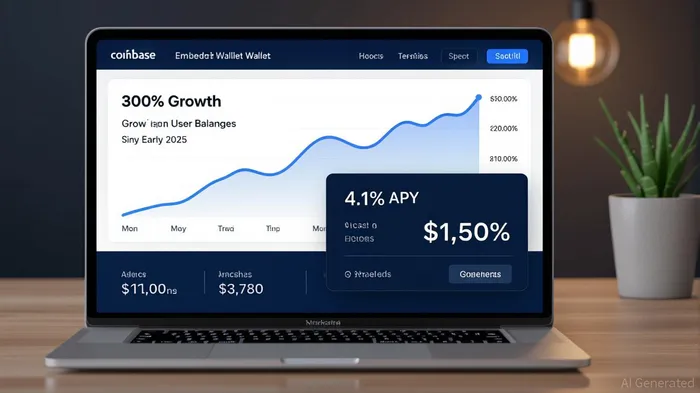
Regulatory developments in 2025 have been instrumental in legitimizing these strategies. The GENIUS Act and CLARITY Act have provided clarity on self-custody rights, reducing legal uncertainties around non-custodial wallets. This has spurred adoption of platforms like Coinbase's Embedded Wallet, which offers a 4.1% APY on a non-custodial basis. The wallet's 300% growth in USDC holdings since its launch highlights how regulatory confidence is translating into user trust.
Moreover, the integration of USDC into multiple blockchains (Ethereum, SolanaSOL--, Avalanche) has expanded its utility beyond simple yield generation. Developers are now building applications that leverage USDC's programmability for instant, low-cost transactions in gaming, DeFi, and Web3 ecosystems. For instance, Axiom's hybrid trading platform, which uses Coinbase Onramp for fiat-to-USDC onboarding, has seen daily trading volumes exceed $100 million, demonstrating USDC's role as a functional currency in onchain finance.
Investment Implications and Strategic Recommendations
For investors, the convergence of institutional demand and stablecoin yield strategies presents both opportunities and risks. Here's how to navigate this evolving landscape:
- Diversify Yield Strategies: While Coinbase's APY provides a stable baseline, consider layering with DeFi protocols to enhance returns. However, allocate only a portion of your portfolio to aggressive strategies like LSDs to mitigate smart contract risks.
- Monitor Regulatory Developments: The regulatory environment remains dynamic. Stay informed about changes in custody laws and stablecoin regulations, as these could impact APYs and liquidity.
- Leverage Institutional Infrastructure: Platforms like Coinbase offer a safer entry point into yield generation compared to pure DeFi. Use their institutional-grade security and compliance frameworks to access high-APY opportunities without exposing yourself to unnecessary risks.
- Adopt a Long-Term Perspective: The maturation of the crypto market is blurring the lines between traditional finance and onchain ecosystems. Position yourself to benefit from this transition by investing in assets and platforms that bridge both worlds.
Conclusion
Coinbase's 4.1% APY on USDC is more than a product feature—it's a harbinger of a new era in finance. By aligning institutional demand with innovative yield strategies, the platform is reshaping how custody and DeFi are perceived and adopted. For investors, this represents a unique opportunity to participate in a market where stability and growth coexist, provided they approach it with a balanced, informed strategy. As the crypto ecosystem continues to evolve, those who embrace these shifts will find themselves at the forefront of a financial revolution.





Comentarios
Aún no hay comentarios