
Coinbase's Tokenization Platform and Its Disruptive Potential in Financial Markets
The financial landscape is undergoing a seismic shift as blockchain technology redefines how assets are created, traded, and governed. At the forefront of this transformation is CoinbaseCOIN--, whose Tokenization Platform is poised to bridge traditional finance and decentralized systems. By tokenizing equities, real estate, and other real-world assets (RWAs), Coinbase is not merely adapting to change-it is actively reshaping it. This analysis explores how the platform's strategic innovations, institutional-grade infrastructure, and regulatory alignment position it as a leader in the tokenization revolution, while offering actionable insights for investors navigating this evolving ecosystem.
A New Era of Asset Tokenization
Coinbase's Tokenization Platform, rebranded as Coinbase Tokenize in late 2025, represents a pivotal step toward democratizing access to financial markets. The platform enables the tokenization of traditional assets such as equities, real estate, and treasuries, converting them into blockchain-based tokens that can be traded 24/7 with enhanced liquidity and transparency according to a recent update. This move aligns with Coinbase's broader vision of an "everything exchange," where users can trade stocks, perpetual futures, prediction markets, and tokenized assets on a unified platform as reported by CNBC.
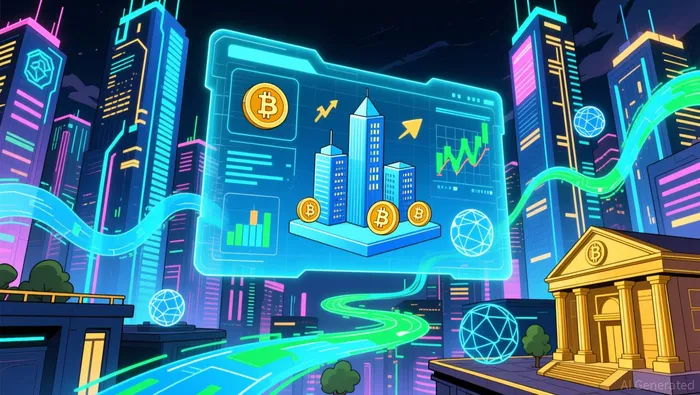 The significance of this initiative lies in its ability to address long-standing inefficiencies in traditional markets. For instance, tokenized equities eliminate intermediaries like clearinghouses, reducing settlement times from days to seconds. Similarly, real estate tokenization allows fractional ownership of high-value properties, lowering barriers to entry for retail investors. By leveraging blockchain's programmability, Coinbase is also enabling smart contracts to automate compliance, such as restricting voting rights to long-term shareholders-a feature highlighted by CEO Brian Armstrong as a harbinger of tokenized governance models.
Bridging Traditional and Digital Finance
Coinbase's competitive edge stems from its dual focus on institutional trust and technological innovation. The platform's infrastructure, already robust for crypto trading, now extends to custody solutions, staking services, and institutional prime brokerage-services critical for attracting institutional capital according to Forbes. This alignment with regulatory frameworks has made Coinbase a preferred partner for enterprises seeking to tokenize assets without compromising compliance.
A key differentiator is the integration of prediction markets via its partnership with Kalshi. These markets allow users to bet on outcomes ranging from economic indicators to geopolitical events, creating a dynamic layer of financial innovation. For example, a user could trade tokens tied to the outcome of the 2026 U.S. presidential election or the Federal Reserve's interest rate decisions. Such tools not only diversify Coinbase's offerings but also position it as a hub for real-time data-driven trading.
Moreover, Coinbase's expansion into custom stablecoins and decentralized finance (DeFi) on SolanaSOL-- underscores its commitment to interoperability. By supporting developers in building tokenized solutions, the platform is fostering a broader ecosystem where traditional and digital assets coexist seamlessly. This approach contrasts with competitors like Bakkt, which have struggled to gain traction due to fragmented infrastructure and limited regulatory clarity according to CoinGape.
Market Dynamics and Competitive Positioning
The tokenization market itself is experiencing explosive growth. As of mid-2025, the RWA sector has surpassed $25 billion in value, with projections of $9.43 trillion to $18.9 trillion by 2030 according to financial data. Coinbase's early investments in this space-coupled with its first-mover advantage in institutional adoption-position it to capture a significant share of this growth.
Financial experts highlight several factors that reinforce Coinbase's leadership. First, its regulatory alignment reduces friction for institutional clients, who prioritize compliance in asset tokenization. Second, the platform's distribution capabilities-rooted in its established crypto exchange-allow it to scale tokenized products rapidly. Third, Coinbase's ecosystem strategy-integrating prediction markets, tokenized stocks, and DeFi-creates network effects that competitors like Maple FinanceSYRUP-- and OndoONDO-- Finance lack according to market analysis.
For instance, while Maple Finance specializes in high-yield tokenized real estate and Ondo Finance focuses on treasuries, Coinbase's holistic approach addresses a broader spectrum of financial needs. This breadth is critical in an era where investors demand diversified exposure to both traditional and digital assets according to financial reports.
Strategic Investment Considerations
For investors, Coinbase's tokenization platform represents a compelling long-term opportunity. The company's roadmap-spanning tokenized equities, real estate, and governance-aligns with macroeconomic trends such as the rise of decentralized finance and the demand for 24/7 trading. Additionally, the 2025 Institutional Investor Digital Assets Survey reveals that 59% of institutional investors plan to allocate over 5% of their assets under management to digital assets, a trend Coinbase is uniquely positioned to capitalize on according to Coinbase research.
However, risks remain. Regulatory shifts, particularly in the U.S., could impact the tokenization of equities and real estate. Investors should monitor developments in the SEC's stance on tokenized securities and Coinbase's compliance strategies. Furthermore, while the RWA market is projected to grow exponentially, execution risks-such as liquidity challenges for tokenized real estate-could temper short-term gains.
Conclusion
Coinbase's Tokenization Platform is more than a technological innovation; it is a catalyst for reimagining financial markets. By tokenizing traditional assets, integrating prediction markets, and fostering institutional trust, the platform is building a unified ecosystem that transcends the boundaries of traditional and digital finance. For investors, the key lies in recognizing Coinbase's strategic alignment with macroeconomic trends and its ability to execute on a vision that others are only beginning to conceptualize. As the "everything exchange" evolves, those who position themselves early may reap substantial rewards in the tokenized future.







Comentarios
Aún no hay comentarios