
Coinbase's Strategic Transition to a Crypto Financial Infrastructure Giant
Derivatives: Expanding Market Access and Retail Adoption
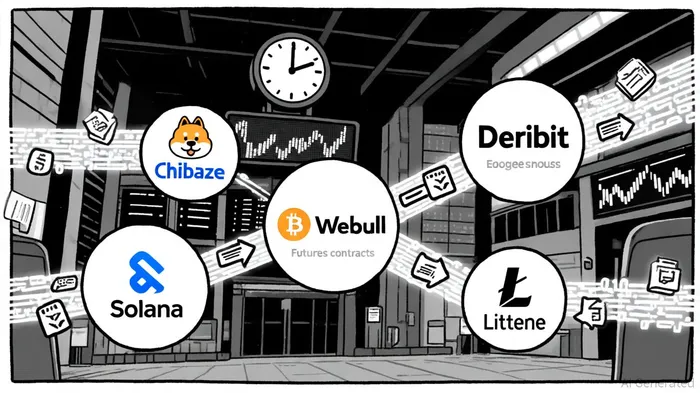
Coinbase's foray into derivatives has gained momentum, with the acquisition of Deribit in 2024 marking a turning point. This move has allowed the company to tap into the maturing global derivatives market, where Wall Street analysts project significant revenue potential, according to The Block. A recent collaboration with Webull further underscores this strategy: Webull now offers crypto futures for assets like DogecoinDOGE--, SolanaSOL--, and LitecoinLTC-- through Coinbase Derivatives, providing U.S. retail traders with smaller-size contracts and 23/6 trading access, per FinanceFeeds. Such partnerships not only broaden Coinbase's product offerings but also democratize access to derivatives, aligning with the growing demand for regulated crypto trading tools, as StockTitan reports.
Stablecoins: Bridging Traditional and Digital Finance
Coinbase's stablecoin initiatives are equally transformative. The company's 2026 partnership with Apollo Global Management aims to create institutional-grade credit products anchored in stablecoins, targeting over-collateralized asset lending, corporate direct lending, and tokenized credit holdings, according to CryptoBriefing. These strategies are designed to integrate stablecoin reserves with Apollo's credit expertise, offering investors exposure to high-quality, compliant opportunities in a market projected to grow from $300 billion in 2025 to $3 trillion by 2030, per AltcoinBuzz. Regulatory clarity, such as the proposed GENIUS Act, further supports this growth by mitigating run risks and ensuring 1:1 reserve audits, a point noted by AltcoinBuzz. Additionally, Coinbase Asset Management's collaboration with iTrustCapital to enable IRA accounts for digital assets highlights the company's role in bridging traditional finance and crypto, appealing to a broader demographic of accredited investors, as AltcoinBuzz also describes.
Base Ecosystem: Scalability and Financial Product Diversification
The Base ecosystem, Coinbase's EthereumETH-- LayerLAYER-- 2 network, is a cornerstone of its long-term vision. By 2026, Base aims to scale to 10,000 transactions per second, leveraging upgrades like Fusaka and zk-proofs to enhance efficiency, according to Blockonomi. This scalability is critical for handling the growing demand for decentralized applications (dApps) and financial products, such as tokenized equities and prediction markets, which Coinbase is actively developing, as reported by U.Today. The network already generates $100 million in annual revenue, a figure expected to rise as more operations migrate to Ethereum-secured infrastructure. Furthermore, Coinbase's Ethereum treasury expansion-adding 11,933 ETH in Q3 2025-signals a long-term commitment to both Ethereum and BitcoinBTC--, reinforcing its position as a key infrastructure player.
The Road Ahead: Profit Margins and Institutional Adoption
Analysts from William Blair and JPMorgan highlight Coinbase's potential to achieve high profit margins by 2026, driven by its diversified ecosystem and strategic cost management. While rising operating costs could pressure near-term margins, the company's focus on derivatives, stablecoins, and Base positions it to capitalize on the broader crypto market's maturation. A December 2025 product event hints at further innovations, including a potential Base token launch, which could unlock new revenue streams and liquidity mechanisms.
Conclusion
Coinbase's strategic pivot to a crypto financial infrastructure giant is underpinned by its ability to innovate across derivatives, stablecoins, and blockchain scalability. By addressing both retail and institutional demand, the company is not only diversifying its revenue streams but also positioning itself as a critical bridge between traditional finance and the digital asset ecosystem. As regulatory frameworks solidify and market adoption accelerates, Coinbase's long-term growth trajectory appears robust, making it a compelling case study in the evolution of crypto infrastructure.





Comentarios
Aún no hay comentarios