
Coinbase's Strategic Push into Fintech Lending and Non-Bank Financial Services: Redefining Digital Asset Infrastructure Without Traditional Banking
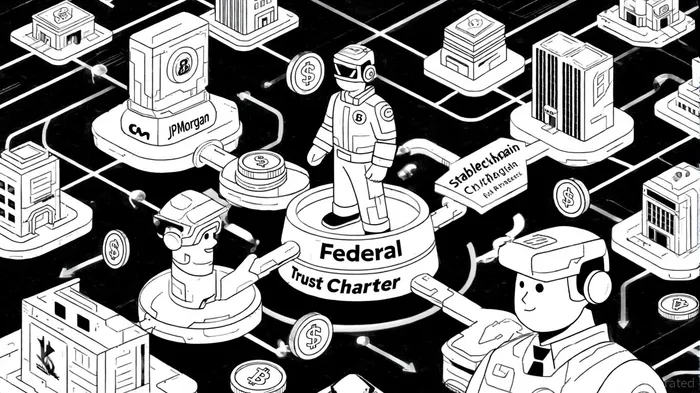
In 2025, CoinbaseCOIN-- is redefining the boundaries of digital asset infrastructure by aggressively expanding into fintech lending and non-bank financial services. The company's strategic moves-ranging from regulatory innovations to partnerships with legacy institutions-signal a bold vision to integrate blockchain technology into mainstream finance without relying on traditional banking frameworks. This approach notNOT-- only challenges existing financial paradigms but also positions Coinbase as a pivotal player in the onchain revolution.
Regulatory Agility: The Federal Trust Charter Strategy
Coinbase's application for a National Trust Company Charter from the U.S. Office of the Comptroller of the Currency (OCC) is a cornerstone of its strategy to bypass the complexities of state-by-state banking regulations. By securing this charter, Coinbase aims to offer services such as payments, settlements, and custody under a single federal framework, reducing operational friction and enabling faster innovation, according to Coinbase. This move aligns with broader industry trends, as competitors like Circle, Paxos, and Ripple also pursue similar charters to streamline compliance and scale operations, AltcoinBeat reports.
The OCC's recent rollback of restrictive crypto rules-such as the Biden-era requirement for supervisory non-objection-has further lowered barriers for firms like Coinbase, Coindesk reported. Acting Comptroller Rodney Hood and nominee Jonathan Gould have publicly endorsed crypto innovation, creating a regulatory environment conducive to Coinbase's ambitions. By avoiding a full-service bank charter, Coinbase emphasizes its focus on blockchain-native solutions while maintaining flexibility to adapt to evolving regulations, as the company itself has noted.
Strategic Partnerships: Bridging Traditional and Crypto Finance
Coinbase's collaboration with JPMorgan Chase exemplifies its strategy to democratize access to crypto services. The partnership allows Chase customers to link their bank accounts directly to Coinbase and transfer Chase Ultimate Rewards points into crypto holdings, according to reporting on the application. This integration not only expands Coinbase's user base but also signals growing institutional confidence in crypto as a legitimate financial asset class.
Beyond partnerships, Coinbase is leveraging decentralized finance (DeFi) protocols to expand its lending capabilities. By integrating with platforms like Morpho, the company enables users to lend USDCUSDC-- and earn competitive yields directly through the Coinbase app, as described in a Tearsheet podcast. These blockchain-based lending solutions highlight Coinbase's ability to blend traditional financial tools with decentralized infrastructure, offering users greater control over their assets without intermediaries.
Technological Innovation: Onchain Financial Services
Coinbase's technological advancements are redefining how users interact with digital assets. A notable example is its Bitcoin-backed loan feature, which allows users to borrow USDC against their BitcoinBTC-- holdings in minutes without selling their crypto. This innovation, powered by on-chain lending protocols, underscores Coinbase's commitment to creating instant, low-cost financial tools accessible to a global audience.
The company's 10-year roadmap, outlined by CEO Brian Armstrong, envisions a future where stablecoins like USDC become foundational to its revenue streams and bridge traditional and crypto finance. In Q1 2025, stablecoin revenue grew by 32%, reflecting the growing demand for these assets in products like loans, rewards, and cross-border payments. With projections of $665–$745 million in subscription and services revenue for Q3 2025, Coinbase's diversification strategy is paying off.
Competitive Landscape and Long-Term Implications
Coinbase's push into non-bank financial services is part of a broader industry race for regulatory clarity and market dominance. Competitors like Circle and Paxos are also vying for OCC charters, but Coinbase's institutional-grade custody services and strategic acquisitions-such as Deribit-position it as a leader in crypto derivatives and institutional adoption. Meanwhile, Ripple's focus on cross-border settlements and Circle's tokenization ambitions highlight the fragmented yet dynamic nature of the sector.
For investors, Coinbase's strategy represents a high-stakes bet on the future of finance. By avoiding traditional banking structures, the company reduces regulatory overhead while accelerating innovation in areas like stablecoins and DeFi. However, risks remain, including potential shifts in regulatory sentiment and competition from both legacy institutions and decentralized protocols.
Conclusion
Coinbase's strategic push into fintech lending and non-bank financial services is a testament to its vision of redefining digital asset infrastructure. By leveraging regulatory agility, strategic partnerships, and blockchain-native innovations, the company is not only expanding its revenue streams but also reshaping how the world interacts with money. As the race for federal charters intensifies and stablecoins gain traction, Coinbase's ability to bridge traditional finance and the cryptoeconomy will likely determine its success in the next decade.







Comentarios
Aún no hay comentarios