
Coinbase's Strategic Position in a Regulated Crypto World: Evaluating Long-Term Growth Amid Regulatory Clarity and Diversified Revenue Streams
The crypto industry in 2025 is no longer a frontier market but a maturing asset class, with regulatory frameworks evolving to accommodate its integration into traditional finance. At the forefront of this transformation is CoinbaseCOIN--, a company that has adeptly navigated the shifting landscape to position itself as a cornerstone of the regulated crypto ecosystem. With a projected revenue of $7.4 billion in 2025, Coinbase's strategic pivot toward diversified revenue streams and its alignment with regulatory tailwinds underscore its long-term growth potential.
Regulatory Clarity: A Catalyst for Institutional Adoption
The U.S. Securities and Exchange Commission (SEC) has played a pivotal role in reshaping the crypto regulatory environment. Under Chair Paul Atkins, the agency has moved away from the broad application of securities law to most digital assets, instead categorizing tokens into distinct classes-digital commodities, digital collectibles, digital tools, and tokenized securities. This framework, articulated in a November 2025 speech, has provided much-needed clarity for market participants.
The passage of the GENIUS Act in July 2025 further solidified this shift by defining stablecoins as neither securities nor commodities while establishing reserve management standards. This legislation has enhanced trust in stablecoins, enabling their integration into traditional financial systems and fostering broader adoption. Additionally, cross-agency collaboration between the SEC and CFTC, alongside international efforts like the Transatlantic Taskforce for Markets of the Future, is harmonizing regulatory approaches, reducing fragmentation, and creating a more predictable environment for innovation.
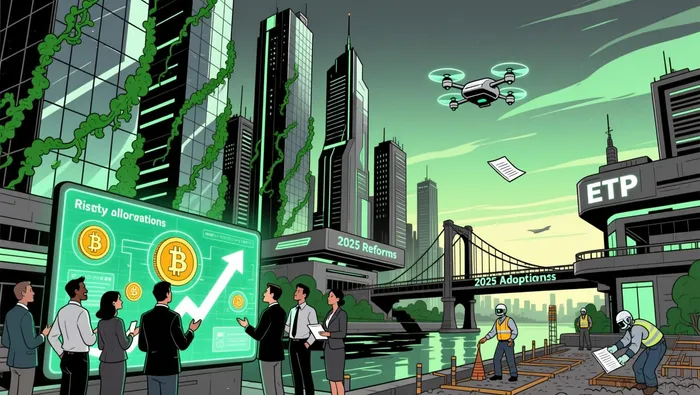
For Coinbase, these developments are transformative. Regulatory clarity has not only mitigated legal uncertainties but also accelerated institutional adoption. A survey by EY-Parthenon and Coinbase revealed that 83% of institutional investors plan to increase digital asset allocations in 2025, with regulatory certainty identified as the primary growth driver. This trend is further amplified by the rise of exchange-traded products (ETPs), which now account for 55% of spot crypto holdings among investors, a segment where Coinbase's exchange infrastructure is well-positioned to thrive.
Diversified Revenue Streams: Beyond Trading Fees
Coinbase's revenue model has evolved significantly, reducing reliance on trading fees and expanding into high-margin, recurring revenue streams. Subscriptions and services now constitute a growing portion of its income, driven by products like staking, institutional custody, and settlement services.
In 2025, Coinbase has also broadened its product suite to include stock trading and prediction markets in the U.S., signaling an aggressive move to become a one-stop financial services platform. These additions cater to both retail and institutional clients, leveraging Coinbase's existing user base and infrastructure. The company's inclusion in the S&P 500-a milestone achieved in 2025-reflects its growing credibility as a regulated entity capable of competing with legacy financial firms.
Moreover, Coinbase's foray into tokenized assets and decentralized finance (DeFi) integration positions it to capitalize on the next wave of blockchain innovation. As stablecoins transition from speculative assets to core financial infrastructure, platforms that facilitate their utility-such as Coinbase's settlement services-stand to benefit from increased transaction volumes and network effects.
Strategic Synergy: Regulation and Innovation in Tandem
The interplay between regulatory clarity and Coinbase's business strategy is a key driver of its long-term potential. A pro-crypto political environment in the U.S., coupled with bipartisan legislative efforts, ensures that Coinbase's compliance framework remains aligned with evolving standards. This alignment reduces operational risks and enhances investor confidence, critical factors for sustaining growth in a highly scrutinized sector.
Furthermore, Coinbase's ability to adapt to regulatory changes-such as its proactive engagement with the SEC and CFTC-demonstrates a governance model that prioritizes compliance without stifling innovation. This balance is rare in the crypto space and positions Coinbase as a trusted intermediary between traditional finance and emerging blockchain technologies.
Conclusion: A Regulated Future, A Scalable Opportunity
Coinbase's journey in 2025 exemplifies how regulatory clarity and strategic diversification can coexist to unlock value. With a revenue model that spans trading, subscriptions, and institutional services, and a regulatory environment that increasingly legitimizes crypto as a mainstream asset class, the company is well-positioned to scale sustainably. For investors, Coinbase represents not just a bet on crypto's future but a stake in the infrastructure that will underpin its integration into the global financial system.
As the industry continues to mature, the ability to navigate regulatory complexity while innovating will separate winners from losers. Coinbase, with its diversified revenue streams and regulatory foresight, is poised to lead this transition.





Comentarios
Aún no hay comentarios