
Coinbase's Strategic Delisting of Altcoin Pairs and Its Implications for Market Liquidity and Investor Behavior
Coinbase's recent delistings of altcoin trading pairs in 2025 have sparked a seismic shift in the cryptocurrency market, reshaping liquidity dynamics and investor behavior. The exchange's decision to remove assets such as BLAST, VARA, ZETACHAIN, and others-alongside pairs like ANKR-GBP, AXS-EUR, and LRC-USDT-has been framed as a strategic move to align with regulatory standards and consolidate liquidity around major cryptocurrencies according to a report. This article examines the cascading effects of these delistings, focusing on how liquidity consolidation has altered token valuations, forced traders to adapt strategies, and signaled a broader industry trend toward institutional-grade assets.
Regulatory Compliance and Liquidity as Dual Drivers
Coinbase's delistings are rooted in two primary factors: regulatory compliance and liquidity constraints. The exchange has explicitly cited the need to adhere to evolving legal frameworks, particularly for tokens linked to projects with stalled development or unclear governance structures according to financial analysis. For instance, the delisting of rebranded EOS (now VAULTA) and tokens like MUSE and WCFG reflects a tightening of standards to mitigate compliance risks as reported. Simultaneously, low trading volumes and insufficient liquidity have rendered many altcoin pairs uneconomical to maintain, prompting CoinbaseCOIN-- to prioritize resources for assets with higher demand according to market intelligence.
This dual rationale mirrors broader industry trends. As noted by Bloomberg, exchanges are increasingly adopting a "quality over quantity" approach, favoring assets with robust fundamentals and active ecosystems according to industry analysis. 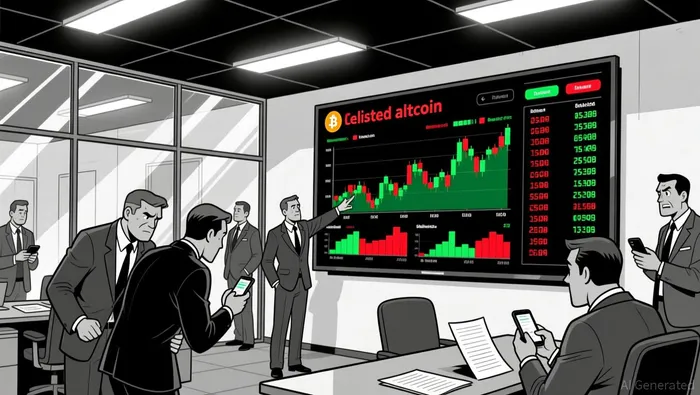 The delistings also align with Coinbase's institutional focus, as highlighted in its 2025 market outlook, which emphasizes the growing importance of compliance-driven asset selection according to institutional research.
Liquidity Consolidation and Token Valuation Impacts
The delistings have triggered a redistribution of liquidity, with smaller tokens facing heightened volatility and wider bid-ask spreads. Data from Coinbase's institutional research indicates that affected assets, such as MINA and MASK, experienced immediate price declines post-delisting, as traders rushed to unwind positions or migrate to alternative exchanges according to market data. This liquidity crunch was exacerbated by the October 2025 "black swan" event-a macroeconomic shock triggered by U.S. trade policy announcements-which led to a cascading liquidation of leveraged altcoin positions as an academic analysis notes.
Notably, the October crash revealed structural vulnerabilities in altcoin markets. According to a report by CNBC, tokens with limited liquidity, such as LOKA and CLV, saw flash crashes and de-pegging of stablecoins like USDeUSDe--, amplifying losses for retail traders according to market analysis. In contrast, BitcoinBTC-- and EthereumETH-- demonstrated relative resilience, stabilizing above $100,000 despite a 14% drawdown according to financial reporting. This divergence underscores the growing disparity between major cryptocurrencies and smaller tokens, with liquidity consolidation favoring the former.
Investor Behavior and Trading Strategy Adaptations
Investor behavior has shifted in response to these developments. Traders are increasingly prioritizing assets with strong fundamentals and institutional backing, such as SolanaSOL-- (SOL) and Ethereum (ETH), while avoiding lower-cap altcoins according to market commentary. This trend is supported by the approval of the Bitwise Solana Staking ETF, which attracted concentrated demand despite muted interest in other altcoins like LitecoinLTC-- as reported.
Trading strategies have also evolved. As Coinbase's institutional research highlights, traders are adopting diversification, dollar-cost averaging, and stablecoin usage to mitigate risks according to a crypto recap. For example, crypto-friendly SMEs are leveraging stablecoins for payroll and operations, reducing exposure to volatile altcoins according to industry reporting. Additionally, the delistings have prompted a migration of liquidity to decentralized and alternative centralized exchanges, with traders seeking to maintain access to delisted pairs according to market analysis.
Broader Implications and Future Outlook
The delistings signal a maturing market where liquidity and compliance are paramount. As noted by VanEck's November 2025 crypto recap, the sector is undergoing a "necessary correction" to eliminate excessive leverage and position the market for sustainable growth according to market analysis. This recalibration has already led to healthier leverage levels and a gradual recovery in institutional inflows according to market reports.
However, challenges remain. The Custom M2 Liquidity Index's November drawdown highlights ongoing macroeconomic headwinds, while regulatory uncertainty continues to weigh on smaller projects according to Coinbase guidance. For investors, the key takeaway is the importance of liquidity management and strategic diversification in an increasingly polarized market.





Comentarios
Aún no hay comentarios