
Coinbase's Shareholder Resale and Market Implications: A Balancing Act for Long-Term Investors
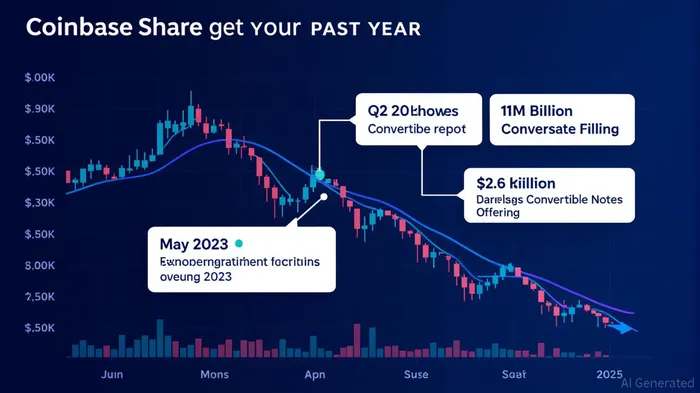
The recent announcement of Coinbase GlobalCOIN--, Inc.'s (COIN) 11M-share resale event has reignited debates about the company's valuation, investor sentiment, and the broader implications for long-term holders. While the resale itself is a routine corporate action, its timing and context—amid a backdrop of mixed earnings, regulatory uncertainty, and a history of insider selling—demand a closer look. For investors, the question is whether this event signals a buying opportunity or a red flag.
The Resale Mechanics: Dilution or Liquidity?
The resale of up to 10,997,856 Class A shares by selling stockholders, including entities like Sentillia B.V. and Stichting Administratiekantoor DRB, is governed by a shelf registration under SEC Rule 424(b)(7). These shares were issued in a private placement and are now being registered for public resale. Crucially, CoinbaseCOIN-- will not receive any proceeds from the sale, and the selling stockholders will bear all transaction costs. The flexibility in resale methods—ranging from negotiated deals to Rule 10b5-1 trading plans—suggests the shares could be sold gradually, potentially mitigating immediate market pressure.
However, the sheer size of the resale (approximately 5% of Coinbase's total outstanding shares as of July 2025) raises concerns about dilutive pressure. While the shares represent a relatively small portion of the float, the market's reaction will depend on the pace and aggressiveness of the sales. A sudden flood of shares could depress the stock price, especially in a market already sensitive to crypto volatility.
Financial Context: A Company at a Crossroads
Coinbase's Q2 2025 financials highlight a company navigating a challenging environment. Revenue of $1.5 billion, while up 3.3% year-over-year, missed estimates by 4.3%, driven by weaker trading volumes and a strategic shift in stablecoin pricing. Non-GAAP profits ($5.14 per share) exceeded expectations, but operating expenses surged 37.5% due to a $307 million data breach and increased cybersecurity investments.
The company's balance sheet remains robust, with $7.5 billion in cash and $2.9 billion in long-term debt. Yet, the recent $2.6 billion convertible notes offering—announced just days before the resale filing—has raised eyebrows. Convertible debt often comes with embedded dilution risks, and the 6.34% drop in Coinbase's stock price following the announcement underscores investor wariness.
Investor Sentiment: A Tug-of-War Between OptimismOP-- and Skepticism
Investor sentiment toward Coinbase is deeply polarized. On one hand, the company's expansion into tokenized real-world assets, derivatives, and decentralized finance (DeFi) integrations has drawn praise from growth-oriented investors. On the other, the combination of insider selling, regulatory headwinds, and a premium valuation has fueled caution.
Insider selling has been a persistent theme. The Brian Armstrong Living Trust alone sold over 1.15 million shares in the past three months, generating $424 million in proceeds. While such sales are legally permissible and often part of estate planning, they can signal a lack of conviction in the stock's short-term prospects. The largest single transaction—a $121.9 million blockXYZ-- sale in June 2025—coincided with a 6.34% drop in Coinbase's share price, amplifying concerns about liquidity pressures.
Analysts are similarly divided. Morningstar's $205 fair value estimate and Zacks' “Hold” rating reflect skepticism about Coinbase's ability to sustain its current valuation. Meanwhile, institutional investors like BlackRockBLK-- have increased their stakes, betting on the company's long-term potential in a maturing crypto market.
The Resale as a Buying Opportunity or Red Flag?
For long-term holders, the 11M-share resale presents a nuanced scenario. On the one hand, the event could create a short-term overreaction, potentially offering a discounted entry point for investors who believe in Coinbase's strategic vision. The company's cash reserves, strong EBITDA margins, and expansion into high-growth segments like tokenized assets suggest it has the financial and operational flexibility to weather near-term challenges.
On the other hand, the resale, combined with the convertible notes offering and insider selling, could exacerbate investor anxiety. The market's sensitivity to crypto volatility—evidenced by Coinbase's beta coefficient of 2.91—means even a modest increase in supply could trigger a sharper-than-expected price correction.
Strategic Considerations for Investors
- Dilution Risk Mitigation: Investors should monitor the pace of the resale and Coinbase's broader capital structure. If the shares are sold gradually, the impact on the stock price may be minimal. However, a rapid or aggressive sale could signal desperation among the selling stockholders.
- Valuation Realism: At a forward P/E of 51.36X, Coinbase trades at a significant premium to its peers. While this reflects optimism about its growth potential, it also leaves little room for error. A meaningful earnings miss or regulatory setback could trigger a valuation reset.
- Regulatory Tailwinds: Coinbase's recent regulatory wins, including its role in legitimizing crypto infrastructure (e.g., the Base blockchain), could offset some of the near-term headwinds. Investors should weigh these developments against the risks of a potential crackdown.
- Diversification: Given the stock's high volatility, investors should consider hedging their exposure or allocating only a small portion of their portfolio to Coinbase.
Conclusion: A Calculated Bet in a Cyclical Market
Coinbase's 11M-share resale is neither a death knell nor a golden opportunity—it's a reminder of the crypto market's inherent volatility and the importance of disciplined investing. For long-term holders, the key is to separate noise from signal. The resale, while noteworthy, is part of a broader narrative that includes strategic growth initiatives, regulatory progress, and a maturing crypto ecosystem.
If the market overreacts to the resale, it could create a buying opportunity for those who believe in Coinbase's long-term vision. However, investors should approach the stock with caution, given its premium valuation and the risks of further dilution. In the end, the decision to buy, hold, or sell will depend on one's risk tolerance and conviction in the company's ability to navigate the crypto market's next phase.





Comentarios
Aún no hay comentarios