
Coinbase's Onchain Wallet Migration: A Catalyst for Institutional Trust and Risk Mitigation in Crypto Assets
Strategic Expansion into Onchain Markets
Coinbase's acquisition of Vector, a Solana-based onchain trading platform, underscores its commitment to expanding access to high-speed, decentralized markets according to Seeking Alpha. This integration allows Coinbase to offer institutional-grade tools for Solana's ecosystem, including dynamic fee adjustments and API-driven automation. By leveraging Vector's technology, Coinbase is addressing a critical gap in institutional onchain trading: the need for seamless liquidity and 24/7 accessibility. This move aligns with the broader trend of institutions allocating more capital to altcoins and DeFi, as 84% of surveyed investors now utilize or plan to adopt stablecoins for yield generation and cross-border transactions.
Institutional Trust: A Numbers-Driven Narrative
Institutional confidence in Coinbase is not speculative-it's quantifiable. As of 2025, Coinbase Institutional serves as the custodian for 9 out of 11 spot Bitcoin ETFs and 8 out of 9 EthereumETH-- ETFs. This dominance in ETF custody reflects the platform's ability to meet stringent institutional demands for transparency and asset segregation. The firm's Prime Custody solution, which offers SOC 2 compliance and customizable access controls, has become a benchmark for secure digital asset management. With 59% of institutional investors planning to allocate over 5% of their AUM to crypto by 2025, Coinbase's infrastructure is positioned to scale alongside this surge in demand.
Security Protocols: Beyond Cold Storage
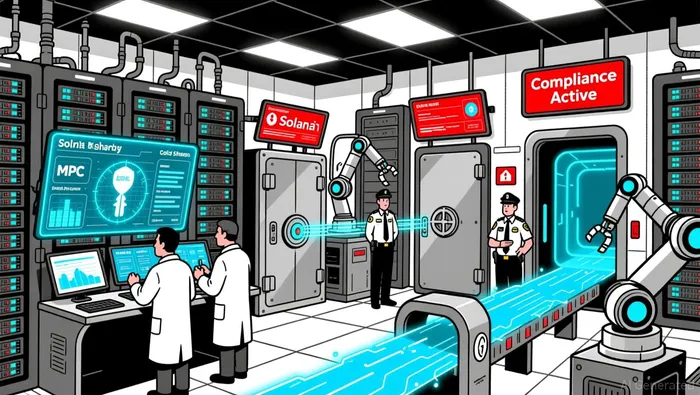
Coinbase's onchain wallet migration introduces a suite of security measures that directly address institutional risk aversion. The Prime Onchain Wallet, designed for institutional use, employs cold storage and MPC key security to ensure assets remain protected while enabling onchain operations. This approach eliminates single points of failure, as transactions require independent signing and verification across multiple nodes. Additionally, Coinbase enforces consensus-based change management, mandating approvals for any production environment modifications-a safeguard against unauthorized access. For Ethereum validators, the platform's double signing protection and real-time metrics prevent slashing incidents, maintaining a 99% uptime guarantee.
Risk Mitigation: A Layered Approach
Institutional investors prioritize risk mitigation frameworks that align with traditional finance standards. Coinbase's onchain wallet migration incorporates dynamic fee adjustments and transaction labeling to reduce operational friction. These features are complemented by policy engines that allow granular access controls and automate compliance checks. By integrating these tools, Coinbase is not merely securing assets-it's creating a governance model that mirrors the accountability expected in institutional finance. This is further reinforced by the platform's zero slashing incident record, a testament to its robust validator monitoring systems.
Conclusion: A New Era of Institutional Confidence
Coinbase's onchain wallet migration is more than a technical upgrade-it's a strategic response to institutional demands for security, compliance, and operational transparency. By combining cutting-edge security protocols with a proven track record in ETF custody and global market expansion, Coinbase is setting a new standard for institutional-grade crypto infrastructure. As 71% of global crypto derivatives trading volume shifts to regulated platforms, the firm's ability to bridge the gap between onchain innovation and institutional trust will likely accelerate adoption across asset classes. For investors, this signals a maturing market where risk is no longer a barrier but a solvable challenge.







Comentarios
Aún no hay comentarios