
Coinbase's OMNI Suspension: A Harbinger of Derivatives Market Volatility and Institutional Opportunities
The recent suspension of Omni Network (OMNI) perpetual contracts by CoinbaseCOIN-- has ignited a critical conversation about the stability of the crypto derivatives market. While the move appears to be a localized response to liquidity and token restructuring challenges, it signals broader systemic risks for institutional investors. This analysis unpacks the implications of Coinbase's decision, contextualizes it within the October 2025 market crash, and identifies strategic opportunities amid the turbulence.
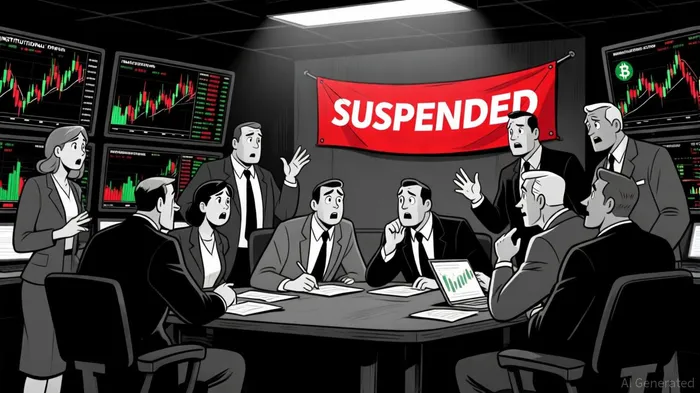
The OMNI Suspension: A Symptom of Derivatives Market Fragility
Coinbase announced the suspension of OMNI perpetual contracts on October 21, 2025, citing concerns over liquidity and ongoing token restructurings, according to a Coinbase announcement. The exchange will settle open positions using a 60-minute average index price, with the right to adjust the final settlement price, as outlined in a Coinbase notice. This approach, while standard in some cases, introduces volatility for OMNI-related assets, particularly as traders scramble to exit positions ahead of the deadline, as reported by CoinLive.
The suspension is not an isolated incident. Coinbase has been systematically delisting tokens like Galxe (GAL), LitentryLIT-- (LIT), and PARSIQ (PRQ) for non-compliance or version upgrades, as highlighted in a Millionero blog post. These actions reflect a tightening of listing standards but also highlight the inherent instability of derivatives markets tied to projects undergoing structural changes. For institutional investors, this underscores a critical risk: the concentration of derivatives liquidity on centralized exchanges that can unilaterally alter market conditions.
Broader Market Context: October 2025's $19.3B Liquidation Event
The OMNI suspension coincides with a historic $19.3 billion liquidation event in October 2025, driven by geopolitical tensions, leveraged positions, and structural vulnerabilities in crypto markets, an event chronicled in the Millionero blog post. Derivatives platforms, which account for over 60% of crypto trading volume, became focal points of this collapse. The OMNI suspension, occurring against this backdrop, exacerbates concerns about cascading liquidity crises.
Institutional investors must now grapple with the reality that derivatives markets are increasingly susceptible to sudden regulatory interventions and exchange-driven policy shifts. The lack of official statements from Coinbase or the OMNI Network further amplifies uncertainty, as traders speculate on the long-term viability of similar products (see the Coinbase notice for settlement details).
Risks for Institutional Investors
- Liquidity Shocks: The suspension of high-profile derivatives products can trigger panic selling, especially in thinly traded assets. The 60-minute average price mechanism, while designed to mitigate manipulation, may fail to reflect true market value during periods of extreme volatility, as noted in the Coinbase announcement.
- Regulatory Arbitrage: Coinbase's aggressive delisting strategy suggests a proactive alignment with evolving regulatory frameworks. Institutions must now factor in the risk of sudden product withdrawals when structuring hedging strategies, a theme explored in the Millionero blog post.
- Funding Rate Distortions: The zeroing of the final funding rate cycle for OMNI perpetual contracts could distort price discovery mechanisms, creating arbitrage inefficiencies that favor sophisticated traders over long-term holders, as reported by CoinLive.
Opportunities in the Chaos
While the risks are significant, the OMNI suspension also presents strategic openings:
- Hedging Innovation: Institutions can leverage cross-asset correlations to hedge against derivatives-specific risks. For example, pairing OMNI exposure with stablecoin or index-linked products could mitigate tail risks during suspensions, per the Coinbase announcement.
- Arbitrage Windows: The 60-minute average price settlement creates temporary price dislocations between spot and derivatives markets. Algorithmic arbitrage strategies could exploit these gaps, provided they account for Coinbase's potential price adjustments noted in the Coinbase notice.
- Structural Reforms: The incident may accelerate demand for decentralized derivatives platforms with transparent governance models. Institutions with early exposure to such protocols could benefit from a market realignment discussed in the Millionero blog post.
Conclusion: Navigating the New Normal
Coinbase's suspension of OMNI perpetual contracts is a microcosm of the crypto derivatives market's evolving risks. For institutional investors, the lesson is clear: liquidity is no longer a given, and regulatory alignment must be a core component of risk management. However, the same forces that create instability-such as rapid innovation and fragmented regulation-also generate asymmetric opportunities.
As the market digests this event, institutions that adopt a dual strategy of cautious hedging and selective arbitrage will be best positioned to thrive in an era where derivatives market stability is a moving target.





Comentarios
Aún no hay comentarios