
Coinbase's Monad Token Sale and the Broader Implications of Government-Finance Innovation
The Mechanics of Fair Distribution
Coinbase's token sale platform prioritizes long-term holders over speculative traders, using an algorithm to allocate tokens based on user behavior, such as holding duration and transaction history, according to a Coinbase announcement. Participants can bid between $100 and $100,000 in USDCUSDC--, with allocations finalized after a one-week submission period. This approach aims to curb short-term volatility and reward genuine community builders-a stark contrast to traditional token sales, where whales and bots often dominate.
The platform's design aligns with broader goals of democratizing access to blockchain innovation. By requiring issuers to disclose tokenomics and team details, Coinbase fosters transparency, a critical factor in attracting institutional and retail investors alike, according to a Coinbase report. For Monad, this means a controlled rollout ahead of its November 24 mainnet launch, with tokens distributed to participants who are incentivized to hold rather than flip.
Regulatory Experimentation: The U.S. and Beyond
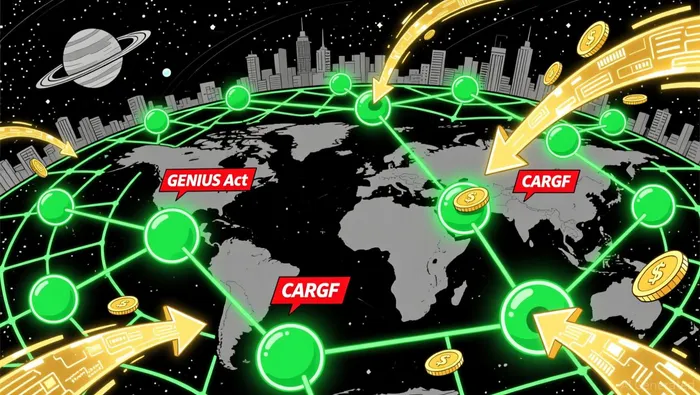
The GENIUS Act, enacted in July 2025, has reshaped the U.S. stablecoin landscape, mandating that reserves be backed by safe, liquid assets like Treasurys and repos, according to a Coinbase report. This framework legitimizes stablecoins as a core part of the payment system, potentially reducing U.S. borrowing costs by increasing demand for dollar-denominated assets, according to a Coinbase report. For Coinbase, the act creates both opportunities and challenges: while it legitimizes USDC (which hit $74 billion in market cap in 2025, according to a Coinbase earnings report), it also restricts yield-bearing stablecoins, forcing platforms to innovate within tighter regulatory boundaries.
Coinbase has lobbied for a narrow interpretation of the GENIUS Act, arguing that broad oversight could stifle blockchain innovation, according to a Coinbase advocacy statement. Its stance highlights a growing divide between crypto-native firms and traditional banking associations, with the former advocating for regulatory clarity that supports decentralized finance (DeFi) and the latter pushing for stricter controls.
Globally, the picture is equally complex. In Africa, South Africa's CARGF framework and Ghana's upcoming crypto regulations are attracting institutional capital, with Sub-Saharan Africa reporting $25 billion in monthly crypto transactions by late 2025, according to an Africa regulatory analysis. Meanwhile, Asia sees India, Vietnam, and Pakistan leading grassroots adoption, driven by large populations and decentralized platforms, according to a 2025 Global Adoption Index. These regions are becoming hotspots for blockchain investment, with projects like CratD2C (a Layer-1 smartchain) and Craddon (a cross-border payment platform) leveraging regulatory clarity to scale real-world use cases, according to a CratD2C investment announcement and a Craddon platform overview.
Strategic Investment in Blockchain Infrastructure
For investors, the interplay between policy and technology creates a unique opportunity set. The Monad Token Sale exemplifies how platforms can bridge the gap between speculative trading and sustainable infrastructure investment. By aligning token distribution with long-term value, Coinbase's model reduces the risk of market manipulation and fosters projects with real utility-such as Monad's focus on high-performance blockchain for enterprise applications.
Institutional interest is also surging. A 2025 report by Chainalysis notes that 52% of hedge funds are exploring tokenised fund structures, with Asia and the Middle East leading adoption, according to a Chainalysis report. This trend is mirrored in Africa, where Ripple's partnership with Absa Bank to build crypto custody infrastructure underscores the continent's growing role in global finance, according to a Crypto Fest 2025 event report.
However, risks remain. Regulatory shifts, such as the U.S. ban on interest-bearing stablecoins, could disrupt yield strategies. Similarly, systemic risks in stablecoin adoption-like runs on reserves-require careful monitoring. Investors must balance optimism with caution, prioritizing projects with transparent tokenomics and regulatory alignment.
Conclusion: The Future of Finance is Decentralized
Coinbase's Monad Token Sale is more than a fundraising event-it's a microcosm of the broader tension between innovation and regulation. As governments experiment with blockchain policies, from the U.S. GENIUS Act to Africa's CARGF framework, the financial system is evolving toward a hybrid model where decentralized infrastructure coexists with traditional institutions.
For strategic investors, the key lies in understanding these dynamics. Projects that align with regulatory trends-like Monad's focus on fair distribution or Craddon's energy-efficient payment solutions-offer compelling long-term value. Meanwhile, platforms like Coinbase, which act as bridges between regulators and innovators, are positioned to shape the next phase of financial infrastructure.
As the November 17 sale approaches, one thing is clear: the future of finance is not just decentralized-it's being redefined by the interplay of policy, technology, and capital.





Comentarios
Aún no hay comentarios