
The Coinbase-Kimchi Price Spread: A Leading Indicator of Bitcoin's Global Bull Run
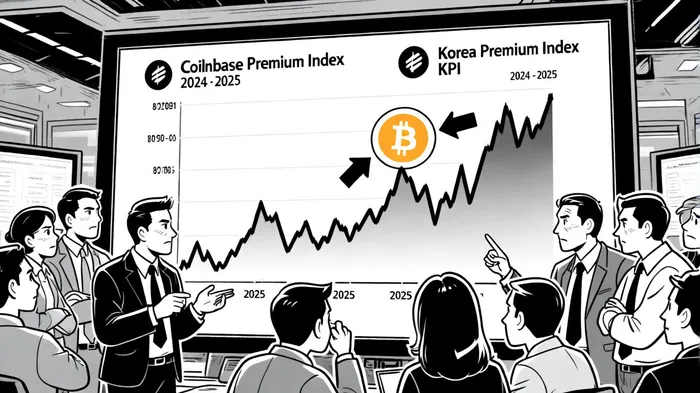
Bitcoin's journey toward global adoption is increasingly shaped by the tug-of-war between U.S. institutional demand and Asian retail speculation, as measured by the Coinbase-Kimchi Price Spread. This spread-the difference between Bitcoin's price on U.S. exchanges like CoinbaseCOIN-- and its premium in South Korean markets-has emerged as a critical leading indicator of bullish momentum. As of October 2025, the Coinbase Premium Index (CPI) and Korea Premium Index (KPI) are flashing signals of a market poised for further consolidation and potential breakout.
The Mechanics of the Kimchi Premium
The Kimchi Premium, or KPI, reflects South Korean retail investors' appetite for BitcoinBTC--, often driven by speculative fervor and regulatory arbitrage. Historically, the KPI has ranged between +1% and +3%, according to a Bitcoinist analysis, but recent data shows it climbing to its highest level since February 2025, as noted in an Aurpay report. The Crypto Fear & Greed Index swung from greed to fear in early October, the Aurpay piece also observed. South Korean buyers, however, remain undeterred, pushing prices higher in local markets.
Meanwhile, the CPI-a measure of U.S. institutional demand-hit 0.18 in early October 2025, the highest since March 2024, the Aurpay report found. While it has since retreated to 0.09, this level remains elevated compared to earlier in the year. U.S. players, particularly those using Coinbase Prime, are accumulating Bitcoin for the long term, signaling institutional confidence, a Bitcoinist analysis noted. This dynamic creates a feedback loop: Asian retail demand drives short-term volatility, while U.S. institutional buying provides a stabilizing force.
Price Discovery in a Fragmented Market
Bitcoin's price discovery process has become increasingly fragmented as liquidity pools form in different regions. When U.S. demand outpaces Asian speculation, the CPI rises, often preceding sustained price rallies. Conversely, heavy inflows into Binance-driven by Asian retail activity-can trigger short-term selling pressure, as reported by Bitcoinist. This interplay explains Bitcoin's recent consolidation around $110,000 and its October 2025 breakout to $126,198, which the Aurpay piece described.
The October rally was fueled by a dovish Federal Reserve, spot Bitcoin ETF inflows, and a tightening on-chain supply, according to the Aurpay report. However, the Kimchi Premium's recent spike suggests that South Korean investors are still aggressively buying the dip, even as global sentiment turns cautious. This divergence highlights the importance of monitoring regional liquidity dynamics: U.S. buying often confirms trends initiated in Asian markets, Bitcoinist reported.
Historical Patterns and Future Projections
October has historically been bullish for Bitcoin, delivering positive returns in 83% of Octobers since 2015, according to an Uptober Outlook. In 2025, this trend was reinforced by macroeconomic tailwinds, including a weaker U.S. dollar and Bitcoin's role as a hedge against currency devaluation. Spot Bitcoin ETFs, which have accumulated over 1.29 million BTC since their 2024 approval, are helping to institutionalize demand, according to the CoinGecko report.
Projections for 2025 suggest Bitcoin could reach $154,936 by 2030, assuming a 5% annual price increase, a Bitcoinist projection suggested. However, the Kimchi Premium's volatility raises questions about sustainability. Past spikes in the CPI and KPI have often been followed by corrections, as seen in March 2024 and February 2025, the Aurpay analysis noted. Investors must balance optimism with caution, recognizing that regional imbalances can amplify both gains and losses.
Conclusion: A Global Barometer for Bitcoin
The Coinbase-Kimchi Price Spread is more than a niche metric-it is a barometer of Bitcoin's global adoption. U.S. institutional demand and Asian retail speculation are two sides of the same coin, shaping price discovery in real time. As of October 2025, the spread suggests a market at a crossroads: South Korean buyers are betting on further upside, while U.S. institutions are hedging for the long term. For investors, the key takeaway is clear: the Kimchi Premium is not just a local phenomenon but a leading indicator of Bitcoin's next move.







Comentarios
Aún no hay comentarios