
Coeur d'Alene Bancorp's Q3 2025 Performance and Growth Momentum: Strategic Positioning in a Shifting Regional Banking Landscape
Coeur d'Alene Bancorp (CDAB) reported robust third-quarter 2025 results, with net income rising to $402,111 or $0.21 per share, a 62.5% increase compared to $253,324 or $0.13 per share in Q3 2024, according to the company's third-quarter 2025 release. This growth, despite a 1.1% year-on-year decline in total consolidated assets to $237.3 million, underscores the bank's disciplined approach to balancing expansion with asset quality. Gross loans grew by 3.8% to $130.1 million, while deposits increased modestly by 0.3% to $204.0 million, reflecting steady demand in its core markets of Idaho and Washington (per the company release).
Strategic Expansion and Operational Efficiency
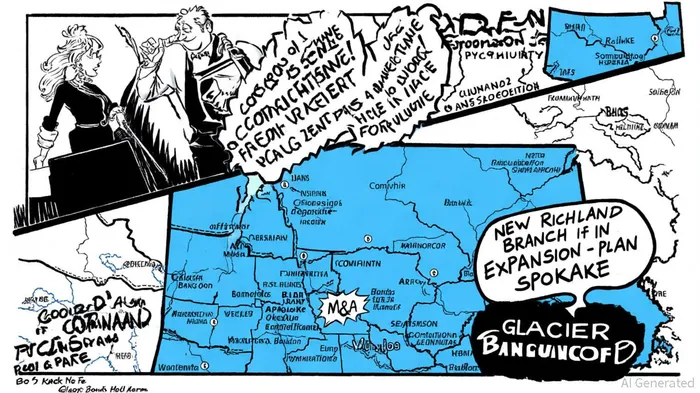
The bank's strategic focus on geographic expansion is a key driver of its growth momentum. In Q3 2025, Coeur d'Alene Bancorp opened its second branch in Washington state, located in Richland, as part of a broader plan to strengthen its presence in the Spokane market (the company release). This expansion aligns with the bank's emphasis on community banking, leveraging its local relationships to capture market share in high-growth regions. While increased overhead from expansion has temporarily pressured profitability, management highlighted an expanding net interest margin (NIM) of 3.62% in Q1 2025, according to Forvis Mazars' Q2 2025 update, which has helped offset these costs.
The regional banking landscape in Idaho and Washington is marked by intense competition and a wave of consolidation. For instance, Glacier Bancorp, a regional peer, has aggressively expanded through acquisitions, including the $245.4 million purchase of Bank of Idaho in May 2025, according to a GlobeNewswire release. Such deals reflect a broader industry trend: 34 bank M&A transactions were announced in Q1 2025 alone, up from 28 in Q1 2024 (the company release). While Coeur d'Alene Bancorp has opted for organic growth rather than M&A, its branch expansion strategy positions it to compete with larger players seeking scale through consolidation.
Regulatory and Economic Tailwinds
The shifting regulatory environment in 2025 further bolsters Coeur d'Alene's strategic positioning. A new administration in Washington, D.C., has prioritized deregulation, including easing capital and stress testing requirements under the Dodd-Frank Act (Forvis Mazars' Q2 2025 update). This shift provides regional banks like Coeur d'Alene with greater flexibility to allocate capital toward growth initiatives. Additionally, the expiration of the Tax Cuts and Jobs Act (TCJA) provisions at year-end 2025 is expected to extend tax cuts, potentially reducing corporate tax rates to 15–20% (Forvis Mazars' Q2 2025 update). These developments could enhance Coeur d'Alene's profitability, particularly as it invests in technology and infrastructure to support its expansion.
However, the bank must also navigate macroeconomic headwinds. Deloitte's 2025 banking outlook notes that declining interest rates could compress net interest margins, with estimates suggesting a marginal settlement around 3% by year-end (the company release). While Coeur d'Alene's NIM of 3.62% in Q1 2025 provides a buffer, the bank will need to diversify revenue streams through noninterest income-such as investment banking fees and asset management-to maintain profitability (the company release).
Technology and Competitive Differentiation
Coeur d'Alene's emphasis on technology adoption further strengthens its competitive edge. The bank has integrated digital solutions to streamline operations and enhance customer service, aligning with broader industry trends toward cloud computing and AI-driven personalization (Forvis Mazars' Q2 2025 update). For example, regional banks in Idaho and Washington are increasingly leveraging cloud infrastructure to modernize legacy systems and improve agility (Forvis Mazars' Q2 2025 update). By combining technological innovation with its community-focused model, Coeur d'Alene differentiates itself from both larger banks and fintechs, which often lack localized relationships.
In contrast, competitors like Glacier Bancorp are prioritizing scale through M&A, integrating acquired institutions into existing divisions to achieve economies of scale (the GlobeNewswire release). While this approach reduces funding costs and expands deposit bases, it also introduces integration risks and regulatory scrutiny. Coeur d'Alene's organic growth strategy, though slower, allows it to maintain operational control and preserve its customer-centric identity.
Valuation and Outlook
Coeur d'Alene's financials remain resilient, with nonperforming assets to Tier 1 capital at 0.57% as of September 30, 2025 (the company release), reflecting strong risk management. Its conservative balance sheet, coupled with strategic expansion and regulatory tailwinds, positions the bank to outperform in a fragmented regional banking sector. However, investors should monitor the impact of rising interest-bearing deposit costs and potential credit risks from lower interest rates (the company release).
Conclusion
Coeur d'Alene Bancorp's Q3 2025 results and strategic initiatives highlight its ability to navigate a dynamic regional banking landscape. By prioritizing disciplined expansion, technological innovation, and regulatory agility, the bank is well-positioned to capitalize on growth opportunities in Idaho and Washington. While challenges such as margin compression and competitive consolidation persist, its focus on asset quality and community banking provides a durable foundation for long-term value creation.







Comentarios
Aún no hay comentarios