
Cocoon and the Future of Decentralized AI: A Game-Changer for TON and GPU Providers
The emergence of decentralized AI infrastructure represents a seismic shift in the technology and finance landscapes. At the forefront of this movement is Cocoon, Telegram's decentralized AI network built on the Telegram Open Network (TON) blockchain. By leveraging TON's scalability and Telegram's 1.8 billion-user ecosystem, Cocoon is poised to disrupt traditional cloud computing while creating a lucrative, privacy-preserving market for GPU providers. This analysis examines Cocoon's economic and technological potential, its implications for TON's utility, and the broader GPU compute market.
Economic Impact: A New Paradigm for GPU Compute Markets
Cocoon's decentralized model introduces a direct, peer-to-peer marketplace for GPU compute power, bypassing intermediaries like Amazon Web Services or Google Cloud. GPU owners can rent out their hardware-particularly high-end NvidiaNVDA-- B200-class GPUs-to developers and enterprises, earning TONTON-- tokens in return. This model not only reduces costs for users but also democratizes access to AI infrastructure, which has historically been dominated by a few centralized players according to reports.
A critical driver of Cocoon's economic potential is AlphaTON Capital's $82.5 million investment in a 1,000+ GPU cluster, including $70 million in B200-class hardware. This infrastructure, deployed in hydroelectric-powered data centers, ensures both performance and environmental sustainability according to data. The projected returns on this investment are staggering: an internal rate of return (IRR) of 59.7% and a net present value (NPV) of $59.6 million according to Nasdaq. These figures underscore the financial viability of Cocoon's model, particularly as AI demand surges.
Moreover, Cocoon's integration with Telegram's ecosystem creates a self-reinforcing cycle. With over one billion users, Telegram can drive adoption of privacy-first AI features like message summarization and automated drafting, further increasing demand for GPU resources according to reports. This dynamic mirrors the success of Akash Network, a decentralized compute platform that achieved 18x revenue growth by catering to AI startups unable to secure high-end GPUs through traditional channels according to LinkedIn.
Technological Framework: TON's Role in Enabling Decentralized AI
Cocoon's technological foundation lies in TON's blockchain, which offers high throughput, low latency, and robust smart contract capabilities. Unlike EthereumETH-- or BitcoinBTC--, TON is designed for mass adoption, with Telegram's user base providing an immediate audience for decentralized applications (dApps). Cocoon leverages TON's Proof-of-Stake (PoS) consensus and secure data encryption to ensure privacy and efficiency, addressing a key pain point in AI development: data sovereignty according to TradingView.
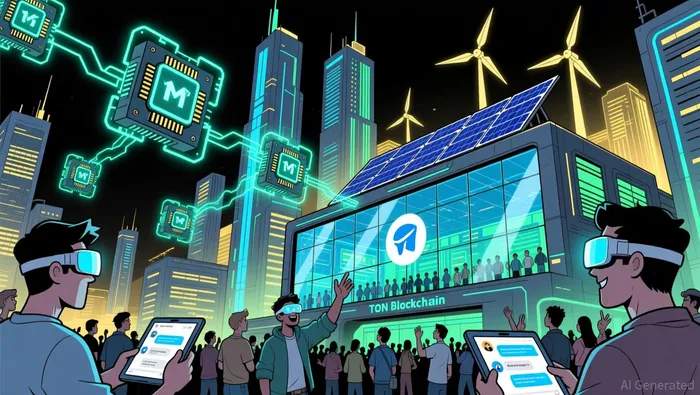
The network's use of Nvidia B200 GPUs-a cutting-edge architecture optimized for AI workloads-further enhances its competitiveness. These GPUs, combined with TON's decentralized architecture, enable Cocoon to deliver performance comparable to centralized cloud providers while eliminating the risks of data breaches or vendor lock-in according to Nasdaq. For developers, this means a cost-effective, scalable solution for training and deploying AI models without sacrificing privacy according to reports.
Implications for TON's Utility and Token Value
Cocoon's success could significantly elevate TON's utility beyond its current role as a messaging platform. By anchoring a high-value use case-decentralized AI-TON transitions from a niche blockchain to a critical infrastructure layer for global AI development. This shift is likely to drive demand for TON tokens, which are used for transactions, staking, and governance within the network according to TradingView.
The economic incentives embedded in Cocoon's model also create a flywheel effect. As more GPU providers join the network, compute capacity increases, attracting developers and enterprises. This, in turn, boosts TON's transaction volume and token utility, reinforcing the network's value proposition according to Nasdaq. For investors, this dynamic mirrors the growth trajectories of earlier blockchain networks like Ethereum, where dApps drove token adoption and price appreciation.
Challenges and Considerations
Despite its promise, Cocoon faces challenges. Regulatory scrutiny of decentralized AI infrastructure could emerge, particularly in jurisdictions with strict data privacy laws. Additionally, the network must overcome technical hurdles, such as ensuring consistent GPU performance and mitigating potential bottlenecks in decentralized compute networks. However, AlphaTON's strategic partnerships-with firms like SingularityNET and CUDO Compute-suggest a robust ecosystem capable of addressing these issues according to QuiverQuant.
Conclusion: A Strategic Investment Opportunity
Cocoon represents a convergence of technological innovation and economic opportunity. By decentralizing AI compute and leveraging TON's infrastructure, it addresses critical gaps in privacy, cost, and scalability. For GPU providers, it offers a new revenue stream with projected returns exceeding traditional markets. For TON, it unlocks a path to mainstream adoption as a foundational layer for AI. Investors who recognize this potential early may position themselves to capitalize on a transformative shift in the tech industry.
As the AI revolution accelerates, Cocoon's ability to deliver privacy-preserving, cost-effective, and sustainable compute solutions will likely define its trajectory. With Telegram's ecosystem as a catalyst and AlphaTON's capital as a backer, the network is well-positioned to become a cornerstone of the decentralized AI economy.







Comentarios
Aún no hay comentarios