
Cocoa Market Resilience and Growth Opportunities Amid Rising North American Demand
The global cocoa market has faced significant headwinds in recent years, from supply chain disruptions to climate-related shocks. Yet, North America stands out as a beacon of resilience and growth, offering compelling opportunities for commodity investors navigating the post-pandemic recovery phase. This analysis explores the structural and cyclical factors driving North America's cocoa demand, the challenges that persist, and the strategic implications for investors seeking to capitalize on this evolving market.
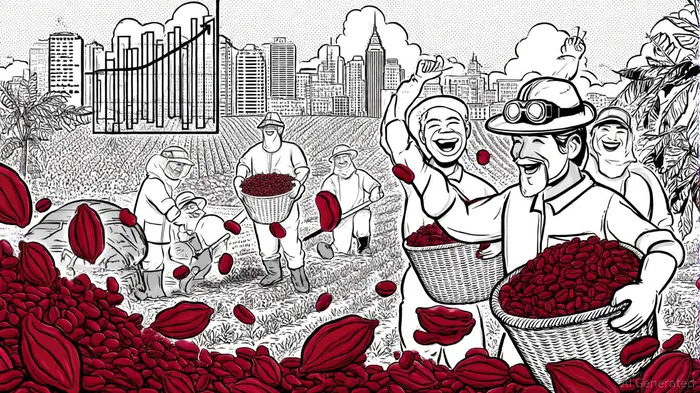
Market Resilience: A North American Exception
North America's cocoa market has demonstrated remarkable resilience, bucking broader global trends of slowing demand. According to an Expert Market Research report, the region's cocoa market was valued at USD 2.67 billion in 2024, with the United States accounting for the lion's share of consumption due to its high per capita chocolate intake and advanced processing infrastructure. This growth is underpinned by shifting consumer preferences toward premium, ethically sourced products; Millennials and Gen Z, in particular, are prioritizing single-origin, organic, and Fairtrade-certified cocoa, reflecting a broader societal shift toward sustainability and transparency, as noted by Expert Market Research.
The third quarter of 2025 further underscored this resilience: the North American cocoa grind hit a record high of 131,974 tonnes, an 8.25% increase year-on-year-the highest level since at least 2009, according to a Yahoo Finance report. This surge was driven by confectioners stockpiling inventory ahead of the holiday season and robust business conditions in the U.S. However, this growth contrasts sharply with declining cocoa demand in Europe, Asia, and other regions, highlighting North America's unique position as a growth pole, as the Yahoo Finance piece also observed.
Growth Opportunities: Innovation and Diversification
The North American cocoa market is not merely recovering-it is evolving. Rising health consciousness has spurred innovation in cocoa applications beyond traditional chocolate confections. For instance, cocoa powder is increasingly used in plant-based snacks, protein bars, and low-sugar desserts, aligning with dietary trends toward clean labels and functional ingredients (Expert Market Research outlines these shifts). Similarly, the cosmetics industry is leveraging cocoa butter for its moisturizing and antioxidant properties, expanding its use in skincare and personal care products, as the same report details.
Investors should also note the strategic moves of major players like HersheyHSY--, Mars, and MondelezMDLZ--, which are deepening their supply chain ties to secure premium cocoa. The U.S. alone imported cocoa butter worth $598 million in 2022, reflecting its critical role in both confectionery and non-food sectors, according to Expert Market Research. Meanwhile, Canada's growing appetite for artisanal and ethically sourced cocoa products is creating a parallel growth trajectory, driven by similar demographic and cultural shifts (Expert Market Research highlights this trend).
Challenges: Supply Constraints and Price Volatility
Despite these positives, the cocoa market remains vulnerable to global supply shocks. North America's reliance on cocoa imports-primarily from West Africa-exposes it to disruptions caused by climate change, aging cocoa trees, and plant diseases. For example, cocoa production in Côte d'Ivoire and Ghana, the world's top producers, declined by 40% in 2024 due to erratic weather patterns and crop failures, according to Expert Market Research. These supply-side pressures have driven up prices for cocoa butter and liquor, critical inputs for North American manufacturers.
To mitigate these risks, companies are diversifying their sourcing strategies. Latin American countries like Ecuador and Brazil are emerging as alternative suppliers, though scaling production in these regions will take time, the report notes. Investors must weigh the long-term sustainability of such strategies against the immediate cost implications of price volatility.
Strategic Implications for Commodity Investors
For investors, the North American cocoa market presents a nuanced opportunity. The region's demand growth is underpinned by durable trends-sustainability, health consciousness, and product innovation-that are unlikely to reverse. However, exposure to this market requires a balanced approach:
1. Diversification: Allocating capital to companies with diversified sourcing strategies or vertical integration can reduce vulnerability to supply shocks.
2. Ethical Sourcing: Firms with strong ESG credentials and transparent supply chains are better positioned to capture the premium segment, which is growing faster than the mass market.
3. Hedging: Given price volatility, investors might consider hedging strategies or investing in derivatives to manage exposure to cocoa price swings.
Conclusion
The North American cocoa market exemplifies how structural consumer shifts and strategic innovation can drive resilience in a volatile global commodity landscape. While challenges like supply constraints persist, the region's unique growth dynamics-rooted in demographic trends and product diversification-make it an attractive proposition for investors. Those who navigate the risks with agility and foresight are likely to reap rewards in this evolving market.





Comentarios
Aún no hay comentarios