
Cocoa Market Dynamics: Cyclical Recovery and Strategic Investment Opportunities
The cocoa market has long been a barometer of global agricultural volatility, shaped by the delicate balance of supply-side constraints and demand-side pressures. As of September 2025, the market is at a pivotal juncture, with prices oscillating between bearish and bullish signals. For commodity-linked investors, understanding the cyclical patterns and structural shifts in West Africa's production landscape is critical to identifying strategic entry points into cocoa futures and related agri-commodity assets.
Supply-Demand Imbalances and Cyclical Volatility
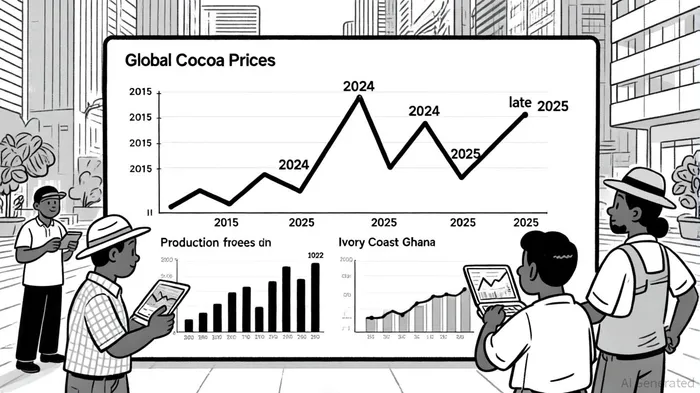
Cocoa prices reached a record high of $8,401.95 per metric ton in June 2025, driven by persistent supply-side challenges in Ivory Coast and Ghana, the world's top two producers[1]. However, by early September, prices had fallen to $7,081.42 per ton, a 19.33% drop, as improved harvest prospects in West Africa—particularly a 7% increase in cocoa pod counts—temporarily eased market fears[2]. This volatility underscores the cyclical nature of the market, where short-term supply optimism clashes with long-term structural issues such as aging cocoa trees, crop diseases, and erratic rainfall[3].
Historical data reveals a recurring pattern: cocoa prices surged in 2024 due to El Niño-induced droughts, fertilizer shortages, and disease outbreaks, only to face sharp corrections when supply conditions improved[4]. For instance, Ghana's 2024–25 output of 530,000 tons—the weakest in over two decades—sparked a 20% price rebound in May 2025[5]. Yet, the International Cocoa Organization (ICCO) projects a 7.8% increase in global supply for 2024/25, reaching 4.840 million tonnes, while demand is expected to contract by 4.8% to 4.650 million tonnes[6]. This divergence between supply and demand highlights the market's susceptibility to sudden shifts, creating opportunities for investors to capitalize on mispricings.
Production Challenges and Regional Divergence
Ivory Coast and Ghana account for over 60% of global cocoa output, yet their trajectories diverge sharply. Ivory Coast's 2024/25 production is projected at 1.84 million tons, a modest increase from 1.76 million tons in the prior season[7]. However, the mid-crop harvest—typically smaller and lower quality—faces risks from poor rainfall and disease, with rejections reaching 5–6% in 2025[8]. Ghana, meanwhile, is grappling with a 22-year low of 530,000 tons for 2024–25, attributed to the cocoa swollen shoot virus and aging plantations[9]. Despite these challenges, Ghana's 2025/26 crop is expected to rise by 8.3% to 650,000 tons, potentially introducing downward pressure on prices[10].
The ICCO's data underscores a broader trend: global cocoa production has declined by 12.9% in 2023/24, exacerbating a 494,000-ton deficit[11]. While this deficit has historically driven price spikes, the market's response to 2025's improved supply forecasts suggests that cyclical corrections are inevitable. Investors must weigh these short-term fluctuations against long-term risks, such as climate change and deforestation, which threaten to erode production gains.
Investment Case: Timing the Cyclical Recovery
For investors, the current market environment presents a nuanced opportunity. Cocoa futures have traded below $7,000 per ton in late 2025, a level last seen in November 2024[12]. Analysts project a partial recovery to $8,858.15 per ton by mid-2026, driven by anticipated supply constraints in 2025/26[13]. This trajectory aligns with historical cycles, where prices rebound after periods of oversupply, particularly when production in key regions falters.
Strategic entry into cocoa futures or related agri-commodity assets—such as coffee or palm oil—could capitalize on this dynamic. For instance, Ghana's state-guaranteed price hikes for farmers (up 45% in 2024/25) aim to stabilize supply chains and reduce smuggling[14]. However, these measures may delay the market's full recovery, creating a window for investors to secure positions at discounted prices. Additionally, the projected surplus in 2025/26 (142,000 tons) may not materialize if weather disruptions or disease outbreaks persist[15].
Risks and Mitigation Strategies
While the investment case is compelling, risks remain. A Reuters poll warns of potential price declines by late 2025 due to weakening demand and a projected surplus[16]. Moreover, geopolitical factors—such as Ivory Coast's proposed export tax hikes—could disrupt trade flows[17]. To mitigate these risks, investors should diversify across agri-commodities and hedge against currency fluctuations, given the reliance on CFA franc-denominated cocoa in West Africa.
Conclusion
The cocoa market's cyclical nature, driven by West Africa's production challenges and global demand shifts, offers a fertile ground for strategic investment. While short-term volatility persists, the long-term fundamentals—aging plantations, climate risks, and policy interventions—suggest a market poised for recovery. Investors who act decisively in the current low-price environment may position themselves to benefit from the inevitable rebound, provided they remain vigilant to evolving supply-side dynamics.







Comentarios
Aún no hay comentarios