
Coca-Cola's Sustainable Packaging Revolution: ESG-Driven Innovation and Long-Term Value Creation in a Carbon-Conscious Market
Paper-Based Innovations: A Blueprint for Circular Economy
Coca-Cola's recent launch of the Lift Up paper-based carrier-a fully recyclable cardboard handle for 1.5-liter soda multipacks-exemplifies its commitment to reducing plastic waste. This innovation, developed in partnership with DS Smith and Krones, replaces traditional plastic shrink wrap and is already being tested in Austria. The initiative is projected to eliminate 200 metric tons of plastic annually, a tangible step toward Coca-Cola's goal of making 100% of its packaging recyclable by 2025.
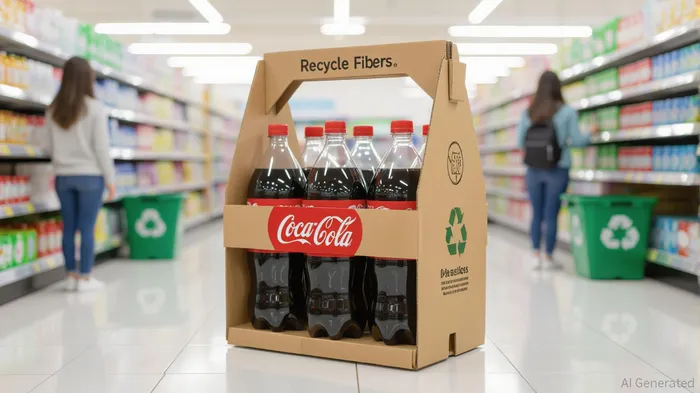 Beyond the Lift Up carrier, the company is exploring more radical solutions, such as a paper bottle prototype with a bio-based barrier capable of containing carbonated beverages. These efforts align with broader shifts in the beverage sector, where 70% of consumers now prioritize brands that demonstrate environmental responsibility. By redesigning packaging to be both functional and eco-friendly, Coca-Cola is embedding circular economy principles into its operations, reducing reliance on virgin plastics and mitigating supply chain risks tied to fossil fuel volatility according to industry analysis.
Financial Resilience and ESG Synergy
Coca-Cola's sustainability initiatives are not merely symbolic; they are financially material. The company's third-quarter 2025 results underscore this synergy: net revenues grew 5% to $12.5 billion, with operating income surging 59% year-over-year to $3.98 billion according to investor reports. These gains reflect a strategic pivot toward cost-efficient, sustainable practices. For instance, the shift to clear PET bottles and standardized cap designs simplifies recycling, reducing material costs and enhancing operational efficiency.
Moreover, Coca-Cola's ESG performance is attracting capital. The company's bottler, Coca-Cola FEMSA, scored 79/100 in S&P Global's 2025 Corporate Sustainability Assessment-a 9-point improvement from 2024-highlighting its appeal to ESG-focused investors according to recent data. As global markets increasingly tie capital allocation to sustainability metrics, Coca-Cola's proactive approach positions it to outperform peers in a sector where 85% of investors now prioritize ESG criteria.
Sector-Wide Trends and Competitive Positioning
The beverage industry's shift toward sustainability is accelerating, driven by regulatory pressures and consumer demand. For example, California's 2022 law mandates that all packaging be recyclable or compostable by 2032, a standard Coca-Cola is already exceeding. Meanwhile, the global recyclable beverage packaging market is projected to grow at a 6.5% CAGR through 2032, fueled by innovations like biodegradable materials and advanced recycling technologies.
Coca-Cola's leadership in this space is further reinforced by its 2035 sustainability targets, including a 35% to 40% recycled material usage in primary packaging and a 70% to 75% collection rate for bottles and cans according to company disclosures. These goals align with broader sector trends, such as the rise of zero-waste beverages and refillable systems, which cater to a "sober curious" demographic seeking both health and environmental benefits. By staying ahead of these trends, Coca-Cola is mitigating regulatory risks and capturing market share in a sector where 31% of consumers explicitly choose upcycled products to avoid waste.
Investment Implications: A Carbon-Conscious Future
For investors, Coca-Cola's ESG-driven strategy signals resilience in a carbon-conscious market. The company's 2025 Q3 results-marked by a 32% operating margin and $9.8 billion in projected free cash flow-demonstrate that sustainability and profitability are not mutually exclusive according to financial analysis. Furthermore, Coca-Cola's partnerships with suppliers and bottlers to scale sustainable packaging innovations suggest a scalable model that can be replicated across its global footprint.
However, challenges remain. The beverage sector faces regulatory headwinds, including sugar content restrictions and advertising bans, which could pressure margins. Yet, Coca-Cola's diversified portfolio-spanning low-sugar options and functional beverages-positions it to navigate these risks. As the global carbonated soft drinks market grows at a 3.8% CAGR through 2025, with health-conscious consumers driving demand for sugar-free and functional products according to market forecasts, Coca-Cola's ability to innovate while maintaining ESG integrity will be critical to sustaining its competitive edge.
Conclusion
Coca-Cola's sustainable packaging revolution is more than a response to environmental concerns-it is a strategic imperative for long-term value creation. By embedding ESG principles into its product innovation and supply chain, the company is not only reducing its carbon footprint but also enhancing financial resilience and investor appeal. As the beverage sector evolves, Coca-Cola's proactive approach to sustainability will likely serve as a benchmark for peers, reinforcing its position as a leader in a carbon-conscious market. For investors, this signals a compelling opportunity to align capital with a company that is redefining the future of consumer goods.







Comentarios
Aún no hay comentarios