
Coal India's Credit Stability Amid Energy Transition: A Balancing Act of Strength and Vulnerability
In the shifting landscape of global energy markets, state-owned enterprises like Coal India Ltd. (CIL) stand at a crossroads. As India accelerates its transition to renewable energy, CIL's creditworthiness hinges on its ability to balance short-term operational dominance with long-term strategic adaptation. While the company's FY2025 financial results underscore its current resilience, underlying vulnerabilities-stemming from energy policy shifts, market competition, and environmental pressures-pose existential risks to its legacy as a coal titan.
Financial Fortitude and Operational Dominance
CIL's FY2025 performance was nothing short of robust, with revenue from operations hitting ₹1,43,369 crore ($18.8 billion) and net profit surging to ₹35,358 crore ($4.6 billion), enabling a generous dividend of ₹5.15 per share, according to Livemint (according to Livemint). These figures reflect the company's entrenched position in India's energy ecosystem, where it controls 80% of domestic coal production and 48% of proven coal reserves, as the Livemint report notes. Its logistics network, spanning railways, ports, and coal washeries, further cements its operational scale.
However, recent quarterly results reveal cracks in this armor. Q2 FY2025 saw an 18.21% drop in revenue to ₹30,672 crore, while Q3 witnessed a 17% decline in net profit to ₹8,505 crore, attributed to softer demand and lower coal offtake, the Livemint report added. These dips highlight the volatility of CIL's business model in a market increasingly influenced by renewable energy adoption and global coal price crashes (from $445/tonne in 2023 to $100/tonne in 2025), according to the same coverage.
Structural Advantages and Energy Transition Challenges
CIL's dominance is underpinned by structural advantages: its monopoly over coal reserves and production, coupled with India's continued reliance on coal for 55% of its electricity mix by 2030, the Livemint analysis observes. The Central Electricity Authority (CEA) projects that coal will remain a critical energy source for the next decade, with 40–50 GW of new coal-based capacity planned to meet rising demand. At the same time, Moody's estimates India will spend up to $385 billion on renewables, according to Reuters (Reuters). This provides CILCIL-- with a buffer against immediate obsolescence.
Yet, India's energy transition is accelerating. The International Energy Agency (IEA) forecasts renewable energy capacity to surge from 168 GW in 2023 to over 500 GW by 2030, reducing coal's share in electricity generation from 73% to 55%, a trend highlighted in media coverage. This shift is compounded by policy reforms like the Mines and Minerals (Development and Regulation) Amendment Act of 2021, which has spurred private coal production. Private players now account for 19% of the market, up from 9% in 2019–20, with 125 auctioned mines contributing 273 million tonnes annually, the Livemint piece reports.
Diversification Delays and Credit Implications
CIL's attempts to diversify into renewables and critical minerals remain nascent. While the company has partnered with GAIL Ltd. to produce synthetic natural gas and plans 3 GW of solar projects, these initiatives lack clear timelines and tangible outcomes, the Livemint coverage cautions. A CRISIL ESG rating of 53 (as of September 2025) reflects its sustainability efforts but underscores the gap between ambition and execution, according to the same report.
Credit analysts remain cautious. Fitch Ratings notes that weaker coal prices are weighing on Asian coal producers' credit profiles, while Moody's highlights the $385 billion renewable investment as a long-term threat to coal's relevance. Although CIL's sovereign-backed status and fiscal discipline (evidenced by India's recent S&P upgrade to 'BBB+') offer some credit resilience, its reliance on a single commodity exposes it to regulatory and market shocks, as noted by S&P Global (S&P Global).
The Path Forward: Balancing Act or Precarious Gamble?
CIL's credit stability will depend on its ability to navigate three key challenges:
1. Operational Efficiency: Meeting production targets (FY2025 output fell short by 57 million tonnes) and reducing costs amid rising labor and environmental compliance expenses.
2. Diversification Execution: Scaling renewable projects and critical mineral exploration to offset coal's declining role.
3. Social Transition: Addressing job losses in coal-dependent regions (which host 13 million direct/indirect jobs) through reskilling programs like Suryamitra and Vayumitra, as reported in media coverage.
For investors, CIL represents a paradox: a financially robust entity with short-term stability but long-term vulnerabilities tied to India's climate commitments. While its sovereign ties and market dominance provide a credit cushion, the pace of energy transition and policy shifts could erode its AAA-like resilience. 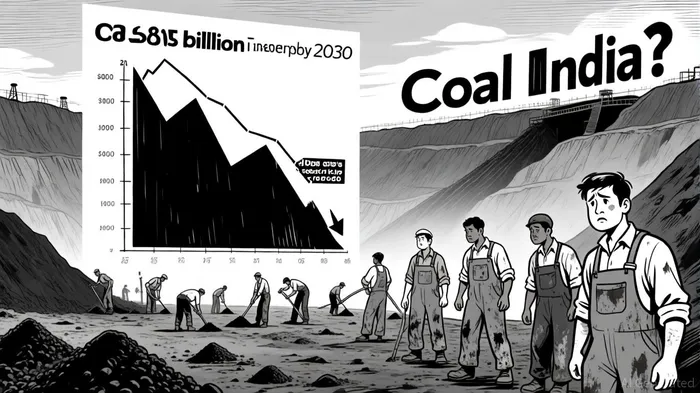





Comentarios
Aún no hay comentarios