
The COAI Token Scam: Uncovering Risks in the Fast-Growing Crypto Investment Landscape
Centralized Governance and Technical Flaws
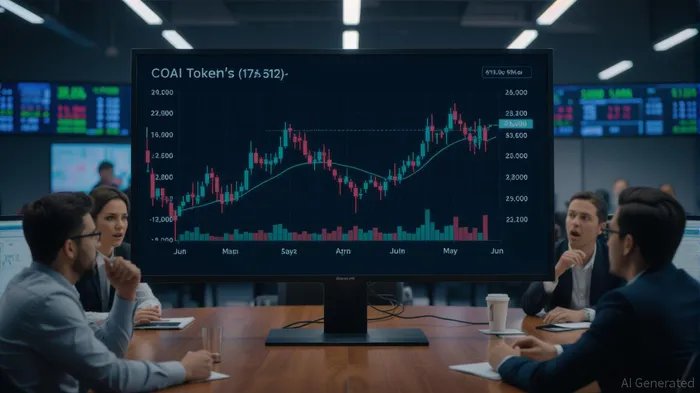 The COAI token's downfall was rooted in its centralized governance model, where 87.9% of the supply was controlled by just ten wallets. This concentration of power created a liquidity crisis, as panic selling accelerated when confidence in the project eroded. Compounding the issue were technical flaws in the AI models underpinning algorithmic stablecoins like xUSDXUSD-- and deUSD. These "black box" systems, which lacked transparency and rigorous validation, destabilized the token's value proposition.
Such failures highlight a broader trend in DeFi: the tension between innovation and accountability. While proponents argue that decentralized systems reduce counterparty risk, the COAI case demonstrates how opaque governance and algorithmic complexity can amplify fragility. As one expert noted, "The illusion of decentralization often masks centralized control, leaving investors exposed to manipulation and systemic collapse."
Regulatory Ambiguities and Responses
Regulatory uncertainty further exacerbated the crisis. The U.S. CLARITY Act and the 2025 GENIUS Act, designed to clarify crypto oversight, instead introduced conflicting interpretations that left investors in limbo. For instance, the SEC's focus on securities laws clashed with the CFTC's jurisdiction over derivatives, creating enforcement gaps. While regulators have since issued no-action letters and refined policy frameworks, jurisdictional overlaps and inconsistent compliance standards persist.
Globally, the response has been uneven. Southeast Asia, a hub for crypto scams, has seen asset freezes and sanctions, but enforcement remains fragmented. Meanwhile, the EU's Markets in Crypto-Assets Regulation (MiCAR) is setting new compliance benchmarks, emphasizing transparency and investor safeguards. Yet, as SIFMA executives warn, overly broad definitions of "decentralization" risk creating parallel markets with weaker protections, enabling regulatory arbitrage.
Broader DeFi Risks and High-Profile Scams
The COAI incident is not an isolated event. In 2025, scams like Web3.rfolmax.com and Up-Business have exploited social media to lure investors with fake AI trading programs and withdrawal fees. These schemes, often orchestrated through WhatsApp and Facebook, highlight how scammers weaponize trust and high-pressure tactics to drain funds.
DeFi's inherent risks-rug pulls, pump-and-dump schemes, and fake dApps-have also surged. For example, the DPRK's $1.5 billion hack of ByBit in the first half of 2025 underscored the vulnerability of even institutional-grade platforms. Meanwhile, AI-powered deepfakes and trading bots are now being used to mimic legitimate services, deceiving even seasoned investors.
Expert Warnings and Investor Protection Strategies
Experts emphasize that investor protection must evolve alongside technological innovation. The SEC and CFTC are pushing for smart contract transparency, governance token registration, and robust KYC/AML systems. However, SIFMA argues that traditional safeguards like best execution and market transparency are often absent in DeFi, leaving gaps in investor recourse.
To mitigate risks, investors are advised to adopt a multi-layered approach:
1. Due diligence: Scrutinize governance structures, algorithmic transparency, and liquidity models.
2. Diversification: Avoid overreliance on speculative tokens or AI-driven narratives.
3. Compliance tools: Use platforms with embedded KYC/AML protocols and real-time transaction monitoring.
Emerging solutions, such as zero-knowledge KYC and on-chain monitoring, aim to balance privacy with regulatory compliance. Yet, as NASAA cautions, emotional manipulation and pressure tactics remain potent tools for scammers, bypassing even the most rigorous due diligence.
Conclusion
The COAI token scam is a microcosm of the broader challenges facing the crypto ecosystem. While innovation in AI and blockchain holds promise, the absence of robust safeguards and coherent regulation has left investors vulnerable to exploitation. As DeFi continues to evolve, policymakers and market participants must prioritize frameworks that balance innovation with accountability. For investors, the lesson is clear: in a landscape where hype often outpaces substance, vigilance and education are the best defenses.







Comentarios
Aún no hay comentarios