
CNOOC's Weizhou 11-4 Project: A Strategic Pillar for China's Energy Security in the South China Sea
China's quest to insulate itself from global oil market volatility has long hinged on its ability to develop domestic hydrocarbon resources, particularly in the resource-rich but geopolitically sensitive South China Sea. CNOOC Limited's Weizhou 11-4 Oilfield Adjustment and Satellite Fields Development Project, now operational as of December 2025, represents a critical step in this strategy. By combining advanced infrastructure with scalable production, the project not only bolsters regional energy security but also underscores China's determination to reduce its reliance on imported crude-a vulnerability that has long exposed its economy to external shocks.
Strategic Infrastructure and Production Scalability
The Weizhou 11-4 project, located in the Beibu Gulf Basin of the South China Sea, features a meticulously designed infrastructure tailored to maximize efficiency and longevity. According to CNOOC's report, the development includes a newly constructed unmanned wellhead platform and a central processing platform connected to an existing facility via a trestle bridge. This configuration minimizes operational costs while enabling seamless integration with existing infrastructure. The project's 35 development wells-28 production and 7 water injection-reflect a balanced approach to maintaining reservoir pressure and optimizing output.
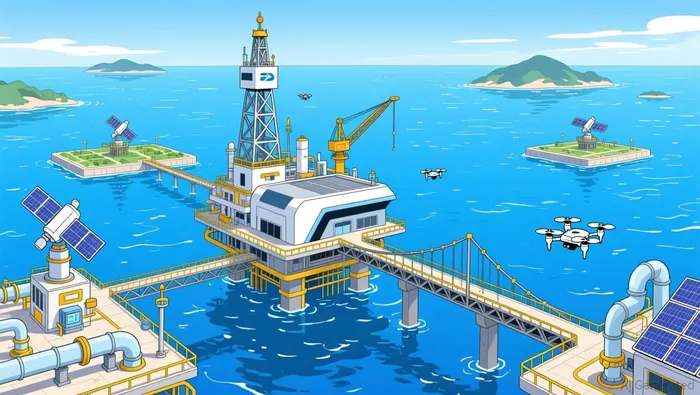
Production scalability is another key strength. The field is projected to achieve a plateau of 16,900 barrels of oil equivalent per day (BOE/d) in 2026, with light crude oil as the primary output. Light crude's higher value and lower refining costs compared to heavier grades further enhance the project's economic viability. This output, while modest on a global scale, is significant for China, which imports over 70% of its crude oil. By extending the field's operational life until 2037, CNOOC ensures a steady, predictable supply of domestic oil during a period when global energy markets remain fragmented and volatile.
Energy Security and Geopolitical Implications
The strategic importance of the Weizhou 11-4 project extends beyond its production metrics. As of 2025, the field has already recovered 91.19% of its total reserves, with peak production recorded in 2000. Yet, its continued operation until 2037 demonstrates CNOOC's ability to extract value from mature fields through technological upgrades-a capability that is increasingly vital as China's onshore reserves decline. This project, alongside others in the South China Sea, forms part of a broader "three offshore processing centers + one onshore terminal" network designed to stabilize regional energy supply.
China's energy security strategy is further reinforced by the South China Sea's geopolitical significance. While territorial disputes with neighboring countries complicate large-scale offshore development, projects like Weizhou 11-4-located in a shallow water area with relatively clear jurisdiction-allow CNOOC to assert control without overt confrontation. By prioritizing such projects, China reduces its exposure to supply chain disruptions in the Strait of Malacca, a chokepoint through which 80% of its imported oil transits.
Investment Considerations
For investors, the Weizhou 11-4 project exemplifies CNOOC's dual focus on operational efficiency and long-term resilience. The use of unmanned platforms and satellite fields reduces labor and maintenance costs, while the integration with existing infrastructure lowers capital expenditures. Moreover, the project's alignment with China's national energy security goals ensures regulatory and financial support, mitigating risks associated with policy shifts or market fluctuations.
However, challenges remain. The field's high recovery rate (91.19%) means declining production is inevitable as it approaches its economic limit in 2037. Investors must also weigh geopolitical risks in the South China Sea, where tensions could disrupt operations or escalate costs. That said, CNOOC's track record in managing mature fields and its aggressive expansion into new satellite projects suggest a capacity to adapt.
Conclusion
CNOOC's Weizhou 11-4 project is more than a technical achievement; it is a strategic asset in China's energy security architecture. By leveraging advanced infrastructure, scalable production, and a favorable geopolitical position, the project reduces China's dependence on volatile global markets while setting a precedent for future developments in the South China Sea. For investors, it represents a compelling case study in how state-backed energy firms can balance profitability with national imperatives-a rare alignment in an era of fragmented energy markets.







Comentarios
Aún no hay comentarios