
CME Halt: Thermodynamic Limits Expose Global Market Fragility
CME Group, one of the world's largest derivatives exchanges, abruptly halted trading across its Globex platform on November 28, 2025, citing a cooling system failure at CyrusOne data centers in Chicago. The outage froze futures and options contracts for equities, commodities, currencies, and cryptocurrencies, including BitcoinBTC-- and EthereumETH--, disrupting global markets, leaving traders without critical benchmarks for indices like the S&P 500 and Nasdaq 100. The incident, which occurred just before 0300 GMT, underscored the fragility of modern financial infrastructure as thermodynamic limits-rather than cyberattacks or software glitches-became the unexpected weak link.
The cooling failure forced CMECME-- to shut down servers to prevent hardware damage, halting 90% of global derivatives trading and causing erratic price movements in assets like gold and silver. 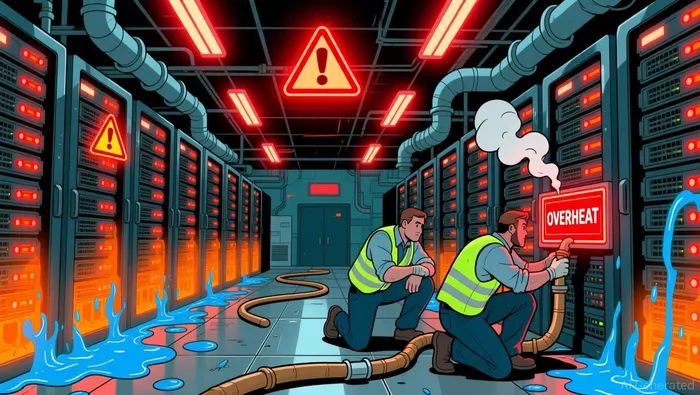 Gold saw two sharp $40 liquidation drops before recovering, while silver fell nearly $1 in minutes. Traders described the outage as a "nightmare," with one market participant noting the halt exacerbated thin liquidity post-Thanksgiving and disrupted position-rolling strategies. The disruption also impacted EBS, a key foreign exchange platform, halting USD/EUR and USD/JPY pair updates and widening bid-ask spreads by 20 times the norm.
CME's outage added to a year of growing pains for the exchange. Despite record volumes in crypto derivatives-794,903 contracts traded in a single day on November 21, a 132% year-over-year increase-the incident highlighted vulnerabilities in its reliance on third-party data centers. CME sold the affected facility to CyrusOne in 2016, leasing it back, which critics argue created a single point of failure. The outage also drew comparisons to a 2019 incident, where a technical error halted trading for three hours, and raised questions about the adequacy of cooling infrastructure for AI-driven workloads, which now consume 30% of annual U.S. energy demand.
Analysts noted the timing of the outage-during a relatively quiet post-holiday period-softened its immediate impact. Deutsche Bank's Jim Reid observed that "even an overnight outage at the CME... hasn't really been noticed" due to low trading activity. However, the event exposed systemic risks: a similar failure during a volatile period could trigger cascading effects across markets. CME's recent expansion into altcoin derivatives, including upcoming spot-quoted futures for XRPXRP-- and SolanaSOL--, further complicates its infrastructure demands.
Looking ahead, CME faces mounting pressure to address these challenges. The exchange plans to launch 24/7 crypto futures trading in early 2026, but the cooling failure underscores the need for redundant systems and distributed infrastructure. As global data center demand is projected to triple by 2030, financial institutions must balance efficiency with resilience. For now, CME's shares remain resilient, up over 20% year-to-date, but the incident serves as a stark reminder that even the most sophisticated markets remain vulnerable to the physical world's constraints.







Comentarios
Aún no hay comentarios