
Clough Global Dividend and Income Fund: Is the $0.0526 Monthly Payout Sustainable in Today's Markets?
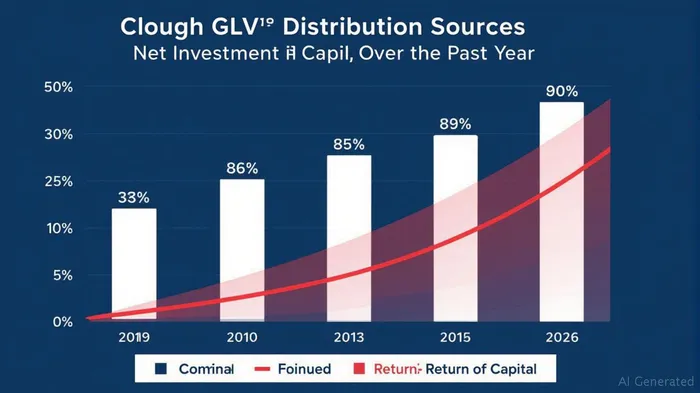
The Clough Global Dividend and Income Fund (NYSE American: GLV) has maintained a consistent $0.0526 monthly distribution since at least 2025, offering investors a steady income stream amid volatile markets. But beneath its unbroken payout lies a complex structure that raises critical questions about sustainability. With 85% of its May 2025 distribution classified as a return of capital—a signal that investors may be receiving back their own principal—the fund's managed distribution policy faces scrutiny in an environment where interest rates and inflation remain uncertain.
The Distribution Breakdown: A Reliance on Return of Capital
The fund's June 2025 distribution highlights its dependence on return of capital. Of the $0.0526 monthly payout, only $0.00766 stems from net investment income, while $0.04494 is sourced from return of capital or other capital. This pattern has persisted year-to-date, with 84.5% of cumulative distributions labeled as return of capital. Such a structure can erode investor principal over time, especially if the fund's underlying assets fail to generate sufficient income or capital gains to offset these payouts.
Expense Pressures and Leverage Risks
The fund's high expense ratio of 3.09%—among the highest in its peer group—adds another layer of concern. This includes management fees, operating costs, and interest expenses tied to its 27.88% effective leverage. While leverage can amplify returns during favorable markets, it also magnifies losses during downturns. With the fund's fiscal year-to-date NAV total return at just 2.06%, the math becomes stark: investors are paying dearly for a strategy that has delivered modest gains.
Portfolio Composition: A Mixed Bag of Sectors and Holdings
As of April 2025, the fund's portfolio was heavily weighted in “Sensitive” sectors (25.04%) and cash equivalents (23.08%), with corporate bonds and top equity holdings like MicrosoftMSFT-- and TransDigmTDG-- rounding out allocations. The average coupon of 5.89% on fixed-income assets provides a modest yield cushion, but the heavy cash allocation suggests a defensive stance. However, the fund's 12.32% discount to its NAV as of June 2025 raises questions about market sentiment. A persistent discount can signal investor skepticism about future performance or liquidity concerns.
Managed Distribution Policy: A Double-Edged Sword
Clough's managed distribution plan, which guarantees steady payouts regardless of market conditions, is a key selling point for income-focused investors. Yet this policy comes with trade-offs. The fund's Board of Trustees periodically reviews distributions, but the heavy reliance on return of capital—rather than income or capital gains—suggests the payout may not reflect underlying performance. Over time, this could deplete the fund's capital base, particularly if asset valuations stagnate or decline.
Attractiveness in Today's Markets
For short-term income seekers, GLV's consistent payout may still hold appeal, especially amid a search for yield in a low-interest-rate environment. However, long-term investors should proceed with caution. The fund's five-year annualized NAV return of 3.56% lags behind broader equity benchmarks, and its expense ratio and leverage amplify risks. Additionally, the return of capital component reduces the fund's ability to grow principal, making it less suitable for wealth accumulation strategies.
Investment Considerations
- Risk Tolerance: Investors should weigh the allure of steady income against the erosion of principal via return of capital.
- Expense Awareness: High fees may negate gains in low-return environments.
- Market Valuation: The NAV discount suggests caution; a narrowing discount could signal improved sentiment, while widening could indicate trouble.
Conclusion: A Cautionary Tale for Income Investors
While Clough GLV's $0.0526 monthly distribution provides a reliable income stream, its structure raises red flags about long-term sustainability. The heavy reliance on return of capital, elevated expenses, and leverage risks suggest that this fund is best suited for tactical allocations rather than core holdings. Investors seeking dividends should prioritize funds with distributions backed by robust income generation or capital appreciation, rather than principal returns. For now, GLV may offer a stopgap for yield hunters—but its appeal hinges on whether its strategy can outpace its own costs and market headwinds.





Comentarios
Aún no hay comentarios