
Cloudflare Plunges 4.95% on Heavy Volume as Technical Support Breaks
Generado por agente de IAAinvest Technical Radar
jueves, 12 de junio de 2025, 6:25 pm ET2 min de lectura
NET--
Cloudflare (NET) declined 4.95% in the latest session to close at $170.81, with trading volume surging to 7.89 million shares. This sell-off occurred within a daily range of $168.12 to $181.49, breaching key short-term technical levels. The following integrated analysis examines this move through multiple technical lenses.
Candlestick Theory
Recent candlesticks show a bearish reversal pattern. The June 10-11 sessions formed consecutive small-bodied candles near $180 after a rally from May lows ($130), indicating exhaustion. The June 12 long red candle – closing near its low on expanded volume – confirms distribution. Critical support now emerges at the psychological $170 level (May's resistance-turned-support), while the $180-$182 zone becomes resistance, evidenced by repeated rejections on June 6, 9, and 11.
Moving Average Theory
The 50-day moving average ($159) maintains an upward slope above the rising 100-day ($142) and 200-day ($118) averages, preserving the long-term bullish structure. However, the latest close below the 20-day EMA ($175) signals near-term weakness. Death crosses are absent, but the separation between short and long-term averages remains excessive historically, suggesting potential mean-reversion pressure.
MACD & KDJ Indicators
The MACD (12,26,9) histogram turned negative in early June as the signal line crossed bearish, confirming weakening momentum. KDJ readings show the %K line (currently 38) crossing below %D (42) from overbought territory (June 10: %K=84). This oscillator divergence preceded the current pullback. Both indicators now point to building bearish momentum, though neither yet signals oversold conditions.
Bollinger Bands
Bollinger Band width contracted 18% during the June consolidation near $180, indicating declining volatility before the breakdown. Price has now pierced the lower band ($173) – an occurrence observed only twice in the prior three months. Such violations typically precede either trend reversals or continuation spikes. The breach coincides with the highest volume in 30 days, increasing reliability of this breakdown signal.
Volume-Price Relationship
The 4.1% price surge on June 5 occurred on 5.25 million shares (47% above 30-day average), indicating strong accumulation. Conversely, the current 4.95% drop materialized on 7.89 million shares (85% above average), confirming distribution. This high-volume capitulation near all-time highs suggests institutional selling, with volume intensity supporting bearish near-term bias.
Relative Strength Index (RSI)
The 14-day RSI has descended from overbought territory (73.5 on June 7) to its current 52 – its most precipitous decline since April's 20% correction. While neutral now, the velocity of the RSI drop exceeds the price decline, indicating accelerating bearish momentum. The indicator must hold above 45 to avoid triggering historical oversold thresholds that preceded prior 15%+ corrections.
Fibonacci Retracement
Applying Fibonacci to the March-June uptrend (low: $122 on April 23, high: $181.49 on June 12) shows critical levels. The 23.6% retracement at $170.50 provided initial support during Thursday's close – a level now under threat. Below this, the 38.2% level ($164.30) aligns with the 50-day moving average and May's resistance break, creating a high-confluence support zone should selling intensify.
Confluence and Divergence Synthesis
Confluence emerges at $170, where candlestick support, Fibonacci 23.6%, and Bollinger Band breach levels converge. Bearish alignment is evidenced by MACD/KDJ crossovers validated through volume-backed price breakdown. Notable divergence exists between intermediate trend damage (price below 20-day EMA) and intact long-term moving average structure. Should $170 support fail, the $164 confluence zone (50-day MA + 38.2% Fibonacci) becomes the critical bull/bear demarcation line, with a violation potentially triggering accelerated liquidation toward $147.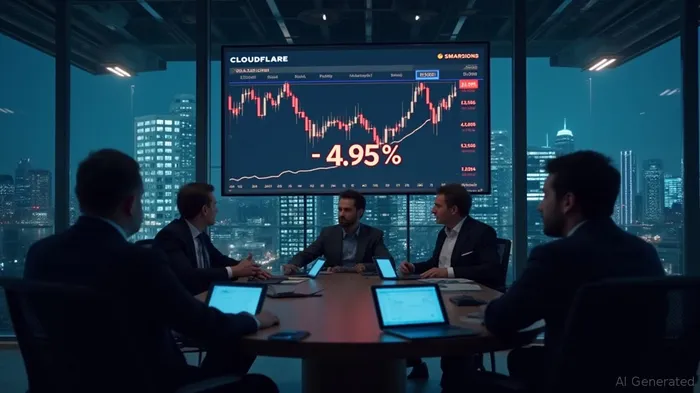
Cloudflare (NET) declined 4.95% in the latest session to close at $170.81, with trading volume surging to 7.89 million shares. This sell-off occurred within a daily range of $168.12 to $181.49, breaching key short-term technical levels. The following integrated analysis examines this move through multiple technical lenses.
Candlestick Theory
Recent candlesticks show a bearish reversal pattern. The June 10-11 sessions formed consecutive small-bodied candles near $180 after a rally from May lows ($130), indicating exhaustion. The June 12 long red candle – closing near its low on expanded volume – confirms distribution. Critical support now emerges at the psychological $170 level (May's resistance-turned-support), while the $180-$182 zone becomes resistance, evidenced by repeated rejections on June 6, 9, and 11.
Moving Average Theory
The 50-day moving average ($159) maintains an upward slope above the rising 100-day ($142) and 200-day ($118) averages, preserving the long-term bullish structure. However, the latest close below the 20-day EMA ($175) signals near-term weakness. Death crosses are absent, but the separation between short and long-term averages remains excessive historically, suggesting potential mean-reversion pressure.
MACD & KDJ Indicators
The MACD (12,26,9) histogram turned negative in early June as the signal line crossed bearish, confirming weakening momentum. KDJ readings show the %K line (currently 38) crossing below %D (42) from overbought territory (June 10: %K=84). This oscillator divergence preceded the current pullback. Both indicators now point to building bearish momentum, though neither yet signals oversold conditions.
Bollinger Bands
Bollinger Band width contracted 18% during the June consolidation near $180, indicating declining volatility before the breakdown. Price has now pierced the lower band ($173) – an occurrence observed only twice in the prior three months. Such violations typically precede either trend reversals or continuation spikes. The breach coincides with the highest volume in 30 days, increasing reliability of this breakdown signal.
Volume-Price Relationship
The 4.1% price surge on June 5 occurred on 5.25 million shares (47% above 30-day average), indicating strong accumulation. Conversely, the current 4.95% drop materialized on 7.89 million shares (85% above average), confirming distribution. This high-volume capitulation near all-time highs suggests institutional selling, with volume intensity supporting bearish near-term bias.
Relative Strength Index (RSI)
The 14-day RSI has descended from overbought territory (73.5 on June 7) to its current 52 – its most precipitous decline since April's 20% correction. While neutral now, the velocity of the RSI drop exceeds the price decline, indicating accelerating bearish momentum. The indicator must hold above 45 to avoid triggering historical oversold thresholds that preceded prior 15%+ corrections.
Fibonacci Retracement
Applying Fibonacci to the March-June uptrend (low: $122 on April 23, high: $181.49 on June 12) shows critical levels. The 23.6% retracement at $170.50 provided initial support during Thursday's close – a level now under threat. Below this, the 38.2% level ($164.30) aligns with the 50-day moving average and May's resistance break, creating a high-confluence support zone should selling intensify.
Confluence and Divergence Synthesis
Confluence emerges at $170, where candlestick support, Fibonacci 23.6%, and Bollinger Band breach levels converge. Bearish alignment is evidenced by MACD/KDJ crossovers validated through volume-backed price breakdown. Notable divergence exists between intermediate trend damage (price below 20-day EMA) and intact long-term moving average structure. Should $170 support fail, the $164 confluence zone (50-day MA + 38.2% Fibonacci) becomes the critical bull/bear demarcation line, with a violation potentially triggering accelerated liquidation toward $147.

Divulgación editorial y transparencia de la IA: Ainvest News utiliza tecnología avanzada de Modelos de Lenguaje Largo (LLM) para sintetizar y analizar datos de mercado en tiempo real. Para garantizar los más altos estándares de integridad, cada artículo se somete a un riguroso proceso de verificación con participación humana.
Mientras la IA asiste en el procesamiento de datos y la redacción inicial, un miembro editorial profesional de Ainvest revisa, verifica y aprueba de forma independiente todo el contenido para garantizar su precisión y cumplimiento con los estándares editoriales de Ainvest Fintech Inc. Esta supervisión humana está diseñada para mitigar las alucinaciones de la IA y garantizar el contexto financiero.
Advertencia sobre inversiones: Este contenido se proporciona únicamente con fines informativos y no constituye asesoramiento profesional de inversión, legal o financiero. Los mercados conllevan riesgos inherentes. Se recomienda a los usuarios que realicen una investigación independiente o consulten a un asesor financiero certificado antes de tomar cualquier decisión. Ainvest Fintech Inc. se exime de toda responsabilidad por las acciones tomadas con base en esta información. ¿Encontró un error? Reportar un problema




Comentarios
Aún no hay comentarios