
Cloud Earnings Week: AI Demand Meets Capacity Reality
This earnings season, cloud revenue growth has become the headline metric that could sway tech investors’ confidence. With AmazonAMZN--, MicrosoftMSFT--, and GoogleGOOGL-- reporting, Wall Street is focused on one thing—how many billions the cloud giants pulled in last quarter and how fast those billions are still growing.
Artificial intelligence has turned cloud computing into the modern gold rush. The hyperscalers are racing to supply computing power fast enough to meet demand, building data centers at unprecedented speed. That surge has translated into tens of billions in quarterly revenue—and rising.
Where Growth Stands
AWS (Amazon): Last quarter’s +17.5% YoY looked “uneven,” with CEO Andy Jassy noting that a few very large customers spend in bursts—great for long-term total contract value, choppy for quarterly comps.
Azure (Microsoft): The envy of the group with +39% YoY, lifted by AI services layered on core workloads and expanding seat penetration across enterprise stacks.
Google Cloud: A healthy +31.7% YoY, with differentiation pushes (Vertex AI, data cloud) and a growing tilt toward industry solutions.
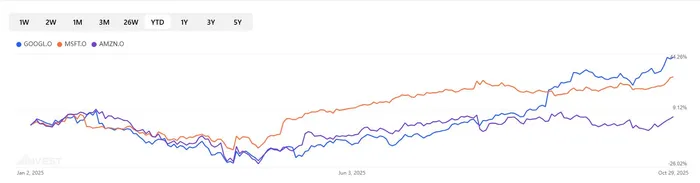
YTD performance for GOOGL, MSFTMSFT--, AMZN
What Will Move the Stocks
1) AI Workloads vs. Classic Cloud: Are AI services (training + inference) still outgrowing traditional lift-and-shift and data platform work—or are customers optimizing bills after early AI experiments?
2) Capacity & Chips:
Amazon: Jassy is leaning into Trainium for cost/energy efficiency—a path to expand AI margin dollars if performance stays competitive.
Microsoft: Demand remains intense, and the company cites a $368B book of signed work; investors want clarity on how quickly that converts to revenue given data center lead times.
Google: Custom silicon efforts put it in more direct contention with Nvidia; watch for details on performance/$ and how much of AI gross margin Google can keep.
3) Profitability Mix:
The key debate: do AI services dilute margin (heavy capex, pricey GPUs, power) or accrete (high-value software layers, managed services, premium SKUs)? Any color on gross margin per AI dollar will be market moving.
ETF Angle: How to Get Exposure
QQQ: Broad Nasdaq 100 proxy where the mega-cap cloud trio dominate index earnings power, cleanest beta to “Big Cloud + AI.”
IVES: Concentrated AI/tech tilt aligned with secular compute, chips, and software beneficiaries, higher octane than broad tech.
ARTY: Another AI/tech-thematic sleeve to express the same supercycle from a different basket construction.
Each offers a different approach to participate in the structural shift that’s redefining enterprise technology spending.
Risks & Wildcards
AI Monetization Gaps: End customers still refining business models; slower payback could temper consumption.
Price/Performance Pressure: If proprietary chips underdeliver or if GPU pricing resets, margin math changes quickly.
"AI Bubble” Narrative: Any hint of decelerating AI consumption could revive bubble fears and compress multiples.
The Takeaway
Amazon continues to bet on efficiency with its in-house Trainium chips, aiming to cut costs and power consumption per AI workload. Microsoft’s “intelligent cloud” division now boasts $368 billion in signed contracts, reflecting extraordinary backlog momentum. Google Cloud, still smaller but ambitious, is pushing its custom chips to challenge Nvidia’s dominance in AI acceleration.
With demand for compute power still outpacing supply, this earnings season isn’t just about who grew fastest—it’s about who’s best positioned to handle the next wave of AI-driven cloud demand.
Quickly compare QQQ, IVES, ARTY with our ETF Compare Tool





Comentarios
Aún no hay comentarios