
Closing the NAV Discount Through Structural Reforms: A Compelling BDC Opportunity in BCP Investment Corp.
The Bull Case for BCP Investment Corp. (BCP): A Self-Reinforcing Play on NAV Convergence
Business development companies (BDCs) have long struggled with persistent discounts to net asset value (NAV), a phenomenon exacerbated by macro uncertainty and investor skepticism. Yet, BCPBCBP-- Investment Corp. (formerly Portman Ridge Finance) is engineering a bold turnaround through structural reforms, strategic mergers, and a disciplined buyback program—all aimed at erasing its 43% NAV discount. For income-focused investors willing to ride out near-term volatility, BCP presents a high-conviction opportunity to capture a 31%+ upside embedded in its buyback threshold, alongside monthly income streams and a June 20 merger catalyst.
The NAV Discount Conundrum: Why BCP's 43% Discount Matters
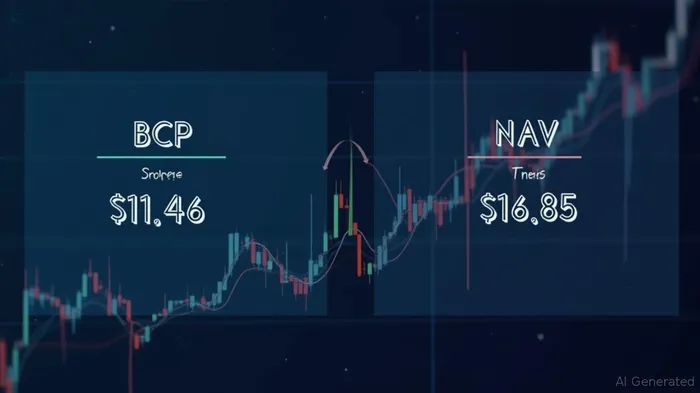
BCP's shares currently trade at $11.46, a steep discount to its March 31 NAV of $18.85. This gap—among the widest in the BDC sector—reflects investor concerns over rising interest rates, portfolio concentration, and liquidity risks. However, management's recent reforms are designed to address these pain points systematically.
Structural Reforms: Monthly Distributions + NAV-Based Buybacks
The cornerstone of BCP's turnaround is a dual-pronged strategy:
1. Monthly Distributions: Starting in 2026, BCP will shift from quarterly to monthly base distributions, smoothing income for investors while retaining the option for quarterly supplemental payouts (50% of excess net investment income). This aligns BCP's payout cadence with peers like Main Street Capital (MAIN), potentially attracting income-seeking capital.
2. NAV-Based Buyback Program: The company has authorized a $10M repurchase program and pledged to buy back shares whenever the stock trades below 80% of NAV (equivalent to $15.08 per share). Crucially, this threshold creates a 31% upside catalyst from current levels, as management and insiders (including CEO Ted Goldthorpe and CFO Brandon Satoren) have already invested over $38,000 of their own capital in the stock.
Merger Catalyst: Logan Ridge and the $9B BC Partners Platform
The June 20 shareholder vote on merging with Logan Ridge Finance (LRFC) is a binary inflection point. A “yes” vote would:
- Combine BCP's $240M portfolio with LRFC's $360M assets, creating a $600M+ platform with 1.3% NAV accretion for BCP shareholders.
- Unlock $2.8M in annual cost savings through back-office consolidation and scale-driven efficiencies.
- Diversify BCP's portfolio into sectors like healthcare and software, reducing reliance on the current 59% weighting in real estate.
Proxy advisory firms ISS and Glass Lewis support the deal, and insider buying signals confidence. A failed merger, however, would eliminate these synergies and leave BCP's discount unresolved.
Why the Self-Reinforcing Mechanism Works
BCP's reforms create a virtuous cycle:
1. Buybacks at Discounts: When shares dip below 80% NAV, repurchases shrink the share count, lifting per-share NAV and attracting buyers chasing the narrowing gap.
2. Monthly Distributions: Steady income reduces reliance on NAV appreciation and appeals to retirees and income allocators.
3. Merger Synergies: The combined scale and diversification bolster BCP's credit quality, potentially lowering borrowing costs and improving investor sentiment.
This interplay could accelerate NAV convergence, particularly if the June 20 vote succeeds.
Risks to Consider
- Interest Rate Sensitivity: BCP's 88.5% floating-rate portfolio mitigates duration risk, but rising rates could pressure net investment income (NII). Q1 2025 NII of $0.47 per share was down from $0.60 in Q4, signaling caution.
- Execution on Cost Savings: Realizing $2.8M in synergies post-merger requires flawless integration.
- Macroeconomic Downturn: A recession could strain BCP's borrowers, particularly in real estate and software.
Investment Thesis: High-Conviction Buy for NAV Hunters
Despite risks, BCP's 43% discount and structural reforms make it a compelling long-term income play. Key takeaways:
- Valuation Floor: The 80% NAV buyback threshold acts as a safety net, with shares trading at a 31% discount to this floor.
- Catalyst-Driven: The June 20 merger vote offers a clear binary outcome, while monthly distributions reduce volatility for income investors.
- Management Alignment: Insider purchases and the buyback program align management incentives with shareholders.
Actionable Idea: Buy BCP at current levels, with a $15.08 price target (80% NAV) as the near-term upside. A “yes” merger vote could push the stock closer to NAV over 12–18 months. For conservative investors, wait for post-vote clarity before scaling into the position.
In a world of BDCs stuck in valuation limbo, BCP's proactive reforms and merger-driven catalysts position it as a standout candidate to close its discount—and deliver outsized returns in the process.







Comentarios
Aún no hay comentarios