
Climate Policy Uncertainty and Energy Sector Implications: Investor Preparedness for Political Shifts and Regulatory Volatility
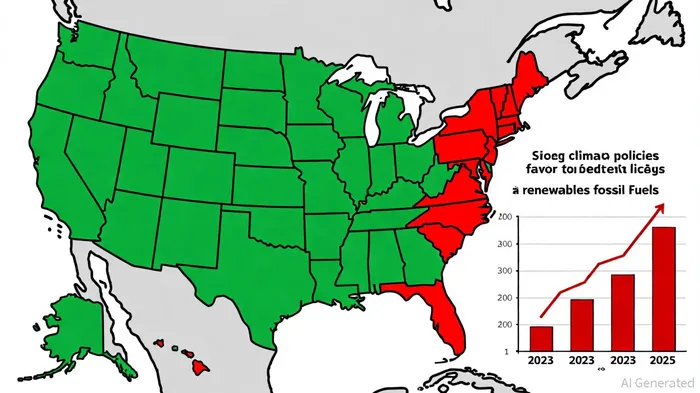
The energy sector is navigating a turbulent landscape as climate policy shifts create stark contrasts between federal and state priorities. In early 2025, the U.S. president signed executive orders prioritizing fossil fuel production over renewable energy development, including halting offshore wind leases and rescinding climate-focused mandates under the Inflation Reduction Act [1]. These actions have fragmented the regulatory environment, forcing investors to reconcile diverging mandates between federal rollbacks and state-level climate commitments, such as California's continued push for decarbonization [1].
The Dual Challenge: Policy Uncertainty and Investor Momentum
Despite federal policy reversals, the energy transition remains a focal point for investors. A global survey of 1,400 senior executives reveals that 72% report accelerating energy transition investments, particularly in energy efficiency, renewables, and storage [3]. However, 78% of investors cite unpredictable government policies as a top risk, underscoring the tension between long-term sustainability goals and short-term regulatory volatility [3]. The U.S. Energy Information Administration's Annual Energy Outlook 2025 (AEO2025) further illustrates this duality, projecting divergent market outcomes under alternative policy scenarios, such as the reinstatement of EV incentives or expanded fossil fuel permits [4].
Investor Strategies for Hedging Climate Policy Risk
To navigate this uncertainty, institutional investors are adopting multifaceted strategies. Financial derivatives—futures, options, and swaps—are increasingly used to stabilize costs and revenues in volatile markets. For example, renewable energy providers leverage power purchase agreements (PPAs) with fixed pricing to hedge against generation variability, while utilities employ fixed-price contracts to manage power market spikes [7]. Diversification across regions, technologies, and value chains is another key tactic. Clean energy sub-sectors, such as grid operations and storage, exhibit distinct climate risk profiles, prompting investors to allocate capital granularly to mitigate exposure [6].
Institutional investors are also embedding climate risk into fiduciary duties. New York City Comptroller Brad Lander, for instance, mandated that investment managers submit credible transition plans to address climate risks, while Oregon State Treasurer Elizabeth Steiner supported legislation to strengthen public retirement funds' resilience to climate-related financial shocks [5]. These actions reflect a broader trend where investors are not only adapting to policy shifts but actively shaping them to align with long-term stability.
The Role of Green Investment Funds and Derivatives
Green investment funds (GIFs) have emerged as tools for hedging climate risks, offering lower volatility and alignment with sustainability goals. Studies show GIFs outperform conventional assets during market turmoil, making them attractive for diversification [8]. Additionally, derivatives are being integrated into net-zero strategies, with institutions using protective puts and collar strategies to manage systemic risks [8]. However, guidelines from the Institutional Investors Group on Climate Change (IIGCC) caution against conflating economic exposure with net-zero alignment, urging transparency in derivative and hedge fund activities [8].
Looking Ahead: Adaptability and Transparency
As regulatory environments evolve, energy companies and investors must remain agile. The AEO2025's alternative scenarios highlight how policy choices can reshape markets, emphasizing the need for dynamic hedging strategies [4]. Investors who prioritize adaptability—through diversified portfolios, policy engagement, and innovative financial tools—will be better positioned to thrive amid uncertainty.







Comentarios
Aún no hay comentarios