
Climate-Driven Travel Disruptions and Investment Opportunities in Aviation and Energy Resilience
The aviation and energy sectors are facing unprecedented challenges as climate-driven disruptions escalate, reshaping global travel patterns and financial landscapes. From extreme weather events to supply chain bottlenecks, the interplay of environmental and operational risks has created a pressing need for resilient infrastructure and innovative mitigation strategies. For investors, this crisis presents a unique opportunity to capitalize on emerging technologies and projects designed to address these systemic vulnerabilities.
The Financial Toll of Climate-Driven Disruptions
The financial impact of climate-related disruptions on the aviation sector has been staggering. In 2024–2025, operational disruptions due to extreme weather events cost airlines an estimated $60 billion globally, equivalent to 8% of total airline revenue. These losses stem from flight cancellations, delays, and the operational strain of aging aircraft fleets, which consume more fuel and require higher maintenance costs according to IATA data. Compounding these challenges, the energy sector has seen a surge in carbon emissions, with aviation contributing to a 5.5% rise in global CO₂ emissions amid record passenger demand as reported by IEA.
Sustainable aviation fuel (SAF) has emerged as a critical solution, yet its adoption remains constrained. Despite regulatory mandates, SAF accounted for just 0.3% of global jet fuel usage in 2025, with projections to reach only 0.7% by year-end according to Reuters. High production costs and limited supply have left airlines struggling to meet decarbonization targets, creating a gap between policy goals and economic feasibility. This shortfall underscores the urgent need for scalable solutions in both aviation and energy infrastructure.
Emerging Investment Opportunities in Resilient Infrastructure
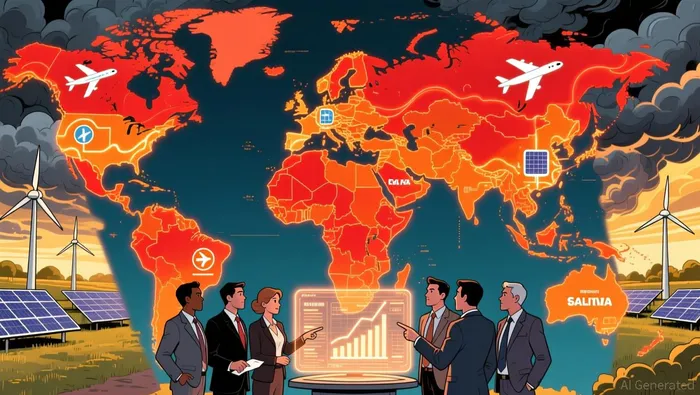 The growing urgency of climate resilience has unlocked a trillion-dollar market for adaptation and mitigation technologies. In 2025 alone, global climate-related disasters caused $162 billion in economic losses, highlighting the imperative for infrastructure upgrades. Aviation and energy sectors are prioritizing investments in multi-hazard risk assessments, reinforced runways, and advanced weather forecasting systems. For example, AI-first forecasting platforms are revolutionizing renewable energy management by optimizing wind and solar generation, while low-Earth orbit (LEO) satellites enable hyperlocal weather data collection.
In aviation, companies like MUNRO are deploying high-resolution weather radar systems and AI-powered tools to enhance flight safety. Similarly, startups such as LanzaJet are pioneering sustainable jet fuel production, reducing aviation emissions by up to 84%. Meanwhile, energy firms like Form Energy are developing iron-air batteries capable of storing renewable energy for up to 100 hours, addressing intermittency challenges. These innovations reflect a broader shift toward climate-resilient technologies that bridge the gap between environmental goals and operational realities.
Case Studies and Funding Mechanisms
Government and private sector initiatives are accelerating the transition to resilient infrastructure. The U.S. Federal Aviation Administration (FAA) has allocated $1.3 billion in 2025 for airport improvements, including runway repairs and zero-emission ground vehicle charging stations according to FAA announcements. Airports like Heathrow and Vancouver (YVR) are leading the charge in SAF adoption, with Heathrow offering rebates to airlines and YVR committing to net-zero operations through renewable energy integration.
Financing tools such as resilience bonds and blended-finance models are also gaining traction. For instance, CenterPoint Energy in Texas secured $2.7 billion for a systemwide resiliency plan, while New York's Con Edison and Xcel Energy are investing in elevated substations and vegetation management to mitigate wildfire risks. These projects exemplify how public-private partnerships can drive large-scale climate adaptation.
The Path Forward for Investors
For investors, the convergence of climate risk and technological innovation offers a compelling roadmap. Key opportunities lie in:
1. Sustainable Aviation Technologies: Startups focused on SAF production, hydrogen propulsion, and AI-driven weather analytics.
2. Energy Resilience Infrastructure: Grid modernization projects, long-duration energy storage, and AI-optimized renewable generation.
3. Climate-Resilient Aviation Infrastructure: Airport upgrades, reinforced runways, and real-time weather monitoring systems.
As the Climate A&R market is projected to grow to $1.3 trillion annually by 2030, early adopters stand to benefit from both environmental impact and financial returns. However, success will require navigating regulatory complexities and aligning investments with long-term decarbonization goals.
Conclusion
Climate-driven disruptions are no longer a distant threat but a present reality reshaping the aviation and energy sectors. While the financial and operational challenges are significant, they also open doors for transformative investments in resilient infrastructure and cutting-edge technologies. By leveraging emerging tools, strategic partnerships, and policy incentives, investors can play a pivotal role in building a more sustainable and adaptive global economy.







Comentarios
Aún no hay comentarios