
Cleveland-Cliffs' Strategic Path Forward in a Challenging Steel and Auto Market
In the volatile landscape of global steel and automotive markets, Cleveland-Cliffs Inc.CLF-- (NYSE: CLF) has positioned itself as a critical player navigating dual pressures: a reliance on automotive demand and the need to mitigate trade risks. As the U.S. steel industry faces headwinds from shifting supply chains and protectionist policies, the company's strategic moves-ranging from securing long-term automotive contracts to forging a landmark partnership with South Korea's POSCO-highlight its efforts to balance growth with resilience. This analysis examines how Cleveland-CliffsCLF-- is leveraging these strategies to offset risks and capitalize on emerging opportunities.
Automotive Demand: A Double-Edged Sword
Cleveland-Cliffs' exposure to the automotive sector remains a cornerstone of its business. In Q3 2025, the company reported $1.4 billion in direct automotive sales, accounting for 30% of its $4.6 billion in steelmaking revenues. This marks a slight decline from 2023, when automotive sales represented 35% of full-year steelmaking revenues ($7.4 billion out of $21.3 billion). However, the company has secured multi-year agreements with all major automotive original equipment manufacturers (OEMs), locking in favorable pricing and volume commitments through 2027 or 2028. These contracts, coupled with the termination of an onerous slab supply agreement in December 2025, are expected to drive growth into 2026.
Despite these strengths, the automotive sector's volatility poses risks. In Q4 2024, Cleveland-Cliffs reported weaker performance, citing "muted demand from the North American automotive industry" as a key factor behind its $85 million adjusted EBITDA. CEO Lourenco Goncalves acknowledged the sector's decline in the second half of 2024 but noted early signs of recovery in 2025, particularly in the order book for automotive steel. 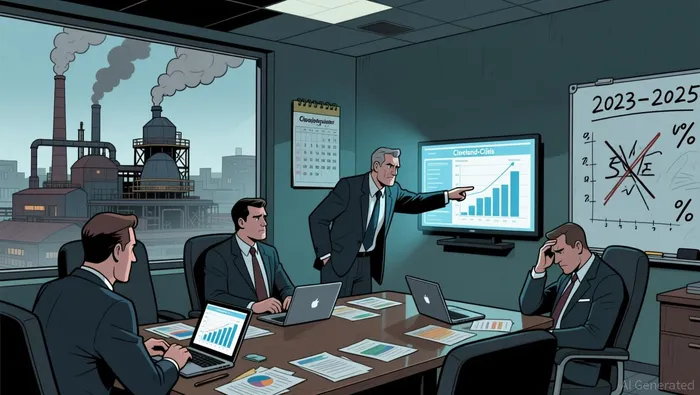 The company's ability to maintain its 30% automotive revenue share in Q3 2025, despite broader market challenges, underscores its competitive positioning.
The POSCO Partnership: A Strategic Shield Against Tariff Risks
To mitigate the impact of U.S. President Donald Trump's proposed 50% steel import tariffs, Cleveland-Cliffs has forged a strategic alliance with POSCO, South Korea's largest steelmaker. Announced in September 2025 via a Memorandum of Understanding (MoU), the partnership aligns with the U.S.-South Korea trade agreement and aims to deepen industrial cooperation. POSCO plans to invest over $700 million to acquire at least a 10% stake in Cleveland-Cliffs by 2026, enabling the Korean company to supply U.S.-origin steel to its domestic clients without incurring tariffs.
This collaboration is a win-win: POSCO gains access to a robust U.S. steel production footprint, while Cleveland-Cliffs secures a long-term investor aligned with its growth objectives. The partnership also aligns with U.S. policy goals to strengthen domestic industry and attract foreign investment. By 2029, when POSCO's Louisiana joint venture with Hyundai Steel is expected to begin operations, the company will have a dual strategy-local production and strategic alliances-to navigate trade barriers.
Operational Efficiency: The Engine of Resilience
Beyond strategic partnerships, Cleveland-Cliffs has prioritized operational efficiency to bolster its financial health. In Q3 2025, the company reported $143 million in adjusted EBITDA, a 52% increase from the previous quarter, driven by cost-cutting initiatives projected to save $300 million annually. These measures include idling non-core operations and optimizing its production footprint, which have helped offset revenue shortfalls. For instance, despite Q3 2025 revenues of $4.6 billion falling slightly below the $4.9 billion forecast, the stock surged 15.13% in pre-market trading, reflecting investor confidence in the company's cost discipline.
CEO Goncalves attributed the improved performance to "strategic cost actions, a rebound in the automotive sector, and favorable trade policies." These operational gains are critical in a sector where margins are often squeezed by raw material costs and regulatory pressures.
Conclusion: A Path Forward in Uncertain Times
Cleveland-Cliffs' strategic path forward hinges on its ability to balance automotive demand with risk mitigation. While the automotive sector remains a vital revenue stream, the company's multi-year contracts and operational efficiency initiatives provide a buffer against market fluctuations. The POSCO partnership further insulates it from trade risks, offering a model for how U.S. steelmakers can collaborate with global allies to thrive in a protectionist environment.
As the company moves into 2026, the closing of the POSCO investment and the full implementation of its efficiency measures will be pivotal. With a strong order book, favorable pricing agreements, and a diversified risk profile, Cleveland-Cliffs is well-positioned to navigate the challenges of the steel and auto markets-and potentially emerge as a leader in the next phase of U.S. industrial growth.







Comentarios
Aún no hay comentarios