
Cleveland-Cliffs: A Deep Dive into the Recent 25% Stock Decline and Path to Recovery
The recent 25% plunge in Cleveland-Cliffs' stock price in December 2025 has sparked intense debate among investors. While the company's long-term strategic ambitions-particularly its foray into rare-earth mineral exploration-remain compelling, the near-term execution risks have overshadowed these prospects. To assess whether this decline presents an opportunity or a warning, one must dissect the interplay between Cleveland-Cliffs' immediate financial challenges and its nascent diversification into critical minerals.
Near-Term Execution Risks: A Perfect Storm of Weakness
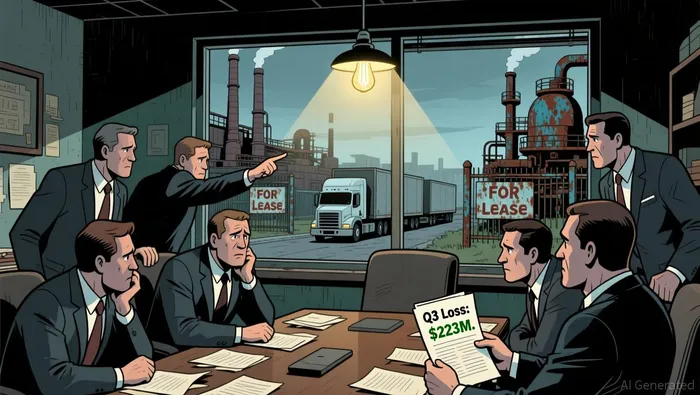
Cleveland-Cliffs' Q3 2025 results underscored a confluence of headwinds. Revenues dipped to $4.7 billion, down from $4.9 billion in the prior quarter, while the company posted an adjusted net loss of $223 million, or $0.45 per diluted share. The steel-making segment, its core business, faced margin compression, with average net selling prices per ton falling to $1,032 in Q3 2025 from $1,045 in the same period the previous year. These declines reflect broader industry-wide struggles: cyclical demand slumps in construction, manufacturing, and automotive sectors, compounded by import competition.
Compounding these issues, Cleveland-Cliffs' strategic initiatives-such as its rare-earth mineral exploration-have yet to yield tangible results. Investors, already wary of the steel industry's volatility, have grown impatient with the lack of progress. As one analyst noted, "The market is punishing the company for not delivering on its long-term vision while grappling with near-term operational pain."
Long-Term Strategic Potential: Rare Earths as a National Imperative
 Yet the company's pivot to rare-earth minerals could redefine its trajectory. Cleveland-Cliffs has identified promising mineralization at two sites in Michigan and Minnesota, leveraging its existing infrastructure to reduce capital intensity. CEO Lourenco Goncalves has framed this initiative as a national imperative, aligning with U.S. efforts to reduce reliance on foreign suppliers-particularly China-for critical materials used in defense, renewable energy, and electronics.
The geopolitical context is pivotal. Recent U.S.-Australia agreements to strengthen domestic critical mineral supply chains have added urgency to Cleveland-Cliffs' efforts. However, the company has not provided a definitive timeline for commercial production, leaving investors in limbo. As of Q3 2025, geological assessments remain in the early stages, with no clarity on when these projects might transition from exploration to revenue generation. This ambiguity heightens execution risks, as the rare-earth sector is capital-intensive and subject to regulatory and market uncertainties.
Cost-Cutting as a Bridge: Can Efficiency Buy Time?
To mitigate near-term pressures, Cleveland-Cliffs has slashed capital expenditures, reducing 2025 guidance from $700 million to $525 million by Q3. Selling, general, and administrative expenses have also been trimmed to $550 million. These measures, coupled with a $50-per-ton reduction in steel unit costs compared to 2024, aim to improve liquidity and fund strategic initiatives.
The company's cost discipline has yielded some progress: multi-year automotive supply agreements and a richer sales mix have stabilized revenue visibility. However, these gains may not be sufficient to offset the broader industry downturn. As one industry observer noted, "Cost-cutting is a necessary bridge, but it won't be enough to transform Cleveland-CliffsCLF-- into a rare-earth powerhouse without execution on the exploration front."
Balancing the Equation: A Calculated Bet
Cleveland-Cliffs' stock decline reflects a market that is skeptical of its ability to balance immediate operational demands with long-term innovation. The steel industry's cyclical nature and margin pressures remain significant hurdles, while the rare-earth projects-though strategically sound-carry the risk of delayed returns.
Yet the company's alignment with national security priorities and its existing infrastructure in key regions provide a unique advantage. If Cleveland-Cliffs can accelerate its rare-earth assessments and secure regulatory approvals, it could position itself as a critical player in the U.S. supply chain. For now, however, investors must weigh the promise of strategic diversification against the reality of a steel business under siege.
Conclusion: A High-Stakes Transition
Cleveland-Cliffs stands at a crossroads. Its recent stock decline is a stark reminder of the challenges facing traditional industrial firms in a rapidly shifting economic landscape. While the company's rare-earth ambitions offer a tantalizing long-term vision, the path to recovery hinges on near-term execution. Investors who are willing to tolerate short-term volatility may find value in the company's dual strategy-but only if management can deliver on its promises without further delay.





Comentarios
Aún no hay comentarios