
CleanSpark's Strategic Financing and Expansion in High-Performance Computing: A Catalyst for Long-Term HPC Market Dominance
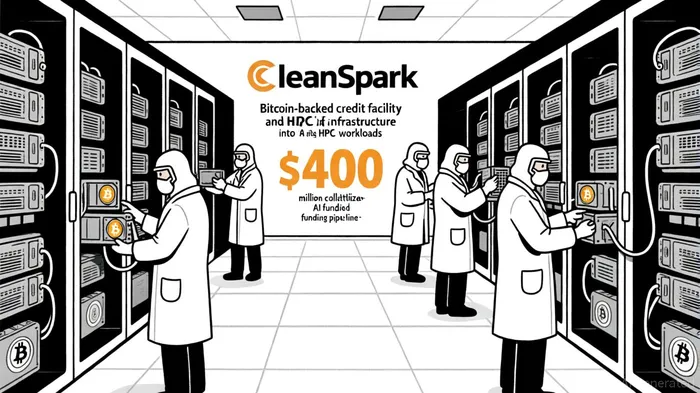
In the rapidly evolving landscape of digital infrastructure, CleanSparkCLSK--, Inc. (NASDAQ: CLSK) has emerged as a strategic innovator, leveraging its BitcoinBTC-- treasury to secure non-dilutive financing and position itself at the intersection of cryptocurrency mining and high-performance computing (HPC). The company's recent $100 million Bitcoin-backed credit facility with Two Prime and Coinbase Prime—bringing its total collateralized lending capacity to $400 million—represents a pivotal step in its transformation from a pure-play Bitcoin miner to a diversified digital infrastructure provider[1]. This move not only underscores CleanSpark's financial agility but also aligns with broader industry trends where crypto mining facilities are repurposed to meet surging demand for AI and HPC workloads[2].
The Credit Facility: A Non-Dilutive Engine for Growth
CleanSpark's $400 million Bitcoin-backed credit facility is a masterstroke in capital efficiency. By using its nearly 13,000 Bitcoin treasury as collateral, the company has secured a scalable funding source without diluting shareholder equity—a stark contrast to peers like Marathon Digital and Riot Platforms, who have relied on equity raises to fund expansion[1]. CFO Gary A. Vecchiarelli emphasized that the facility remains largely undrawn, offering flexibility to accelerate data center growth, deploy Bitcoin mining hashrate, and invest in HPC capabilities[1]. This approach preserves shareholder value while enabling aggressive scaling, a critical advantage in a sector where capital intensity and price volatility often constrain growth.
The strategic use of Bitcoin as collateral also reflects CleanSpark's dual exposure to the asset's potential upside and its utility as a liquidity tool. With Bitcoin prices fluctuating in 2025, the company's ability to leverage its treasury for non-dilutive financing mitigates downside risks while maintaining long-term Bitcoin exposure[2]. This financial model is particularly compelling in an environment where traditional lenders remain cautious about crypto-related assets.
HPC as the Next Frontier: Diversification and ROI
CleanSpark's pivot into HPC is driven by a clear economic rationale. As noted by CEO Matt Schultz at the Wyoming Blockchain Symposium, HPC and AI workloads offer significantly higher returns on investment compared to Bitcoin mining, particularly in energy-efficient facilities near major metro centers[5]. The company is evaluating the conversion of select data centers into HPC campuses, a strategy that aligns with industry-wide trends of repurposing crypto infrastructure for AI and cloud computing[3].
This diversification is not merely speculative. CleanSpark's operational efficiency—98% uptime and a fleet efficiency of 16.15 J/TH—positions it to compete in the HPC market, where energy costs and infrastructure reliability are critical differentiators[4]. By retrofitting existing facilities, the company can capitalize on its vertically integrated model, which includes energy-optimized data centers in Georgia, Mississippi, Tennessee, and Wyoming[2]. The $100 million credit facility further accelerates this transition, enabling investments in GPU-rich environments and enterprise-grade compute infrastructure[5].
Competitive Positioning and Market Dynamics
CleanSpark's strategic financing and HPC ambitions place it in direct competition with firms like Core Scientific and Compute North, which have already established GPU-as-a-Service (GPU-aaS) offerings[3]. However, CleanSpark's late entry into HPC is offset by its unique advantages: a robust Bitcoin treasury, a disciplined capital allocation strategy (no stock issuance since November 2024), and a vertically integrated infrastructure that reduces operational costs[2]. Analysts highlight that CleanSpark's institutional ownership (43.1%) and profitability (47.98% net margin) outperform peers like Bitfarms, which struggles with negative net margins[1].
Moreover, the company's focus on non-dilutive financing creates a moat against competitors reliant on equity markets. As noted in a report by Investing.com, CleanSpark's ability to scale without dilution is a key factor in its long-term growth potential[4]. This is particularly relevant in 2025, where rising power costs and regulatory uncertainties have pressured Bitcoin miners to diversify revenue streams[3].
Risks and the Road Ahead
Despite its strengths, CleanSpark faces challenges. Rising energy costs and Bitcoin price volatility remain tail risks, while its late entry into HPC could delay market capture. However, the company's $400 million credit facility provides a buffer to navigate these headwinds. With a target hash rate of 50 EH/s by June 2025 and a diversified infrastructure strategy, CleanSpark is well-positioned to capitalize on the AI-driven compute boom[5].
Conclusion
CleanSpark's Bitcoin-backed credit facility is more than a financial maneuver—it is a strategic catalyst for long-term HPC market dominance. By leveraging its Bitcoin treasury to fund non-dilutive growth, the company is transforming its infrastructure into a hybrid compute hub capable of serving AI, edge computing, and enterprise workloads. As the demand for HPC surges and crypto mining margins tighten, CleanSpark's dual-use model offers a compelling path to sustained profitability and shareholder value creation.





Comentarios
Aún no hay comentarios