
CleanSpark's Strategic Financing with Coinbase: A Catalyst for Bitcoin Mining Growth and Scalability
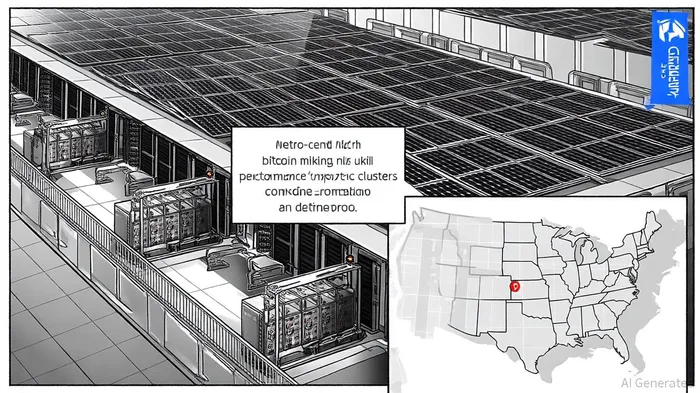
In the rapidly evolving BitcoinBTC-- mining sector, CleanSparkCLSK--, Inc. (CLSK) has emerged as a strategic innovator, leveraging institutional-grade financing to accelerate growth while maintaining operational scalability. The company's recent $100 million Bitcoin-backed credit facility with CoinbaseCOIN-- Prime, announced in September 2025, represents a pivotal step in its capital strategy, enabling non-dilutive expansion into energy infrastructure, high-performance computing (HPC), and Bitcoin mining optimization[1]. This move not only underscores CleanSpark's commitment to shareholder value but also aligns with broader industry trends where institutional adoption of Bitcoin is reshaping the competitive landscape[2].
Strategic Financing: Non-Dilutive Growth and Shareholder Value
CleanSpark's $100 million credit facility with Coinbase Prime is collateralized by its Bitcoin holdings, allowing the company to fund capital expenditures without issuing new equity or liquidating its digital assets[3]. This non-dilutive approach preserves equity for shareholders while providing flexibility to scale operations. According to a report by The Block, such financing models are becoming increasingly common among Bitcoin miners, who are using institutional-grade lending to fund expansion without sacrificing ownership stakes[4].
The proceeds from the credit line are earmarked for three key areas:
1. Energy Portfolio Expansion: CleanSpark aims to optimize its 987 MW power portfolio, with 179 MW allocated for incremental hashrate growth[5].
2. Bitcoin Mining Scaling: The company has already achieved a hashrate of 50 EH/s by June 2025, surpassing its 2024 target of 37 EH/s[6].
3. HPC Development: CleanSpark is investing in high-performance computing campuses near major U.S. metro centers, diversifying revenue streams into AI and enterprise computing[7].
CEO Matt Schultz emphasized that this partnership with Coinbase Prime accelerates CleanSpark's ability to “optimize assets near major metro centers while scaling mining operations,” a dual focus that aligns with the company's “Infrastructure First” strategy[8].
Institutional Trends and Competitive Positioning
CleanSpark's financing strategy reflects a broader industry shift toward institutional validation of Bitcoin as both a financial asset and an infrastructure enabler. As noted in a Q3 2025 report by Coinbase Institutional, institutional investors are increasingly allocating capital to Bitcoin through ETFs, custodial services, and mining infrastructure[9]. This trend is supported by the rise of spot Bitcoin ETFs, such as BlackRock's iShares Bitcoin Trust (IBIT), which have attracted over $5 billion in inflows in 2025 alone[10].
CleanSpark's approach contrasts with peers like Riot Platforms, which prioritizes cost efficiency and large-scale mining operations. While Riot reported record net income of $211.8 million in Q1 2024, its forward P/E ratio remains undefined due to negative earnings, whereas CleanSpark trades at 11 times forward earnings with a more favorable analyst rating[11]. CleanSpark's focus on renewable energy and HPC diversification positions it to capitalize on regulatory tailwinds in the U.S., where Bitcoin mining is increasingly viewed as a tool for grid stabilization and renewable energy utilization[12].
Infrastructure Expansion and Operational Scalability
CleanSpark's infrastructure growth is underpinned by disciplined execution and technological efficiency. By June 2025, the company's fleet efficiency had improved to 16.15 J/Th, down from 17.7 J/Th in 2024, reflecting advancements in cooling systems and ASIC optimization[13]. This efficiency gain, combined with a power portfolio that includes low-cost renewable energy sources, enables CleanSpark to maintain profitability even as Bitcoin's halving event in April 2024 reduced block rewards[14].
The $100 million credit facility will further accelerate CleanSpark's expansion into HPC, a sector projected to grow at a 25.2% CAGR through 2030[15]. By repurposing its data centers for AI and enterprise workloads, CleanSpark is positioning itself to generate stable, high-margin revenue beyond Bitcoin mining. This strategy mirrors moves by competitors like CoreWeave and TeraWulf, which have secured long-term contracts with AI clients[16].
Risks and Market Outlook
While CleanSpark's strategy is compelling, risks remain. Bitcoin price volatility, regulatory shifts, and competition from new ASIC manufacturers like Auradine could impact margins[17]. However, the company's non-dilutive financing model and focus on infrastructure diversification mitigate these risks. Analysts at The Motley Fool note that CleanSpark's “Infrastructure First” approach provides a moat against cyclical downturns in mining profitability[18].
Conclusion
CleanSpark's $100 million financing deal with Coinbase Prime is a masterstroke in the Bitcoin mining sector, combining non-dilutive capital with strategic infrastructure expansion. By leveraging Bitcoin as collateral and targeting HPC growth, CleanSpark is not only scaling its mining operations but also future-proofing its business model. As institutional adoption accelerates and the U.S. emerges as a hub for sustainable mining, CleanSpark's dual focus on efficiency and diversification positions it as a top-tier player in a sector poised for long-term growth.





Comentarios
Aún no hay comentarios