
CleanSpark's Strategic AI Data Center Pivot and Its Implications for Long-Term Growth
The maturing crypto-mining sector is undergoing a profound transformation, driven by regulatory pressures, energy economics, and the relentless pursuit of stable revenue streams. As BitcoinBTC-- mining rewards diminish and environmental scrutiny intensifies, companies are reallocating capital toward AI infrastructure-a shift epitomized by CleanSpark's (CLSK) aggressive pivot into high-performance computing (HPC) and AI data centers. This strategic move, while ambitious, raises critical questions about capital allocation efficiency, diversification risks, and the long-term viability of monetizing AI workloads in a competitive landscape.
Capital Allocation in a Shifting Landscape
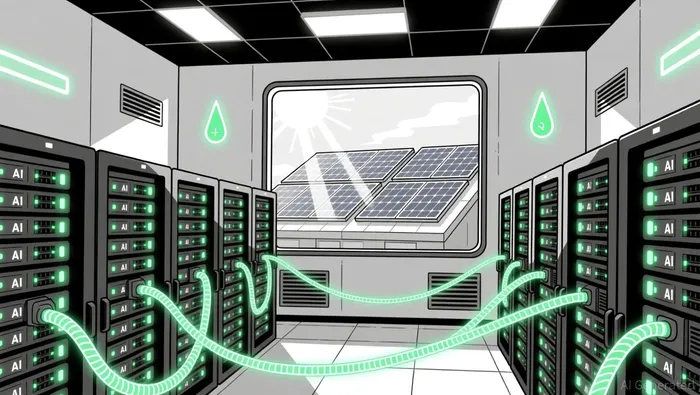
CleanSpark's transition from Bitcoin mining to AI data centers reflects a broader industry trend: the repurposing of energy-intensive infrastructure for emerging compute demands. The company has secured over 1.3 gigawatts of power capacity-a critical asset in energy-starved AI markets-and is leveraging its vertically integrated model to develop AI-ready facilities in Georgia, a state increasingly positioned as a hub for digital infrastructure. However, the capital intensity of this pivot is stark. Construction costs for AI data centers are estimated at $10 million per megawatt, with revenue not expected before 2027 due to delays in tenant onboarding and infrastructure development. This timeline underscores the challenge of balancing near-term liquidity constraints with long-term strategic bets.
CleanSpark's leadership, including the appointment of Jeffrey Thomas as Senior Vice President of AI Data Centers, emphasizes operational excellence and infrastructure-first execution. Thomas's track record-creating over $12 billion in shareholder value across 19 ventures-signals a focus on disciplined capital allocation. Yet, the company's reliance on its existing power contracts and real estate portfolio to fund this expansion introduces execution risk. If AI demand in Georgia fails to materialize at projected rates, CleanSparkCLSK-- could face underutilized assets and stranded costs.
Diversification and Industry-Wide Trends
The crypto-mining sector's broader pivot to AI infrastructure is not unique to CleanSpark. Companies like CoreWeave and Hut 8 Corp. have similarly rebranded as cloud GPU providers, securing long-term leases with hyperscalers and financial backing from firms like Google. This trend is driven by the need for stable cash flows in an industry where Bitcoin mining margins have become increasingly volatile. For instance, Hut 8's $7 billion lease agreement with Fluidstack-backed by Google-highlights the structural shift toward AI as a revenue pillar.
CleanSpark's strategy aligns with these industry dynamics but faces stiff competition. The global HPC market, projected to reach $87.31 billion by 2030, is attracting not only former miners but also traditional data center operators and hyperscalers. CleanSpark's differentiation lies in its vertically integrated power infrastructure and geographic positioning in Georgia, a state with favorable energy policies and growing AI demand. However, the company's ability to secure enterprise clients-such as AI startups or research institutions-will determine whether its infrastructure can achieve the utilization rates necessary for profitability.
Risks and Long-Term Viability
While CleanSpark's pivot is strategically sound, several risks loom. First, the delayed monetization timeline (2027) exposes the company to liquidity pressures, particularly if Bitcoin mining operations fail to generate sufficient cash flow to fund AI construction. Second, the AI infrastructure market is highly competitive, with firms like Bitfarms and Cipher Mining also repurposing facilities for HPC workloads. CleanSpark's success will depend on its ability to secure long-term contracts at premium rates, a challenge in a market where pricing is often dictated by hyperscalers.
Third, regulatory and environmental factors remain critical. The maturing crypto-mining sector is under increasing scrutiny for emissions, with jurisdictions mandating carbon offset programs. CleanSpark's reliance on existing power infrastructure-much of which may be sourced from non-renewable grids-could attract ESG-related criticism unless it accelerates decarbonization efforts.
Conclusion: A High-Stakes Bet on the Future
CleanSpark's AI data center pivot represents a high-conviction bet on the convergence of crypto infrastructure and AI demand. By leveraging its power capacity and operational expertise, the company aims to position itself as a key player in the $87.31 billion HPC market. However, the path to profitability is fraught with execution risks, capital intensity, and competitive pressures. For investors, the key question is whether CleanSpark can execute its infrastructure-first strategy efficiently enough to outpace rivals and deliver on its 2027 revenue projections. If successful, the pivot could unlock significant value; if not, it may serve as a cautionary tale of overambitious diversification in a maturing sector.





Comentarios
Aún no hay comentarios