
CleanSpark's $1.15B Zero-Coupon Financing: A Strategic Bet for Dominance in Post-Halving Bitcoin Mining
Strategic Financing: Zero-Coupon Notes as a Non-Dilutive Growth Tool
CleanSpark's $1.15 billion zero-coupon convertible notes, issued at a 27.5% conversion premium to its $15.03 stock price, reflect a unique approach to capital raising. Unlike traditional high-yield debt, these notes carry a 0% coupon, reducing immediate interest burdens while offering investors a path to equity conversion. Approximately $460 million of the proceeds will be allocated to share repurchases at $15.03 per share, signaling management's confidence in the stock's undervaluation. The remaining funds will expand power infrastructure, develop AI/data center capacity, and repay Bitcoin-backed credit lines.
This structure minimizes equity dilution-a critical advantage in a sector where smaller miners often rely on costly equity raises. By prioritizing non-dilutive financing, CleanSpark preserves shareholder value while funding aggressive expansion. The 13-day underwriter option to purchase an additional $150 million in notes further underscores investor appetite, potentially boosting total proceeds to $1.28 billion.
Capital Structure: Balancing Leverage and Operational Efficiency
CleanSpark's balance sheet now carries over $1.7 billion in long-term debt against a treasury of 12,100 BTC, reflecting a debt-to-equity ratio of 0.38. While this leverage appears moderate compared to peers, the company's operational efficiency metrics justify the risk. By June 2025, CleanSpark achieved a hashrate of 50 EH/s-the first U.S. miner to reach this scale with self-operated infrastructure-and improved fleet efficiency to 16.15 J/Th. These figures indicate cost-effective mining operations, with a gross margin of 55–60% before overhead, assuming Bitcoin trades at $103,000 and mining costs at $42,700 per unit.
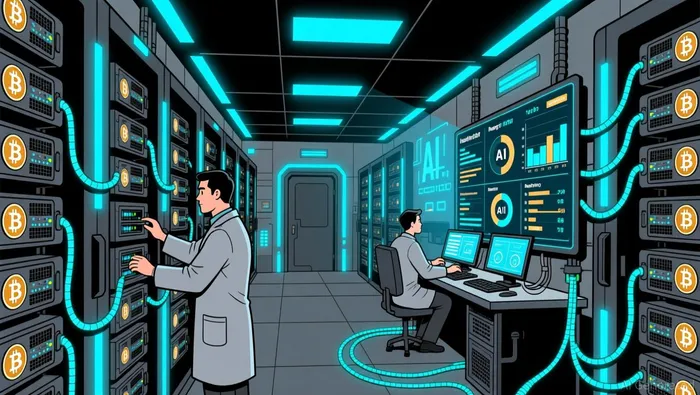
The company's ability to service debt hinges on maintaining these efficiency gains while scaling AI infrastructure. CleanSpark's hybrid data centers, designed to handle both Bitcoin mining and AI workloads, diversify revenue streams and mitigate risks tied to Bitcoin's price volatility. This dual-use model aligns with broader industry trends, as miners like TeraWulf and Galaxy Digital similarly pivot toward AI to offset declining mining margins.
Industry Comparisons: CleanSpark's Leverage vs. Sector Peers
The Bitcoin mining sector's 2024–2025 debt cycle has been marked by record financing activity. Public miners raised over $4.6 billion in Q4 2024 alone, with Q3 2025 figures surging to $6 billion. However, CleanSpark's approach diverges from peers who rely on collateralized hardware or Bitcoin-backed loans-strategies that collapsed during the 2021 hashprice downturn. Instead, CleanSpark's zero-coupon notes and AI-focused expansion reduce reliance on volatile collateral and position the company to capitalize on AI's growing demand for high-performance computing (HPC).
While competitors like TerraWulf face execution risks due to high-interest debt (e.g., $3.2 billion in senior secured notes with annual interest exceeding 2024 revenue), CleanSpark's 0% coupon structure offers a critical edge. This allows the company to allocate capital to growth without immediate cash burn, a necessity in a post-halving environment where only the most efficient operators survive.
Long-Term Competitiveness: Post-Halving Positioning
Bitcoin's halving event in 2024 reduced block rewards by 50%, intensifying pressure on miners to cut costs or diversify revenue. CleanSpark's $1.15B financing addresses this challenge through three vectors:
1. Power Expansion: Acquiring land in Texas and increasing contracted power by 28% ensures scalable operations.
2. AI Diversification: Hybrid data centers generate recurring revenue from AI clients, insulating the company from Bitcoin's price swings.
3. Debt Optimization: The zero-coupon structure defers interest costs until 2032, aligning with long-term cash flow from mining and AI.
JPMorgan analysts note that Bitcoin mining stocks have decoupled from crypto prices, driven by AI-driven valuations. CleanSpark's strategic pivot mirrors this trend, with its share price dropping 5% pre-market due to delta-hedging but rebounding as AI infrastructure gains traction.
Conclusion: A Calculated Bet on the Future
CleanSpark's $1.15B zero-coupon financing is a masterstroke in capital structure engineering. By leveraging low-cost debt, repurchasing undervalued shares, and investing in AI infrastructure, the company positions itself to dominate a post-halving landscape where operational efficiency and diversified revenue streams are paramount. While the $1.7B debt load is substantial, CleanSpark's 0.38 debt-to-equity ratio and industry-leading hashrate efficiency suggest the company is well-equipped to service obligations. As the sector shifts from pure-play mining to hybrid computing models, CleanSpark's strategic bet may prove to be the key to long-term competitiveness.







Comentarios
Aún no hay comentarios